

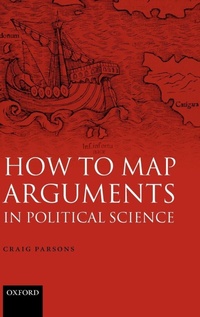
How to Map Arguments in Political Science
Published on 19. April 2007
Book
Hardback
208 pages
978-0-19-928667-6 (ISBN)
Description
To venture into explanation of political action we need some map of our basic options: what kinds of explanations are out there? Even advanced students and scholars can find the landscape difficult to chart. We confront a bewildering maze of partial typologies, contrasting uses of terms, and debate over what counts as explanation. This book makes an argument about the most useful first cut into explanations of action. It illustrates the map with reference to political examples and a wide range of political science literature, but the scheme applies even more broadly across the social sciences and history.
Common terms form the sectors of the map: structural, institutional, ideational, and psychological logics. This book's novelties lie in arguments about how to best define these terms. It narrows them into distinct mechanisms, arriving at basic segments of causal logic into which all explanations of action can be broken down. It also makes them compatible, however, such that we could imagine a world in which all operated while debating how much each caused any given action. Four benefits follow. The typology directs our attention to the most basic debates about what causes what. Its framework is systematic and exhaustive, bounding our explanatory universe. It defines our main approaches in ways that facilitate both competition and combination. Lastly, it leads to revisions of prevailing views on philosophy of science and research design to encourage more open and rigorous debates.
Graduate students will find no other overviews of comparable scope and precision. Scholars of all theoretical inclinations will encounter provocative challenges to their views of theorizing and use of terms.
Common terms form the sectors of the map: structural, institutional, ideational, and psychological logics. This book's novelties lie in arguments about how to best define these terms. It narrows them into distinct mechanisms, arriving at basic segments of causal logic into which all explanations of action can be broken down. It also makes them compatible, however, such that we could imagine a world in which all operated while debating how much each caused any given action. Four benefits follow. The typology directs our attention to the most basic debates about what causes what. Its framework is systematic and exhaustive, bounding our explanatory universe. It defines our main approaches in ways that facilitate both competition and combination. Lastly, it leads to revisions of prevailing views on philosophy of science and research design to encourage more open and rigorous debates.
Graduate students will find no other overviews of comparable scope and precision. Scholars of all theoretical inclinations will encounter provocative challenges to their views of theorizing and use of terms.
More details
Language
English
Place of publication
Oxford
United Kingdom
Target group
College/higher education
Dimensions
Height: 240 mm
Width: 161 mm
Thickness: 16 mm
Weight
482 gr
ISBN-13
978-0-19-928667-6 (9780199286676)
Copyright in bibliographic data and cover images is held by Nielsen Book Services Limited or by the publishers or by their respective licensors: all rights reserved.
Schweitzer Classification
Other editions
Additional editions
Craig Parsons
How to Map Arguments in Political Science
E-Book
04/2007
1st Edition
Oxford University Press
€79.99
Available for download
Craig Parsons
How to Map Arguments in Political Science
Book
04/2007
Oxford University Press
€105.10
Shipment within 15-20 days
Person
Craig Parsons is interested in the ideas and institutions that came together to construct today's Europe. His first book, "A Certain Idea of Europe" (Cornell University Press, 2003), focused on how certain political principles out-battled others in the construction of the European Union. He has also led three edited-book projects, respectively on EU politics (Oxford University Press, 2005), immigration in Europe (Cambridge University Press, 2006), and "constructivist" political economy (under review). His next major research project will move further back in history to trace ideas about democracy in Britain, France, and Germany in the 19th and early 20th centuries, under the title, "The Cultural Origins of Dictatorship and Democracy." .
Content
Introduction ; 1. Boundaries and Divisions in Explanation of Action ; 2. Structural Explanation ; 3. Institutional Explanation ; 4. Ideational Explanation ; 5. Psychological Explanation ; Conclusion