

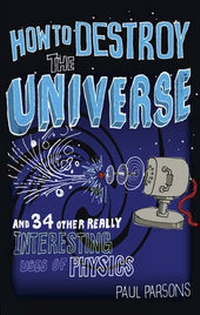
How to Destroy the Universe
And 34 Other Really Interesting Uses of Physics
Published on 29. March 2012
Book
Paperback/Softback
224 pages
978-0-85738-513-0 (ISBN)
Description
How do you generate a force field? Could you survive falling into a black hole? How do you turn lead into gold? If you thought physics was all about measuring the temperature of ice in a bucket or trying to fathom what E=mc2 means, think again. In a series of intriguing, entertaining and often extraordinary scenarios How to Destroy the Universe brings to life 35 key physics ideas in a way that anyone can understand. Read this book and you'll find out how to save the planet from energy shortages by mining the vacuum of empty space, engineer the Earth's climate to reverse the effects of global warming and fend off killer asteroids. You'll learn essential survival skills such as how to live through a lightning strike, how to tough it out during an earthquake and how to fall into a black hole without being turned into spaghetti. And you'll also discover how to turn lead into gold, how to travel to the centre of the Earth, how to crack supposedly unbreakable codes and how to use physics to predict the stock market.
So if you want to get to grips with the science behind relativity, antigravity and parallel universes, or if you are really more interested in learning how to teleport, travel through time or achieve immortality, this is the perfect introduction to the astonishing world of modern physics.
So if you want to get to grips with the science behind relativity, antigravity and parallel universes, or if you are really more interested in learning how to teleport, travel through time or achieve immortality, this is the perfect introduction to the astonishing world of modern physics.
More details
Language
English
Place of publication
London
United Kingdom
Product notice
Paperback (UK-B)
Illustrations
100 2-colour illustrations
Dimensions
Height: 198 mm
Width: 132 mm
ISBN-13
978-0-85738-513-0 (9780857385130)
Copyright in bibliographic data and cover images is held by Nielsen Book Services Limited or by the publishers or by their respective licensors: all rights reserved.
Schweitzer Classification
Person
Dr Paul Parsons is a regular contributor to Nature, New Scientist and the Daily Telegraph. He frequently appears on BBC radio and his television credits include Richard & Judy and BBC Breakfast. He was formerly editor of the BBC's award-winning science and technology magazine Focus. The Science of Doctor Who (Icon Books), was longlisted for the Royal Society Prize for Science Books.