

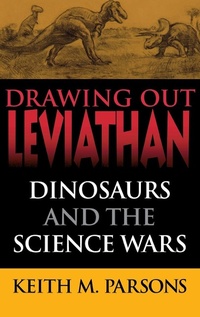
Drawing Out Leviathan
Dinosaurs and the Science Wars
Published on 1. October 2001
Book
Hardback
240 pages
978-0-253-33937-9 (ISBN)
Description
" . . . are dinosaurs social constructs? Do we really know anything about dinosaurs? Might not all of our beliefs about dinosaurs merely be figments of the paleontological imagination? A few years ago such questions would have seemed preposterous, even nonsensical. Now they must have a serious answer."
At stake in the "Science Wars" that have raged in academe and in the media is nothing less than the standing of science in our culture. One side argues that science is a "social construct," that it does not discover facts about the world, but rather constructs artifacts disguised as objective truths. This view threatens the authority of science and rejects science's claims to objectivity, rationality, and disinterested inquiry. Drawing Out Leviathan examines this argument in the light of some major debates about dinosaurs: the case of the wrong-headed dinosaur, the dinosaur "heresies" of the 1970s, and the debate over the extinction of dinosaurs.
Keith Parsons claims that these debates, though lively and sometimes rancorous, show that evidence and logic, not arbitrary "rules of the game," remained vitally important, even when the debates were at their nastiest. They show science to be a complex set of activities, pervaded by social influences, and not easily reducible to any stereotype. Parsons acknowledges that there are lessons to be learned by scientists from their would-be adversaries, and the book concludes with some recommendations for ending the Science Wars.
At stake in the "Science Wars" that have raged in academe and in the media is nothing less than the standing of science in our culture. One side argues that science is a "social construct," that it does not discover facts about the world, but rather constructs artifacts disguised as objective truths. This view threatens the authority of science and rejects science's claims to objectivity, rationality, and disinterested inquiry. Drawing Out Leviathan examines this argument in the light of some major debates about dinosaurs: the case of the wrong-headed dinosaur, the dinosaur "heresies" of the 1970s, and the debate over the extinction of dinosaurs.
Keith Parsons claims that these debates, though lively and sometimes rancorous, show that evidence and logic, not arbitrary "rules of the game," remained vitally important, even when the debates were at their nastiest. They show science to be a complex set of activities, pervaded by social influences, and not easily reducible to any stereotype. Parsons acknowledges that there are lessons to be learned by scientists from their would-be adversaries, and the book concludes with some recommendations for ending the Science Wars.
More details
Series
Language
English
Place of publication
Bloomington, IN
United States
Target group
Professional and scholarly
Product notice
Paper over boards
Illustrations
15 b&w photos
Dimensions
Height: 240 mm
Width: 161 mm
Thickness: 17 mm
Weight
525 gr
ISBN-13
978-0-253-33937-9 (9780253339379)
Copyright in bibliographic data and cover images is held by Nielsen Book Services Limited or by the publishers or by their respective licensors: all rights reserved.
Schweitzer Classification
Person
KEITH M. PARSONS is Assistant Professor of Philosophy at the University of Houston, Clear Lake and author of God and the Burden of Proof. He is editor of Philo, Journal of the Society of Humanist Philosophers.
Content
Preliminary Table of Contents:
Introduction: Why the Science Wars Matter
1. Mr. Carnegie's Sauropods
2. The Heresies of Dr. Bakker
3. The "Conversion" of David Raup
4. Are Dinosaurs Social Constructs?
5. Le Dinosaure Postmoderne
6. History, Wiggery, and Progress
7. Beyond the Science Wars: A Concluding Meditation
References
Introduction: Why the Science Wars Matter
1. Mr. Carnegie's Sauropods
2. The Heresies of Dr. Bakker
3. The "Conversion" of David Raup
4. Are Dinosaurs Social Constructs?
5. Le Dinosaure Postmoderne
6. History, Wiggery, and Progress
7. Beyond the Science Wars: A Concluding Meditation
References