

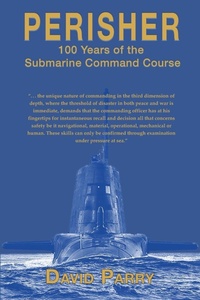
Perisher
100 Years of the Submarine Command Course
Published on 1. October 2022
Book
Paperback/Softback
380 pages
978-1-78963-320-7 (ISBN)
Description
The Royal Navy's Submarine Command Course, or 'Perisher', is a unique course, training, assessing and qualifying officers for submarine command which is, itself, unique, challenging and demanding; the epitome of mission command, with no succour, referral or support in a continuously threatening environment. It is therefore essential that those 'in command' are proven to be worthy and capable of their appointment.
The evolution of 'Perisher' is in recognisable periods: the earliest days, following the submarine's introduction into the Royal Navy, was an autodidactic existence with COs learning from their peers and by experimentation. By 1917 circumstances had conflated to create the Periscope School and the Periscope Course to train and qualify COs whose characteristics were now fully formed. The interwar period was a difficult time, but it produced new submarines and technological innovations just in time for the Second World War and the most intense evolutionary period for 'Perisher'. Post-1945 to 1969 experienced two evolutions: Commander Sandy Woodward's codification of the art of attacking and a shift in emphasis from purely 'periscope eye' attacking toward the development of safety and tactical prowess in students. In the 1970s-1980s, two parallel courses satisfied the demand for COs from an expanding diesel-nuclear submarine fleet using SSKs and then in 1989, an SSN. The final period, 1990-2017 continues today with an all-nuclear Perisher and a curriculum to meet a changing battlespace, new weapons and tactics. Throughout its history, 'Perisher' has shaped the submarine commanding officer and he, in return, has shaped 'Perisher'.
The evolution of 'Perisher' is in recognisable periods: the earliest days, following the submarine's introduction into the Royal Navy, was an autodidactic existence with COs learning from their peers and by experimentation. By 1917 circumstances had conflated to create the Periscope School and the Periscope Course to train and qualify COs whose characteristics were now fully formed. The interwar period was a difficult time, but it produced new submarines and technological innovations just in time for the Second World War and the most intense evolutionary period for 'Perisher'. Post-1945 to 1969 experienced two evolutions: Commander Sandy Woodward's codification of the art of attacking and a shift in emphasis from purely 'periscope eye' attacking toward the development of safety and tactical prowess in students. In the 1970s-1980s, two parallel courses satisfied the demand for COs from an expanding diesel-nuclear submarine fleet using SSKs and then in 1989, an SSN. The final period, 1990-2017 continues today with an all-nuclear Perisher and a curriculum to meet a changing battlespace, new weapons and tactics. Throughout its history, 'Perisher' has shaped the submarine commanding officer and he, in return, has shaped 'Perisher'.
More details
Language
English
Place of publication
Gloucester
United Kingdom
Illustrations
15 black and white images; 27 graphs and tables
Dimensions
Height: 234 mm
Width: 156 mm
Thickness: 21 mm
Weight
576 gr
ISBN-13
978-1-78963-320-7 (9781789633207)
Copyright in bibliographic data and cover images is held by Nielsen Book Services Limited or by the publishers or by their respective licensors: all rights reserved.
Schweitzer Classification
Person
Dr David Parry hails from a Liverpool Merchant Navy family and was schooled at the pre-sea training school, HMS Conway, but instead of the Merchant Navy he chose the Royal Navy. In the Navy he specialised in navigation and submarines, taking his 'Perisher' in 1978 from whence he went to submarine command before leaving the Navy prematurely. In retirement he took his hobby of maritime history a step further with a Master's degree at the University of Greenwich having his dissertation about the escape of merchant ships from the Baltic in WW1 published by the Swedish National Maritime Museum. He then went on to study for a PhD at King's College London.
Content
Figures and Illustrations; Foreword; Acknowledgements; Abbreviations; Preface; Introduction; Culture and Command; Beginnings to 1918; The Interwar Period 1919-1939; The Second World War; Obsolescence to Nuclear; A New Emphasis: 1970s and 1980s; Nuclearisation and the Modern Perisher: 1990-2017; Perisher Concluded; Appendix One; Appendix Two; Appendix Three; Bibliography; Notes;