

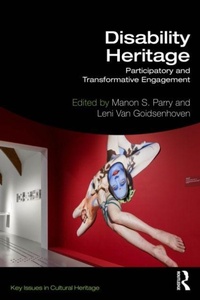
Disability Heritage
Participatory and Transformative Engagement
1st Edition
Will be published approx. on 7. September 2026
Book
Paperback/Softback
384 pages
978-1-041-11311-9 (ISBN)
Description
This volume engages with disability heritage as a participatory, political, relational, and unfinished practice, linking the preservation of the past to lived experience in the present as well as imagined futures. Contributors examine how disability reshapes what counts as heritage, who it is for, and how it is made, and demonstrate ways to transform institutional as well as community-based approaches.
Contributors from Ireland, Germany, Australia, the UK, Sweden, Japan, Poland, Romania, Belgium, Italy, and The Netherlands apply concepts from critical disability studies and disability history to explore participatory, activist, and decolonial practices that challenge ableist structures. Written in an accessible way and drawing on case studies from performance, museums, (digital) archives, landscapes, and architecture, chapters demonstrate how disability is embedded in histories yet rarely acknowledged as a constituting force within them. Positioning disability as integral to heritage-making, the authors show how disability actively shapes archival research, heritage practices, and what can be remembered. Topics include integrating disability perspectives in heritage education, redesigning recruitment and career trajectories, the challenges and benefits of working both within and outside of established institutions, strategies for reinterpreting objects including embodied and sensory methods, and collecting intangible heritage.
The book is aimed at scholars and students in heritage, museum, archival, disability, cultural and historical studies, as well as practitioners, policymakers, and activists. It offers conceptual tools and grounded examples for engaging disability heritage not as a bounded and stable field or object, but as a relational practice that demands attentiveness to friction and difference.
Contributors from Ireland, Germany, Australia, the UK, Sweden, Japan, Poland, Romania, Belgium, Italy, and The Netherlands apply concepts from critical disability studies and disability history to explore participatory, activist, and decolonial practices that challenge ableist structures. Written in an accessible way and drawing on case studies from performance, museums, (digital) archives, landscapes, and architecture, chapters demonstrate how disability is embedded in histories yet rarely acknowledged as a constituting force within them. Positioning disability as integral to heritage-making, the authors show how disability actively shapes archival research, heritage practices, and what can be remembered. Topics include integrating disability perspectives in heritage education, redesigning recruitment and career trajectories, the challenges and benefits of working both within and outside of established institutions, strategies for reinterpreting objects including embodied and sensory methods, and collecting intangible heritage.
The book is aimed at scholars and students in heritage, museum, archival, disability, cultural and historical studies, as well as practitioners, policymakers, and activists. It offers conceptual tools and grounded examples for engaging disability heritage not as a bounded and stable field or object, but as a relational practice that demands attentiveness to friction and difference.
More details
Series
Language
English
Place of publication
London
United Kingdom
Publishing group
Taylor & Francis Ltd
Target group
College/higher education
Professional and scholarly
Academic, Postgraduate, Undergraduate Advanced, and Undergraduate Core
Illustrations
22 s/w Abbildungen, 22 s/w Photographien bzw. Rasterbilder
22 Halftones, black and white; 22 Illustrations, black and white
Dimensions
Height: 234 mm
Width: 156 mm
ISBN-13
978-1-041-11311-9 (9781041113119)
Copyright in bibliographic data and cover images is held by Nielsen Book Services Limited or by the publishers or by their respective licensors: all rights reserved.
Schweitzer Classification
Other editions
Additional editions
Manon S. Parry | Leni Van Goidsenhoven
Disability Heritage
Participatory and Transformative Engagement
Book
approx. 09/2026
1st Edition
Routledge
€191.50
Not yet published

Manon S. Parry | Leni Van Goidsenhoven
Disability Heritage
Participatory and Transformative Engagement
E-Book
approx. 09/2026
Routledge
€55.49
Not yet available
Manon S. Parry | Leni Van Goidsenhoven
Disability Heritage
Participatory and Transformative Engagement
E-Book
approx. 09/2026
Routledge
€55.49
Not yet available
Persons
Manon S. Parry is Professor of Medical and Nursing History at VU Amsterdam and Associate Professor of American Studies and Public History at the University of Amsterdam. Her research focuses on the uses of history and heritage for health and wellbeing.
Leni Van Goidsenhoven is Assistant Professor of Critical Disability Studies at the Department of Literary and Cultural Analysis (ASCA) at the University of Amsterdam. Her research focuses on disability, illness, neurodiversity, and non-normative bodyminds in the arts and literature
Leni Van Goidsenhoven is Assistant Professor of Critical Disability Studies at the Department of Literary and Cultural Analysis (ASCA) at the University of Amsterdam. Her research focuses on disability, illness, neurodiversity, and non-normative bodyminds in the arts and literature
Content
Acknowledgements; List of Contributors; 1. INTRODUCTION; 2. ACCESS, INCLUSION AND BEYOND -- 2.1 Disability Art and Cultural Heritage: Ethical and Political Issues in an Italian Cultural Inclusion Project; 2.2. Eugenic Legacies and the Equity of Employment: Curating a "Fair" Deal for D/deaf, Disabled and Neurodivergent Museum Professionals; 2.3. Between Teaching and Society: Sharing Inclusive, Multisensorial Strategies from Users to Architects; 2.4 Decolonial Approaches to Disability History and Heritage: Asserting the Disabled Gaze; 3. ARCHIVES AND COLLECTIONS -- 3.1. Accessing and Narrating d/Deaf Heritage in Eastern Europe; 3.2. The Heritage of Medical and Welfare Disabilities in Japan: Social Significance and Challenges; 3.3. "Peg Legs", Black servants, and other "strange varieties of mankind": Intersections of disability and race in the Hans Wuertz Collection; 3.4. Embracing Filth: Bedpans and the Body at the Winterthur Museum; 4. CREATING CONTEMPORARY HERITAGE -- 4.1. Access Performance as Disability Heritage: Lettering Club Culture in Amsterdam; 4.2. Deaf Culture and Heritage in Performance: Locating Deaf Theatre in Ireland's Cultural Landscape; 4.3. The Luxury of Memory: Navigating Absences and Gaps in Creating Australia's First Disability Arts Archive; 5. DIFFICULT HISTORIES -- 5.1. Unveiling the Unseen: Disability Heritage in Religious Archives; 5.2. Changing Views on Medical Film and Photography: The Van Gehuchten Collection in Twentieth-Century Belgium; 5.3. Sites of Conscience, Disability and Heritage: Looking Back to Transform the Future; 5.4. Reading Psychiatric Hospital Cemeteries Madly; 6. HERITAGE ACTIVISM -- 6.1. Heritage as Disability Activism: Embodied Engagement, Crip Hacking, and the Disabled Expert; 6.2. Deaf History, Community and Heritage: A Participatory Research Perspective; 6.3. History as a Weapon: Disability Archives and the Fight for our Future; Index.