

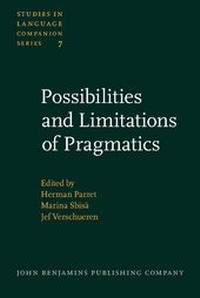
Possibilities and Limitations of Pragmatics
Proceedings of the Conference on Pragmatics, Urbino, July 8-14, 1979
Published on 1. January 1981
Book
Hardback
854 pages
978-90-272-3006-5 (ISBN)
Description
This impressive volume attempts to make an assessment of past achievements, but also to open up new perspectives in the field of pragmatics, exactly ten years after the publication of Searle's seminal Speech Acts. This rich collection presents an unrivaled diversity of topics and approaches united by the possibilities and limitations generic to the field of pragmatics.
More details
Series
Language
English
Place of publication
Amsterdam
Netherlands
Target group
College/higher education
Professional and scholarly
Dimensions
Height: 225 mm
Width: 154 mm
Weight
1220 gr
ISBN-13
978-90-272-3006-5 (9789027230065)
Copyright in bibliographic data and cover images is held by Nielsen Book Services Limited or by the publishers or by their respective licensors: all rights reserved.
Schweitzer Classification
Other editions
Additional editions
Herman Parret | Marina Sbisà | Jef Verschueren
Possibilities and Limitations of Pragmatics
Proceedings of the Conference on Pragmatics, Urbino, July 8-14, 1979
E-Book
01/1981
1st Edition
John Benjamins Publishing Company
€265.99
Available for download
Persons
Content
1. Acknowledgements; 2. List of Contributors; 3. Introduction; 4. Context change and its consequences for a theory of natural language (by Ballmer, Thomas T.); 5. Semantic constraints on relevance (by Brockway, Diane); 6. The problem of appropriateness in pragmatic development (by Camaioni, Luigia); 7. Language acquisition, psychological dualism and the definition of pragmatics (by Campbell, Robin N.); 8. Pragmatic issues in the construction of recent history from interview narratives (by Cicourel, Aaron V.); 9. Pragmatics and pragmatism (by Cooper, David E.); 10. Idiomaticity as a problem of pragmatics (by Coulmas, Florian); 11. Contextualism (by Dascal, Marcelo); 12. Causatives (by Davis, Steven); 13. How to make and understand a request (by Ervin-Tripp, Susan M.); 14. I'll bet you $10 that betting is not a speech act (by Fotion, Nicholas); 15. Seven sins of pragmatics: Theses about speech act theory, conversational analysis, linguistics and rhetoric (by Franck, Dorothea); 16. Attributing mental states: A second look at mother-child interaction (by Gelder, Beatrice de); 17. How to combine speech act theory with formal semantics: A new account of Searle's concept of proposition (by Gochet, Paul); 18. Answering as decision making: A new way of doing pragmatics (by Grewendorf, Gunther); 19. Political determinants of pragmatic and sociolinguistic choices (by Haberland, Hartmut); 20. Pragmatic considerations within a text-theoretical framework (by Heydrich, W.); 21. Pragmatical grammar and the pragmatics of grammar (by Hindelang, Gotz); 22. On insisting (by Hundsnurscher, Franz); 23. Non-truth-conditional quantification (by Kock, Christian); 24. Pragmatically based grammar (by Kummer, Werner); 25. On the delimitation of semantics and the characterization of meaning: Some remarks (by Latraverse, Francois); 26. Pragmatics and conversational rhetoric (by Leech, Geoffrey N.); 27. Pragmatics, language games, questions and answers (by Leonardi, Paolo); 28. The essential inadequacies of speech act models of dialogue (by Levinson, Stephen C.); 29. Grammar, logic and rhetoric in a pragmatic perspective (by Morpurgo-Tagliabue, Guido); 30. Common problems in the theory of anaphora and the theory of discourse (by Oehrle, Richard T.); 31. Classroom verbal interaction: A conversational analysis (by Orletti, Franca); 32. A goal analysis of some pragmatic aspects of language (by Parisi, Domenico); 33. Answers, replies and reactions (by Poggi, Isabella); 34. On Kripke on Donnellan (by Recanati, Francois); 35. Phenomenological analysis of language and its application to time and tense (by Schnelle, Helmut); 36. Coherence as a pragmatic concept (by Sorensen, Viggo); 37. Pragmatics and causal theoretic aspects of semantics (by Stampe, Dennis); 38. How to be a referent (by Travis, Charles); 39. On the art of deception: How to lie while saying the truth (by Vincent Marrelli, Jocelyne); 40. On the formal treatment of illocutionary force indicators (by Zaefferer, Dietmar); 41. References; 42. Index