

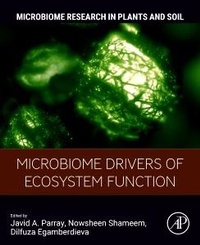
Microbiome Drivers of Ecosystem Function
Published on 18. October 2023
Book
Paperback/Softback
450 pages
978-0-443-19121-3 (ISBN)
Description
Microbiome Drivers of Ecosystem Function, the latest release in the Microbiome Research in Plants and Soil series, focuses on advancements in microbial technologies towards harnessing the microbiome for improved crop productivity and health. The book provides insights into the diversity of endophytic microbiomes and their potential utility in agricultural production. As increased crop yield through chemical interventions have limit thresholds and alternative, natural, and/or integrated approaches are increasingly needed, this book serves as an ideal reference for researchers and students in the fields of agricultural biotechnology, biochemistry, environmental science, plant biology, agricultural sciences, and agricultural engineering.
Microbial inoculants provide ways in which food production efficiency can be improved. Plant growth-promoting soil organisms increase net crop uptake of soil nutrients, resulting in larger crops and higher yields of harvested food. These and other symbiotic associations between plants and microbes can ultimately be exploited for the increased food production necessary to feed the world, in addition to creating safer farming techniques that minimize ecological disruption.
Microbial inoculants provide ways in which food production efficiency can be improved. Plant growth-promoting soil organisms increase net crop uptake of soil nutrients, resulting in larger crops and higher yields of harvested food. These and other symbiotic associations between plants and microbes can ultimately be exploited for the increased food production necessary to feed the world, in addition to creating safer farming techniques that minimize ecological disruption.
More details
Series
Language
English
Place of publication
San Diego
United States
Publishing group
Elsevier Science Publishing Co Inc
Target group
Professional and scholarly
Product notice
Paperback (trade)
Unsewn / adhesive bound
Dimensions
Height: 235 mm
Width: 191 mm
Weight
1000 gr
ISBN-13
978-0-443-19121-3 (9780443191213)
Copyright in bibliographic data and cover images is held by Nielsen Book Services Limited or by the publishers or by their respective licensors: all rights reserved.
Schweitzer Classification
Other editions
Additional editions
Javid A. Parray | Nowsheen Shameem | Dilfuza Egamberdieva
Microbiome Drivers of Ecosystem Function
E-Book
10/2023
Academic Press
€175.00
Available for download
Persons
Javid A. Parray holds a master's degree in Environmental Science and completed his MPhil and PhD from the University of Kashmir, and qualified for the prestigious JKSLET exam. He also conducted post-doctoral research at Kashmir University and received a Fast Track Young Scientist Project by the Science and Engineering Research Board of the Government of India. He currently teaches at the Department of Environmental Science, GDC Eidgah Srinagar, affiliated with Cluster University Srinagar. His research interests include ecological and agricultural microbiology, climate change, microbial biotechnology, and environmental microbiomes. He is a prolific author and editor of numerous papers and books and serves on the editorial boards of several high-impact journals. A member of various scientific organizations, he received the "Emerging Scientist of the Year? Gold Medal in 2018. Currently, he is the national coordinator for a Swayam Moocs program on Environmental Science. Recently, he was appointed series editor for Microbiome Research in Plants and Soil by Elsevier and serves as the Executive Editor in Chief for the open-access journal Micro Environer.
Assistant professor in Department of Environmental Science Cluster University Srinagar, Jammu and Kashmir, India, Dr. Shameem's experience includes Project associate in DBT Sanctioned project entitled "spawn production for the entrepreneurs of Kashmir Valley? at CORD, University of Kashmir. Dilfuza Egamberdieva is a research associate at the Centre of Agricultural Landscape Research, Germany and head of Joint Uzbek-China Key Lab of Ecobiomes of Arid Lands, National University of Uzbekistan. Her research interests include microbial ecology and diversity, plant-microbe interaction, plant nutrition and stress tolerance, and plant biological disease control. She has been awarded the SCOPUS-2019 Award "Top Scientist of the Year?, TWAS (The World Academy of Science) Award in Agricultural Sciences (2013), and TWAS-TWOWS-SCOPUS Young Women Research Award (2009), as well as several Fellowships such as President's International Fellowship for Visiting Professors (PIFI), The Chinese Academy of Sciences (CAS), and the Georg Forster Research Fellowships, Alexander von Humboldt Foundation. She is a member of several journals' editorial board, authored seven books published by Elsevier and Springer, and co-authored over 200 publications in per reviewed journals.
Assistant professor in Department of Environmental Science Cluster University Srinagar, Jammu and Kashmir, India, Dr. Shameem's experience includes Project associate in DBT Sanctioned project entitled "spawn production for the entrepreneurs of Kashmir Valley? at CORD, University of Kashmir. Dilfuza Egamberdieva is a research associate at the Centre of Agricultural Landscape Research, Germany and head of Joint Uzbek-China Key Lab of Ecobiomes of Arid Lands, National University of Uzbekistan. Her research interests include microbial ecology and diversity, plant-microbe interaction, plant nutrition and stress tolerance, and plant biological disease control. She has been awarded the SCOPUS-2019 Award "Top Scientist of the Year?, TWAS (The World Academy of Science) Award in Agricultural Sciences (2013), and TWAS-TWOWS-SCOPUS Young Women Research Award (2009), as well as several Fellowships such as President's International Fellowship for Visiting Professors (PIFI), The Chinese Academy of Sciences (CAS), and the Georg Forster Research Fellowships, Alexander von Humboldt Foundation. She is a member of several journals' editorial board, authored seven books published by Elsevier and Springer, and co-authored over 200 publications in per reviewed journals.
Editor
Assistant Professor, Department of Environmental Science, Government Degree College Eidgah Srinagar, Srinagar, Jammu and Kashmir, India
Assistant Professor, Department of Environmental Science, Cluster University Srinagar - Jammu and Kashmir, India
Associate Professor, Faculty of Biology, National University of Uzbekistan, Tashkent, Uzbekistan
Content
1. Biochar-soil-plant-microbe interactions
2. Halophyte associated endophytic microbes: potential use in crop production
3. Overview of functional metagenomic profiling of root associated bacteria bacteria under salt stress.
4. Microbial Consortium with multifunctional plant growth-promoting attributes: Future Perspective in Agriculture
5. Plant root Endophytes: transformers of plant disease
6. Use of microbial consortia of PGP bacteria for preventing nematode diseases in plants
7. The efficiency of heavy metals-tolerant Bacillus sp. for alleviating heavy metals toxicity on sorghum
8. Biofertilizers and their role in plant growth and minimizing environmental impacts
9. Bioengineering of rhizobiome towards sustainable agricultural production
10. Advancements in understanding plant microbe and microbe interaction
11. Role of microbes to enhance underground functioning in high altitude mountain areas
12. Technological advancements and study of Engineered Microbiome in sustainable crop production
13. Microbial consortium: utility and delimitation
14. Technological intervention in the rhizosphere of tomato plants: a case study
15. Phytomicrobiome in modulating plant - growth and stress resilience: An insight into functions and emerging perspectives in agriculture
2. Halophyte associated endophytic microbes: potential use in crop production
3. Overview of functional metagenomic profiling of root associated bacteria bacteria under salt stress.
4. Microbial Consortium with multifunctional plant growth-promoting attributes: Future Perspective in Agriculture
5. Plant root Endophytes: transformers of plant disease
6. Use of microbial consortia of PGP bacteria for preventing nematode diseases in plants
7. The efficiency of heavy metals-tolerant Bacillus sp. for alleviating heavy metals toxicity on sorghum
8. Biofertilizers and their role in plant growth and minimizing environmental impacts
9. Bioengineering of rhizobiome towards sustainable agricultural production
10. Advancements in understanding plant microbe and microbe interaction
11. Role of microbes to enhance underground functioning in high altitude mountain areas
12. Technological advancements and study of Engineered Microbiome in sustainable crop production
13. Microbial consortium: utility and delimitation
14. Technological intervention in the rhizosphere of tomato plants: a case study
15. Phytomicrobiome in modulating plant - growth and stress resilience: An insight into functions and emerging perspectives in agriculture