

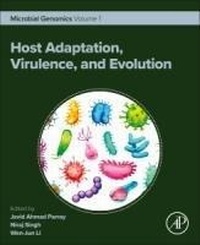
Host Adaptation, Virulence, and Evolution
Microbial Genomics Volume 1
Published on 22. May 2025
Book
Paperback/Softback
532 pages
978-0-443-31554-1 (ISBN)
Description
Microbial Genomics: Host Adaptation, Virulence, and Evolution covers different aspects of microbial genomics, metagenomics, and functional studies of microbes that have provided a significant understanding of microbial-host interactions, virulence function, host adaptation mechanisms, including microbial evolution. Microbial Genomics: Host Adaptation, virulence, and Evolution is a comprehensive source on the latest updates and applications of microbial genomics information to understand the plant, microbe interaction, host adaptation, virulence nature of the infectious pathogen, microbial evolution, host-pathogen interactions contribute to shaping the genetic diversity of both organisms. Sections include an introduction to Microbial Genomics, followed by sections on Plant Microbiome, Genome Editing Prospecting and Approaches, Microbial virulanse and disease incidence. The final section of the book covers Microbial Genomics and evolutionary concepts. "Microbial Genomics: Host Adaptation, virulence, and Evolution" is a valuable resource for faculty members, researchers, and undergraduate and postgraduate students at universities, medical research labs, industries, and government agencies that are interested in the microbial science specific to the microbial genome, virulence function of pathogenic microbes, host adaptation, evolution of microbes, and all other disciplines related to molecular microbiology.
More details
Language
English
Place of publication
San Diego
United States
Publishing group
Elsevier Science Publishing Co Inc
Target group
Professional and scholarly
Product notice
Paperback (trade)
Unsewn / adhesive bound
Dimensions
Height: 233 mm
Width: 195 mm
Thickness: 25 mm
Weight
1061 gr
ISBN-13
978-0-443-31554-1 (9780443315541)
Copyright in bibliographic data and cover images is held by Nielsen Book Services Limited or by the publishers or by their respective licensors: all rights reserved.
Schweitzer Classification
Other editions
Additional editions
Javid Ahmad Parray | Niraj Singh | Wen-Jun Li
Host Adaptation, Virulence, and Evolution
Microbial Genomics Volume 1
E-Book
02/2025
Elsevier
€162.99
Available for download
Persons
Javid A Parray is currently teaching at the Department of Environmental Science, GDC Eidgah, affiliated to Cluster University, Srinagar. His research interests include ecological and agricultural microbiology, climate change, microbial biotechnology, and environmental microbiomes. He has also done his Post Doctorate Research from the University of Kashmir. Dr Parray was also awarded a Fast Track Young Scientist Project by SERB - DST, GoI New Delhi. Dr Javid was also awarded as "Emerging scientist year Gold Medal? for the year 2018 by Indian Academy of Environmental Science. Dr Parray is the course coordinator for the UG- Programmes for CeC-MOOCS Swayam in Environmental Science. Dr Parray is an expert review member in the field of environmental science in the CSTT, Ministry of Education, GoI New Delhi.
Niraj Singh holds a master's degree in Molecular Biology and Technology and a PhD in Molecular Microbiology from Tezpur University, Assam. He has qualified for numerous national and state-level exams in Life Sciences and Biotechnology, enabling him to pursue research at central universities and institutes. After his PhD, he began teaching at North-Eastern Hill University, Shillong, and currently serves as an Assistant Professor and Coordinator at the Department of Microbiology, Assam Royal Global University, Guwahati. His research focuses on virulence gene functions, crop disease control, and Ralstonia solanacearum bacterial wilt, for which he was awarded a Hayward-Prior travel grant in 2020. He has previously disseminated his research in journals articles, book chapters, and a volume published by Springer. He has also received a Young Scientist Award, a Young Plant Pathologist Award, and a Certificate of Appreciation at the Gujrat Vigyan Sammelan in 2022.
Wen-Jun Li received his PhD in microbiology from Shenyang Institute of Applied Ecology, Chinese Academy of Sciences. He is currently working as Distinguished Professor in School of Life Sciences, Sun Yat-Sen University, Guangzhou, China. His research mainly focuses on microbial diversity under those unusual environments, by using culture-dependent and culture-independent methods, as well as mechanisms of extremophilic microbes to adapt those unusual environments. He was awarded the WFCC (The World Federation for Culture Collections) Skerman award for microbial taxonomy in 2007, and other six provincial and ministry level awards for his outstanding research contributions on the field of microbial systematics and microbial ecology. He has successfully trained more than 150 graduate students and postdoc level students in the field of microbial taxonomy and microbial ecology at home and abroad countries.
Niraj Singh holds a master's degree in Molecular Biology and Technology and a PhD in Molecular Microbiology from Tezpur University, Assam. He has qualified for numerous national and state-level exams in Life Sciences and Biotechnology, enabling him to pursue research at central universities and institutes. After his PhD, he began teaching at North-Eastern Hill University, Shillong, and currently serves as an Assistant Professor and Coordinator at the Department of Microbiology, Assam Royal Global University, Guwahati. His research focuses on virulence gene functions, crop disease control, and Ralstonia solanacearum bacterial wilt, for which he was awarded a Hayward-Prior travel grant in 2020. He has previously disseminated his research in journals articles, book chapters, and a volume published by Springer. He has also received a Young Scientist Award, a Young Plant Pathologist Award, and a Certificate of Appreciation at the Gujrat Vigyan Sammelan in 2022.
Wen-Jun Li received his PhD in microbiology from Shenyang Institute of Applied Ecology, Chinese Academy of Sciences. He is currently working as Distinguished Professor in School of Life Sciences, Sun Yat-Sen University, Guangzhou, China. His research mainly focuses on microbial diversity under those unusual environments, by using culture-dependent and culture-independent methods, as well as mechanisms of extremophilic microbes to adapt those unusual environments. He was awarded the WFCC (The World Federation for Culture Collections) Skerman award for microbial taxonomy in 2007, and other six provincial and ministry level awards for his outstanding research contributions on the field of microbial systematics and microbial ecology. He has successfully trained more than 150 graduate students and postdoc level students in the field of microbial taxonomy and microbial ecology at home and abroad countries.
Editor
Assistant Professor and Head of the Department of Environmental Science, Govt. SAM Degree College - Budgam, India
Assistant Professor and Coordinator, Department of Microbiology, The Assam Royal Global University, Guwahati, Assam, India
School of Life Sciences, Sun Yat-Sen University, Guangzhou, China
Content
Section I: Microbial Genomics - Introduction
1-Microbial Genomics and genome sequencing approaches
2-Genomic determinants for host adaptation or host specificity
3- Insight into plant Microbe interaction through a genomics approach
Section II: Plant Microbiome
4-The Genetic Architecture of Adaptation to the Root Microbiota in Plants
5-Genome Sequences and Genetic Features of Beneficial Bacterial Community for Successful Colonization in Plants
6- Omics Approaches to Understanding Plant Microbiome Gene Function
Section III: Genome Editing Prospecting and Approaches
7-Progress and prospect in microbial genome editing
8-Microbial Base Editing: A Powerful Emerging Technology for Microbial Genome Engineering
Section IV: Microbial virulanse and disease incidence
9- Genetic Origins of Microbial Virulence
10- Microbial Genomics and infectious disease forecasting
11- Genomics in infectious disease
12- The future of genome studies of complex human and plant disease
13- Identification of virulence factor and antibiotic resistance marker through genomics approach 14- Virulence factor and microbial drug resistance
Section V: Microbial Genomics and evolutionary concepts
15-Evolution of Microbial Genomics: Conceptual Shifts over a Century
1-Microbial Genomics and genome sequencing approaches
2-Genomic determinants for host adaptation or host specificity
3- Insight into plant Microbe interaction through a genomics approach
Section II: Plant Microbiome
4-The Genetic Architecture of Adaptation to the Root Microbiota in Plants
5-Genome Sequences and Genetic Features of Beneficial Bacterial Community for Successful Colonization in Plants
6- Omics Approaches to Understanding Plant Microbiome Gene Function
Section III: Genome Editing Prospecting and Approaches
7-Progress and prospect in microbial genome editing
8-Microbial Base Editing: A Powerful Emerging Technology for Microbial Genome Engineering
Section IV: Microbial virulanse and disease incidence
9- Genetic Origins of Microbial Virulence
10- Microbial Genomics and infectious disease forecasting
11- Genomics in infectious disease
12- The future of genome studies of complex human and plant disease
13- Identification of virulence factor and antibiotic resistance marker through genomics approach 14- Virulence factor and microbial drug resistance
Section V: Microbial Genomics and evolutionary concepts
15-Evolution of Microbial Genomics: Conceptual Shifts over a Century