

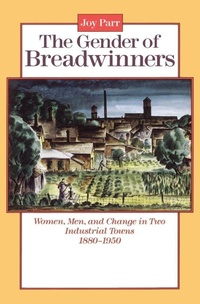
The Gender of Breadwinners
Women, Men and Change in Two Industrial Towns, 1880-1950
Will be published approx. on 18. December 1998
Book
Paperback/Softback
314 pages
978-0-8020-6760-9 (ISBN)
Description
This is a story of two Ontario towns, Hanover and Paris, that grew in many parallel ways. They were about the same size, and both were primarily one-industry towns. But Hanover was a furniture-manufacturing centre; most of its workers were men, drawn from a community of ethnic German artisans and agriculturalists. In Paris the biggest employer was the textile industry; most of its wage earners were women, assisted in emigration from England by their Canadian employer.
Joy Parr considers the impacy of these fundamental differences from a feminist perspective in her study of the towns' industrial, domestic, and community life. She combines interviews of women and men of the towns with analyses of a wide range of documents: records of the firms from which their families worked, newspapers, tax records, paintings, photographs, and government documents.
Two surprising and contrasting narratives emerge. The effects of gender identities upon both women's and men's workplace experience and of economic roles upon familial relationships are starkly apparent.
Extending through seventy crucial years, these closely textured case studies challenge conventional views about the distinctiveness of gender and class roles. They reconfigure the social and economic change accompanying the rise of industry. They insistently transcend the reflexive dichtomies drawn between womena dn men, public and privae, wage and non-wage work. They investigate industrial structure, technological change, domesticity, militance, and perceptions of personal power and worth, simultaneously as products of gender and class identities, recast through community sensibilities.
Joy Parr considers the impacy of these fundamental differences from a feminist perspective in her study of the towns' industrial, domestic, and community life. She combines interviews of women and men of the towns with analyses of a wide range of documents: records of the firms from which their families worked, newspapers, tax records, paintings, photographs, and government documents.
Two surprising and contrasting narratives emerge. The effects of gender identities upon both women's and men's workplace experience and of economic roles upon familial relationships are starkly apparent.
Extending through seventy crucial years, these closely textured case studies challenge conventional views about the distinctiveness of gender and class roles. They reconfigure the social and economic change accompanying the rise of industry. They insistently transcend the reflexive dichtomies drawn between womena dn men, public and privae, wage and non-wage work. They investigate industrial structure, technological change, domesticity, militance, and perceptions of personal power and worth, simultaneously as products of gender and class identities, recast through community sensibilities.
Reviews / Votes
'The most exhilarating, challenging book to appear in modern Canadian social history in many years. Part women's history, part labour history, part technological history, part economic history, it integrates and surpasses these discrete subfields. Its theoretical underpinnings are particularly innovative.'(Craig Heron, Canadian Historical Review) 'Well worth a careful reading for anyone interested in gender and work issues.'
- Nancy E. Bertaux (Journal of Economic History) 'Clearly a benchmark in Canadian historical scholarship.'
- Margaret Conrad (American Review of Canadian Studies) 'A work of truly remarkable sensitivity, depth and complexity.'
- Deborah Gorham (Canadian Forum)
More details
Language
English
Place of publication
Toronto
Canada
Target group
College/higher education
Professional and scholarly
Product notice
Paperback (trade)
Dimensions
Height: 226 mm
Width: 150 mm
Thickness: 25 mm
Weight
517 gr
ISBN-13
978-0-8020-6760-9 (9780802067609)
Copyright in bibliographic data and cover images is held by Nielsen Book Services Limited or by the publishers or by their respective licensors: all rights reserved.
Schweitzer Classification
Person
Joy Parr is Canada Research Chair in Technology, Environment and the Everyday, in the department of Geography at the University of Western Ontario..