

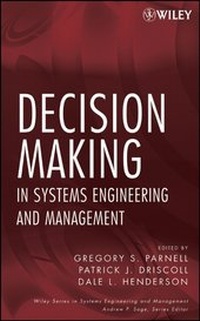
Decision Making in Systems Engineering and Management
1st Edition
Published on 11. March 2008
Book
Hardback
480 pages
978-0-470-16570-6 (ISBN)
Description
A multidisciplinary framework for systems decision making using the principles and practices of systems engineering and decision analysis
Decision Making in Systems Engineering and Management is a comprehensive textbook that provides a logical process for fact-based decision making for the most challenging systems problems. Grounded in systems thinking and based on sound systems engineering principles, the systems decision process (SDP) leverages both multiple-objective decision analysis and value-focused thinking to define the problem, measure stakeholder value, design creative solutions, explore the decision trade space, and structure successful solution implementation.
The book is composed of three bedrock elements to improve readers' understanding and analysis of the most challenging systems problems that exist today:
* Systems thinking, which introduces a powerful mental framework necessary to identify important interconnections between a system and its environment
* Systems engineering, which describes the activities of professional systems engineers and distinguishes the discipline from other engineering fields
* Systems decision making, which provides fact-based information to support major system decisions made at each system life cycle stage
Complemented with examples, exercises, and case studies, this book serves as the foundation of an undergraduate program for systems engineering or engineering management. It is also appropriate as a supplemental text at the graduate level and is a valuable reference for systems engineering and engineering management professionals.
Decision Making in Systems Engineering and Management is a comprehensive textbook that provides a logical process for fact-based decision making for the most challenging systems problems. Grounded in systems thinking and based on sound systems engineering principles, the systems decision process (SDP) leverages both multiple-objective decision analysis and value-focused thinking to define the problem, measure stakeholder value, design creative solutions, explore the decision trade space, and structure successful solution implementation.
The book is composed of three bedrock elements to improve readers' understanding and analysis of the most challenging systems problems that exist today:
* Systems thinking, which introduces a powerful mental framework necessary to identify important interconnections between a system and its environment
* Systems engineering, which describes the activities of professional systems engineers and distinguishes the discipline from other engineering fields
* Systems decision making, which provides fact-based information to support major system decisions made at each system life cycle stage
Complemented with examples, exercises, and case studies, this book serves as the foundation of an undergraduate program for systems engineering or engineering management. It is also appropriate as a supplemental text at the graduate level and is a valuable reference for systems engineering and engineering management professionals.
More details
Series
Edition
1., Auflage
Language
English
Place of publication
Hoboken
United Kingdom
Publishing group
John Wiley and Sons Ltd
Target group
Professional and scholarly
Dimensions
Height: 23.7 cm
Width: 16.4 cm
Thickness: 27 mm
Weight
787 gr
ISBN-13
978-0-470-16570-6 (9780470165706)
Schweitzer Classification
Other editions
New editions
Gregory S. Parnell | Patrick J. Driscoll | Dale L. Henderson
Decision Making in Systems Engineering and Management
Book
11/2010
2nd Edition
Wiley
Unfortunately, price unknown
Article exhausted; check for reprint
Persons
Gregory S. Parnell, PhD, is Professor of Systems Engineering in the Department of Systems Engineering at the United States Military Academy (USMA) at West Point. He has extensive experience in systems engineering, engineering management, and the analysis of major system decisions. He is also a Senior Principal with Innovative Decisions, Inc. His research and consulting has focused on defense, intelligence, environmental cleanup, and homeland security.
Patrick J. Driscoll, PhD, is a Professor of Operations Research in the Department of Systems Engineering at USMA and a consultant to governmental and industrial organizations. A former associate dean for information and educational technology, his research and publications have produced novel insights into optimization and efficiency, information systems modeling, system dynamics effects, and strategy.
Dale L. Henderson, PhD, is an Assistant Professor in the Department of Systems Engineering at USMA and a Senior Analyst in the USMA Operations Research Center of Excellence (ORCEN), addressing complex challenges for U.S. Department of Defense systems on both a national and international scale.
Patrick J. Driscoll, PhD, is a Professor of Operations Research in the Department of Systems Engineering at USMA and a consultant to governmental and industrial organizations. A former associate dean for information and educational technology, his research and publications have produced novel insights into optimization and efficiency, information systems modeling, system dynamics effects, and strategy.
Dale L. Henderson, PhD, is an Assistant Professor in the Department of Systems Engineering at USMA and a Senior Analyst in the USMA Operations Research Center of Excellence (ORCEN), addressing complex challenges for U.S. Department of Defense systems on both a national and international scale.
Content
Foreword.
Preface.
Thoughts for Instructors.
Contributors.
Acknowledgments.
Acronyms.
1. Introduction (Gregory S. Parnell and Patrick J. Driscoll).
References.
Part I: System Thinking.
2. Systems Thinking (Patrick J. Driscoll).
References.
3. System Life Cycle (Patrick J. Driscoll).
References.
4. Systems Modeling and Analysis (Paul D. West, John E. Kobza, and Simon R. Goerger)
References.
5. Life Cycle Costing (Edward Pohl and Heather Nachtmann).
References,
Part II: Systems Engineering.
6. Introduction to Systems Engineering (Gregory S. Parnell).
References.
7. Systems Engineering In Professional Practice (Roger C. Burk).
References.
8. System Effectiveness (Edward Pohl).
References.
Part III: Systems Decision Making.
9. Systems Decision Process Overview (Gregory S. Parnell and Paul D. West).
References.
10. Problem Definition (Timothy Trainor and Gregory S. Parnell).
References.
11. Solution Design (Paul D. West).
References.
12. Decision Making (Michael J. Kwinn, Jr. and Gregory S. Parnell).
References.
13. Solution Implementation (Robert Powell).
References.
14. Summary (Gregory S. Parnell).
Index.
Preface.
Thoughts for Instructors.
Contributors.
Acknowledgments.
Acronyms.
1. Introduction (Gregory S. Parnell and Patrick J. Driscoll).
References.
Part I: System Thinking.
2. Systems Thinking (Patrick J. Driscoll).
References.
3. System Life Cycle (Patrick J. Driscoll).
References.
4. Systems Modeling and Analysis (Paul D. West, John E. Kobza, and Simon R. Goerger)
References.
5. Life Cycle Costing (Edward Pohl and Heather Nachtmann).
References,
Part II: Systems Engineering.
6. Introduction to Systems Engineering (Gregory S. Parnell).
References.
7. Systems Engineering In Professional Practice (Roger C. Burk).
References.
8. System Effectiveness (Edward Pohl).
References.
Part III: Systems Decision Making.
9. Systems Decision Process Overview (Gregory S. Parnell and Paul D. West).
References.
10. Problem Definition (Timothy Trainor and Gregory S. Parnell).
References.
11. Solution Design (Paul D. West).
References.
12. Decision Making (Michael J. Kwinn, Jr. and Gregory S. Parnell).
References.
13. Solution Implementation (Robert Powell).
References.
14. Summary (Gregory S. Parnell).
Index.