

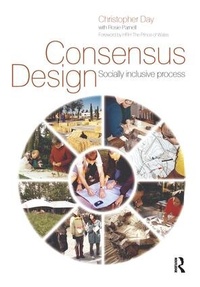
Consensus Design
Socially inclusive process
1st Edition
Published on 1. September 2016
Book
Hardback
240 pages
978-1-138-15186-4 (ISBN)
Description
Consensus Design offers a practical step by step guide to co-design; an increasingly important consideration for architects as they compete for work.
The text moves from identifying the methodology of the process to developing a series of principles and practical steps which illustrate how consensus design can be established.
For easy reference, flow charts show the process of achieving consensus design and include variations for different types of project and different groups of people. It gives clear timings so that agreements can be reached within a specific time frame, and also features a number of case studies to illustrate consensus design principles in practice. Case studies include projects in the UK, US, and Sweden.
Consensus design isn't just a utopian ideal. It's the only meaningful way in which people can be involved in shaping where they live and work. It can have an influence on social stability, crime-reduction, personal health and building longevity, all of which in turn have monetary and environmental cost implications. Its consideration can also greatly help architects win work and commissions.
Day argues that when places are designed by professionals for people, many things obvious to the residents are overlooked. When they are designed by lay people, the design can suffer from the lowest common denominator factor. When places are designed by both it tends to end up in conflict. However, Consensus Design shows that co-design is not doomed to either conflict or banality if it is managed correctly.
The text moves from identifying the methodology of the process to developing a series of principles and practical steps which illustrate how consensus design can be established.
For easy reference, flow charts show the process of achieving consensus design and include variations for different types of project and different groups of people. It gives clear timings so that agreements can be reached within a specific time frame, and also features a number of case studies to illustrate consensus design principles in practice. Case studies include projects in the UK, US, and Sweden.
Consensus design isn't just a utopian ideal. It's the only meaningful way in which people can be involved in shaping where they live and work. It can have an influence on social stability, crime-reduction, personal health and building longevity, all of which in turn have monetary and environmental cost implications. Its consideration can also greatly help architects win work and commissions.
Day argues that when places are designed by professionals for people, many things obvious to the residents are overlooked. When they are designed by lay people, the design can suffer from the lowest common denominator factor. When places are designed by both it tends to end up in conflict. However, Consensus Design shows that co-design is not doomed to either conflict or banality if it is managed correctly.
Reviews / Votes
"The book reads as an instruction manual, complete with ideograms sketched by the author throughout the text."- Journal of Architectural Education, November 2004
More details
Language
English
Place of publication
London
United Kingdom
Publishing group
Taylor & Francis Ltd
Target group
Professional and scholarly
Professional Practice & Development
Dimensions
Height: 234 mm
Width: 165 mm
Weight
498 gr
ISBN-13
978-1-138-15186-4 (9781138151864)
Copyright in bibliographic data and cover images is held by Nielsen Book Services Limited or by the publishers or by their respective licensors: all rights reserved.
Schweitzer Classification
Other editions
Additional editions
Christopher Day | Rosie Parnell
Consensus Design
E-Book
06/2007
1st Edition
Routledge
€61.99
Available for download
Christopher Day | Rosie Parnell
Consensus Design
E-Book
06/2007
1st Edition
Routledge
€61.99
Available for download
Book
10/2002
1st Edition
Architectural Press
€54.46
Shipment within 15-20 days
Persons
Christopher Day, Rosie Parnell
Content
Introduction Chapter One. Architecture as a social art. Chapter Two. Consensus Design: Why? Chapter Three. Consensus Design: How? Chapter Four. Process development: two projects. First - From experimental method to built project: Goethean Science Centre, Scotland. Second - Socially shaped process: Eco-village, Sweden. Chapter Five. Making it work. Chapter Six. Projects. First - Reversing moods: Lunatic Asylum to Steiner School, England. Second - Three tasks in one: East Bay Waldorf School, California. Third - Working with a developer: Mixed-use urban development, California. Fourth - Multiple viewpoints: Multi-faith centre, England. Fifth - Desert ranch: Single-family house, Arizona. Sixth - Project revisiting: Goethean Science Centre, Scotland. Chapter Seven. Broader Implications. Chapter Eight. Useful Practicalities.