

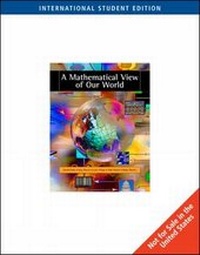
A Mathematical View of Our World
Published on 1. March 2006
Book
Mixed media product
928 pages
978-0-495-11865-7 (ISBN)
Description
Get the mathematics textbook that relates to real life. A Mathematical View of Our World focuses on the math you'll need to know for your liberal arts major and a career outside of science or mathematics. And with iLrn Tutorial, you get explanations from the textbook, examples, step-by-step problem solving help, unlimited practice, and chapter-by-chapter video lessons. And, Personal Tutor with Smarthinking gives you access to one-on-one, online tutoring help with an expert in the subject who has a copy of your textbook. And you get a virtual study group, too - interact with the tutor and other students using two-way audio, an interactive whiteboard for discussing the problem, and instant messaging. Just click to raise a "hand!"
Reviews / Votes
1. NUMBERS IN OUR LIVES. Identification Numbers and Check Digits. Modular Arithmetic and Check Digit Schemes. Encoding Data. 2. SHAPES IN OUR LIVES. Tilings. Symmetry, Rigid Motions, and Escher Patters. Fibonacci Numbers and the Golden Mean ? Shapes in Nature. 3. VOTING AND ELECTIONS. Voting Systems. Flaws of the Voting Systems. Weighted Voting Systems. 4. FAIR DIVISION. Divide and Choose Methods. Discrete and Mixed Division Problems. Envy-Free Division. 5. APPORTIONMENT. The Apportionment Problem ? Quota Methods. The Apportionment Problem ? Divisor Methods. Flaws of the Apportionment Methods. 6. ROUTES AND NETWORKS. Routing Problems. Network Problems. The Traveling Salesperson Problem. 7. SCHEDULING. Basic Concepts of Scheduling. The List-Processing Algorithm and the Decreasing-Time Algorithm. The Critical-Path Algorithm. 8. DESCRIPTIVE STATISTICS ? DATA AND PATTERNS. Organizing and Picturing Data. Comparisons. Enhancement, Distraction, and Distortion. 9. COLLECTING AND INTERPRETING DATA. Populations, Samples, and Data. Survey Sampling Methods. Measures of Central Tendency and Variability. 10. PROBABILITY. Computing Probabilities in Simple Experiments. Computing Probabilities in Multistage Experiments. Conditional Probability, Expected Value, and Odds. 11. INFERENTIAL STATISTICS. Normal Distributions. Applications of Normal Distributions. Confidence Intervals and Reliable Estimation. 12. GROWTH AND DECAY. Malthusian Population Growth. Population Decrease, Radioactive Decay. Logistic Population Models. 13. CONSUMER MATHEMATICS?BUYING AND SAVING. Simple and Compound Interest. Loans. Buying a House.More details
Language
English
Place of publication
CA
United States
Publishing group
Cengage Learning, Inc
Target group
College/higher education
Dimensions
Height: 277 mm
Width: 218 mm
Thickness: 32 mm
Weight
2000 gr
ISBN-13
978-0-495-11865-7 (9780495118657)
Copyright in bibliographic data and cover images is held by Nielsen Book Services Limited or by the publishers or by their respective licensors: all rights reserved.
Schweitzer Classification
Content
1. NUMBERS IN OUR LIVES. Identification Numbers and Check Digits. Modular Arithmetic and Check Digit Schemes. Encoding Data. 2. SHAPES IN OUR LIVES. Tilings. Symmetry, Rigid Motions, and Escher Patters. Fibonacci Numbers and the Golden Mean ? Shapes in Nature. 3. VOTING AND ELECTIONS. Voting Systems. Flaws of the Voting Systems. Weighted Voting Systems. 4. FAIR DIVISION. Divide and Choose Methods. Discrete and Mixed Division Problems. Envy-Free Division. 5. APPORTIONMENT. The Apportionment Problem ? Quota Methods. The Apportionment Problem ? Divisor Methods. Flaws of the Apportionment Methods. 6. ROUTES AND NETWORKS. Routing Problems. Network Problems. The Traveling Salesperson Problem. 7. SCHEDULING. Basic Concepts of Scheduling. The List-Processing Algorithm and the Decreasing-Time Algorithm. The Critical-Path Algorithm. 8. DESCRIPTIVE STATISTICS ? DATA AND PATTERNS. Organizing and Picturing Data. Comparisons. Enhancement, Distraction, and Distortion. 9. COLLECTING AND INTERPRETING DATA. Populations, Samples, and Data. Survey Sampling Methods. Measures of Central Tendency and Variability. 10. PROBABILITY. Computing Probabilities in Simple Experiments. Computing Probabilities in Multistage Experiments. Conditional Probability, Expected Value, and Odds. 11. INFERENTIAL STATISTICS. Normal Distributions. Applications of Normal Distributions. Confidence Intervals and Reliable Estimation. 12. GROWTH AND DECAY. Malthusian Population Growth. Population Decrease, Radioactive Decay. Logistic Population Models. 13. CONSUMER MATHEMATICS?BUYING AND SAVING. Simple and Compound Interest. Loans. Buying a House.