

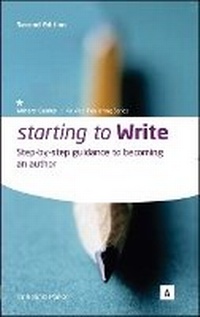
Starting to Write 2ed
Step-By-Step Guidance to Becoming an Author
2nd Edition
Published on 1. January 1999
Book
Paperback/Softback
186 pages
978-1-84285-244-6 (ISBN)
Description
Here is how to become a published writer. Many people yearn to become a published writer but publishers complain of the poor quality manuscripts they receive and how they are un-publishable. There are a substantial number of novice writers who are making totally avoidable mistakes. In this book you will learn: how to start writing and become your best critic; how to deal with writers block, rejection and still keep writing; how to find a market for your work; and, how to find the best writing style and best area to write in, for your personality.
Amazon Customer
4.0 out of 5 starsvery good
This book really encouraged me to write more and find a market for my work. Thanks to it, I am now a published author!
Product details
Paperback: 160 pages
Publisher: Studymates
Language: English
ISBN 978-1842850930
Product Dimensions: 13.4 x 21.6 x 1.9 cm
Amazon Customer
4.0 out of 5 starsvery good
This book really encouraged me to write more and find a market for my work. Thanks to it, I am now a published author!
Product details
Paperback: 160 pages
Publisher: Studymates
Language: English
ISBN 978-1842850930
Product Dimensions: 13.4 x 21.6 x 1.9 cm
Reviews / Votes
5.0 out of 5 stars Essential Reading, 22 Dec 2010 By Rosalie Marsh "Award-Winning Author-Just Us T... (North Wales, UK) - See all my reviews This review is from: Starting to Write: Step-by-step Guidance to Becoming an Author (Studymates Writers Guides) (Paperback) Starting to Write is full of practical advice which initially deals with the basics of constructing a disciplined approach to writing. The chapters cover such areas as: Where Do I Start, Practical Stuff, Becoming a Creative Writer, Avoiding Common Mistakes, to name a few. Dr Rennie Parker talks to the student in a user-friendly and easy to understand way which gets beneath the mystery of the writing process and becoming a published author. 'Where Do I Start' for instance, covers the practicalities of writing and the importance of writing things down as they happen. Although this may seem obvious, for the novice it may not be or they may not have the confidence to do that. This chapter reassures the reader that all ideas are useful and not to be wasted. Each chapter begins with a short overview followed by relative topics with study tips and exercises to make you think and extend the boundaries of your writing .At the end is a period of reflection which is an important part of continual development. Although a large part of the book is geared towards poem, prose and short stories, the underlying lessons are adaptable to writing in general and other genres. Of particular interest are the chapters on dealing with rejection and publishing with a practical analysis of what is, and what is not, acceptable which takes away much of the mystery of becoming a published author. Although 'Starting to Write' is a writing course in itself, it is also a must-read for students attending creative writing courses, either in college or on-line, and should feature on their reading list. Another excellent book from the Aber/Studymates stable. Rosalie MarshMore details
Edition
Who else wants to become an author?
Language
English
Place of publication
Abergale
United Kingdom
Publishing group
GLMP Ltd
Target group
Young adult
College/higher education
Professional and scholarly
Adult education
US School Grade: From Tenth Grade to College Graduate Student, Reading Age: From 14 to 16 years, Interest Age: From 14 to 90 years
Edition type
New edition
Product notice
Unsewn / adhesive bound
Laminated cover
Dimensions
Height: 215 mm
Width: 135 mm
Thickness: 10 mm
Weight
285 gr
ISBN-13
978-1-84285-244-6 (9781842852446)
Copyright in bibliographic data and cover images is held by Nielsen Book Services Limited or by the publishers or by their respective licensors: all rights reserved.
Schweitzer Classification
Person
Dr Parker describes herself as 'Midlands-based cultural worker, employed by local authorities and heritage/arts organisations as: community arts facilitator, education outreach worker, adult education tutor, library assistant. Not all at the same time.'
Content
CONTENTS Introduction Chapter 1: Where Do I Start? One Minute Overview Reading Becoming a Critic Desert Island Books Keeping a Notebook The Diary The Miscellany or Commonplace Book Recording Dreams Start Them Today! Thinking like a Writer Starting Close to Home What Else? Putting the Hours In Do I Need a Study? Your First Practice Poem Prayer Your Turn Now What Is a First Draft? Conclusions Tutorial Section Points for Discussion Practice Questions Chapter 2: Practical Stuff One Minute Overview Essential Reference Kit Handbook/Yearbook Dictionary Thesaurus Rhyming Dictionary Historical Reference Your Public Library Research Computers and the Internet Improving your Punctuation and Grammar Down to the Detail Adjectives, Adverbs and Modifiers Active and Passive More on Layout Anything Else? Conclusions Tutorial Section Points for Discussion Practice Questions Chapter 3: Focusing on Poetry, Prose and Short Stories Prose or Poetry? Why Bother with Genre? Which Genre for Me? Form in Poetry Rhythm Rhyme Problems with Rhyme Imagery Problems with Imagery Defining a Short Story Aim and Direction Moving On Pointers for You Practising Narrative Drive Conclusions Tutorial Section Points for Discussion Practice Questions Chapter 4: Becoming a Creative Writer One Minute Overview Imitation and parody Exercise 1 Exercise 2 Parody Exercise Observation Exercise 1 Exercise 2 Exercise 3 Engaging Five Senses Examples Exercise 1 Exercise 2 Exercise 3 Slow Down! Contrast and Variety Exercise Conflict and Resolution Exercise Point of View An Example How about You Building a Character Get to Know Your People Habits and Hooks Exercise Plotting and Planning How Much Working Out? Devices and Other Mechanisms Sub-plots Basic Plots and Ideas Good Middles and Satisfying Ends Exercises A Challenge - Try Reading This Show, Don't Tell An Example Another Example Exercise Editing Your Work More Revision More editing - Sharpening the Focus Conclusions Tutorial Section Points for Discussion Practice Questions Chapter 5: Avoiding Common Mistakes One Minute Overview Therapy or Writing? Making it Work: Some Examples Archaism What About Period Drama? Cliche and Stereotype Stream of Consciousness - Right or Wrong? Why it Doesn't Work - and What to Do About It The Right Register Exercise Writing, not Speaking What's Wrong? Better Starting Techniques Exercise Plagiarism Essential Things to Do Morality Tales Looking Outside Yourself Are Famous People Different? Caution: Ego in Transit An Example Conclusions Tutorial Section Points for Discussion Practice Questions Chapter 6: Beat the Block One Minute Overview The Block What Is Writer's Block? Does It Exist? See Things In Perspective If you think you have Writer's Block Some Solutions Exercises to Keep You Going Conclusions Tutorial Section Points for Discussion Practice Questions Chapter 7: Dealing With Rejection and General Troubleshooting Dealing With Rejection Why Editors Reject Don't Give Up Finally - Troubleshooting: Sixteen Common Concerns Expressed by New Writers Conclusions Tutorial Section Points for Discussion Practice Questions Chapter 8: Towards Publication One Minute Overview Studying the Market Where Does My Work Belong? Now Try the Following Big Press, Small Press Take Action Submitting Your Work What Is a Synopsis? The Covering Letter Trying An Agent Poetry Magazines What Happens Next? Exercise Conclusions Tutorial Section Points for Discussion Practice Questions Chapter 9: Self-publishing and competitions Self-Publishing What About the ISBN? Marketing Wait a Minute - What's a Press Release? Selling to Shops Where Else? Competitions and Prizes Types of Competitions Where Do I Find the Entry Forms? How To Enter Competitions Schemes, Scams and Vanity Dohh! What Else? Avoid Them! What Is OK? Extra: What Happens To Your Book? The Lowdown on Blurb On Your Side Conclusions Tutorial Section Points for Discussion Practice Questions Chapter 10: Joining In One Minute Overview Classes and Courses Which, What, and Where Get Yourself Organised! Complaints Department Clubs, Groups and Societies The Writer's Group The Reading Group The Literary Society What Should You Look For? Community Arts Festivals Performing and Entertaining How to Read In Public Prose Writers Poets and Dramatists What Is a Performance Poet? Now Select Your Work Refining Your Performance Writing Practice Running An Event Go For It! Conclusions Tutorial Section Points For Discussion Practice Questions Bibliography Index