

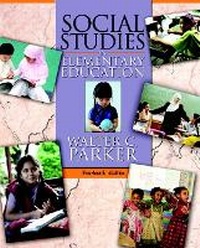
Social Studies in Elementary Education Plus MyEducationLab with Pearson eText -- Access Card Package
14th Edition
Published on 1. August 2012
Book
Mixed media product
504 pages
978-0-13-300747-3 (ISBN)
Description
ALERT: Before you purchase, check with your instructor or review your course syllabus to ensure that you select the correct ISBN. Several versions of Pearson's MyLab & Mastering products exist for each title, including customized versions for individual schools, and registrations are not transferable. In addition, you may need a CourseID, provided by your instructor, to register for and use Pearson's MyLab & Mastering products.
Packages
Access codes for Pearson's MyLab & Mastering products may not be included when purchasing or renting from companies other than Pearson; check with the seller before completing your purchase.
Used or rental books
If you rent or purchase a used book with an access code, the access code may have been redeemed previously and you may have to purchase a new access code.
Access codes
Access codes that are purchased from sellers other than Pearson carry a higher risk of being either the wrong ISBN or a previously redeemed code. Check with the seller prior to purchase.
--
The author wrote this new edition of the most popular elementary social studies methods text on the market with the following three goals in mind: to present the most powerful social studies content and pedagogy for children in elementary school, to offer the material in simple and accessible ways, and to write in a first person active voice. The purpose of this book is to introduce new teachers to the world of social studies teaching and learning in elementary and middle schools. Geography, history, government and the other social sciences are delivered into the palm of the new teacher's hand along with a suite of tools for bringing social studies to life in the classroom.
The book is organized into three sections-the first orients the reader to the mission of social studies education to the increasingly diverse children we teach, the second concentrates on the curriculum, and the third deals with instruction, how we plan and teach this curriculum. Three central themes continue to pervade the book-democratic citizenship, diversity, and the social sciences-to ultimately encourage teachers to excite their students about closing the gap between social realities and democratic ideals. An exceptionally strong chapter on multicultural issues (Chapter 2) helps future teachers truly understand the changing demographics of the American classroom.
Abridged NCSS standards and their classroom applications are found at www.myeducationlab.com.
Packages
Access codes for Pearson's MyLab & Mastering products may not be included when purchasing or renting from companies other than Pearson; check with the seller before completing your purchase.
Used or rental books
If you rent or purchase a used book with an access code, the access code may have been redeemed previously and you may have to purchase a new access code.
Access codes
Access codes that are purchased from sellers other than Pearson carry a higher risk of being either the wrong ISBN or a previously redeemed code. Check with the seller prior to purchase.
--
The author wrote this new edition of the most popular elementary social studies methods text on the market with the following three goals in mind: to present the most powerful social studies content and pedagogy for children in elementary school, to offer the material in simple and accessible ways, and to write in a first person active voice. The purpose of this book is to introduce new teachers to the world of social studies teaching and learning in elementary and middle schools. Geography, history, government and the other social sciences are delivered into the palm of the new teacher's hand along with a suite of tools for bringing social studies to life in the classroom.
The book is organized into three sections-the first orients the reader to the mission of social studies education to the increasingly diverse children we teach, the second concentrates on the curriculum, and the third deals with instruction, how we plan and teach this curriculum. Three central themes continue to pervade the book-democratic citizenship, diversity, and the social sciences-to ultimately encourage teachers to excite their students about closing the gap between social realities and democratic ideals. An exceptionally strong chapter on multicultural issues (Chapter 2) helps future teachers truly understand the changing demographics of the American classroom.
Abridged NCSS standards and their classroom applications are found at www.myeducationlab.com.
More details
Edition
14th edition
Language
English
Place of publication
United States
Publishing group
Pearson Education (US)
Target group
Professional and scholarly
Weight
862 gr
ISBN-13
978-0-13-300747-3 (9780133007473)
Copyright in bibliographic data is held by Nielsen Book Services Limited or its licensors: all rights reserved.
Schweitzer Classification
Other editions
Previous edition
Walter C. Parker
Social Studies in Elementary Education (with MyEducationLab)
Book
05/2008
13th Edition
Pearson
€91.16
Article exhausted; check for reprint
Person
I teach in the College of Education at the University of Washington in Seattle where I chair the Social Studies Education Program. I study K-12 social studies education and, in particular, the civic development of youth. I'm especially interested in the ways civic education, multicultural education, and global education overlap. My other books are Renewing the Social Studies Curriculum (1991); Educating the Democratic Mind (1996); Education for Democracy: Contexts, Curricula, and Assessments (2002); Teaching Democracy: Unity and Diversity in Public Life (2003); and Social Studies Today: Research & Practice (2010). I am the editor of the 'Research and Practice' column for Social Education, the flagship journal of the National Council for the Social Studies.
I was born and raised in Englewood, Colorado, on Denver's south side, and taught school for ten years in Adams County on Denver's north side. I earned the B.A. in Political Science (University of Colorado, Boulder), the M.A. in Social Foundations of Education (University of Colorado, Denver), and the Ph.D. in Curriculum and Instruction (University of Washington, Seattle). I live in Seattle with the rain and my wife, Sheila Valencia.
I was born and raised in Englewood, Colorado, on Denver's south side, and taught school for ten years in Adams County on Denver's north side. I earned the B.A. in Political Science (University of Colorado, Boulder), the M.A. in Social Foundations of Education (University of Colorado, Denver), and the Ph.D. in Curriculum and Instruction (University of Washington, Seattle). I live in Seattle with the rain and my wife, Sheila Valencia.
Content
PART I: Introduction to Social Studies Education
Chapter 1: Social Studies Education: What and Why
Chapter 2: Teaching Diverse Children
PART II: The Social Studies Curriculum
Chapter 3: Democratic Citizenship Education
Chapter 4: History, Geography, and the Social Sciences
Chapter 5: Powerful Tools: Maps, Globes, Charts, and Graphics
Chapter 6: Current Events and Public Issues
PART III: Planning and Teaching Social Studies
Chapter 7: Assessing Student Learning
Chapter 8: Planning Units, Lessons, and Activities
Chapter 9: Five Great Teaching Strategies
Chapter 10: The Literacy-Social Studies Connection
Chapter 11: Social Studies as the Integrating Core
Chapter 12: Four Great Resources
Notes
Index
Chapter 1: Social Studies Education: What and Why
Chapter 2: Teaching Diverse Children
PART II: The Social Studies Curriculum
Chapter 3: Democratic Citizenship Education
Chapter 4: History, Geography, and the Social Sciences
Chapter 5: Powerful Tools: Maps, Globes, Charts, and Graphics
Chapter 6: Current Events and Public Issues
PART III: Planning and Teaching Social Studies
Chapter 7: Assessing Student Learning
Chapter 8: Planning Units, Lessons, and Activities
Chapter 9: Five Great Teaching Strategies
Chapter 10: The Literacy-Social Studies Connection
Chapter 11: Social Studies as the Integrating Core
Chapter 12: Four Great Resources
Notes
Index