

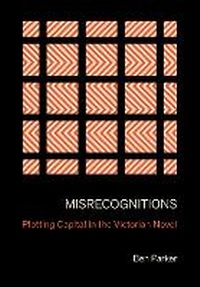
Misrecognitions
Plotting Capital in the Victorian Novel
Published on 15. March 2024
Book
Hardback
198 pages
978-1-5017-7407-2 (ISBN)
Description
Misrecognitions mounts a vigorous defense of the labyrinthine plotting of Victorian novels, notorious for their implausible concluding revelations and coincidences. Critics have long decried Victorian recognition scenes-the reunions and retroactive discoveries of identity that too conveniently bring the story to a close-as regrettable contrivances. Ben Parker counters this view by showing how these recognition scenes offer a critique of the social and economic misrecognitions at work in nineteenth-century capitalism.
Through a meticulous analysis of novels by Charles Dickens, Anthony Trollope, and Henry James, as well as Arthur Conan Doyle's Sherlock Holmes stories, Misrecognitions tracks how the Victorian novel translates the financialized abstractions of capital into dramas of buried secrets and disguised relations. Drawing on Karl Marx's account of commodity fetishism and reification, Parker contends that, by configuring capital as an enigma to be unveiled, Victorian recognition scenes dramatize the inversions of agency and temporality that are repressed in capitalist production. In plotting capital as an agent of opacity and misdirection, Victorian novels and their characteristic dialectic of illusion and illumination reveal the plot hole in capitalism itself.
Through a meticulous analysis of novels by Charles Dickens, Anthony Trollope, and Henry James, as well as Arthur Conan Doyle's Sherlock Holmes stories, Misrecognitions tracks how the Victorian novel translates the financialized abstractions of capital into dramas of buried secrets and disguised relations. Drawing on Karl Marx's account of commodity fetishism and reification, Parker contends that, by configuring capital as an enigma to be unveiled, Victorian recognition scenes dramatize the inversions of agency and temporality that are repressed in capitalist production. In plotting capital as an agent of opacity and misdirection, Victorian novels and their characteristic dialectic of illusion and illumination reveal the plot hole in capitalism itself.
Reviews / Votes
Misrecognitions makes you want to revisit your favorite modernist novel in this new light. * Cambridge Quarterly * Misrecognitions turns its new formalist approach to excellent effect, producing nuanced analyses of novels in which capital is revealed as an organizing principle of narrative and social forms * Victorian Review *More details
Language
English
Place of publication
Ithaca
United States
Product notice
Paper over boards
Dimensions
Height: 229 mm
Width: 152 mm
Thickness: 22 mm
Weight
907 gr
ISBN-13
978-1-5017-7407-2 (9781501774072)
Copyright in bibliographic data and cover images is held by Nielsen Book Services Limited or by the publishers or by their respective licensors: all rights reserved.
Schweitzer Classification
Other editions
Additional editions
E-Book
03/2024
Cornell University Press
€36.99
Available for download
Person
Ben Parker is Assistant Professor of English at Brown University. His writing has appeared in Modern Language Quarterly, New Literary History, Novel, boundary 2, Film Quarterly, and n+1.
Content
Introduction: Capital's Plot Hole
1. Financial Crisis and the Partitions of Subjectivity in Little Dorrit
2. Interest-Bearing Capital and the Displacement of Affect in The Last Chronicle of Barset
3. The Fetishism of the Subject and Its Secret in The Portrait of a Lady
4. The Fragmentation of Subject and Object in Sherlock Holmes
Conclusion: From Reification to the Theory of the Novel
1. Financial Crisis and the Partitions of Subjectivity in Little Dorrit
2. Interest-Bearing Capital and the Displacement of Affect in The Last Chronicle of Barset
3. The Fetishism of the Subject and Its Secret in The Portrait of a Lady
4. The Fragmentation of Subject and Object in Sherlock Holmes
Conclusion: From Reification to the Theory of the Novel