

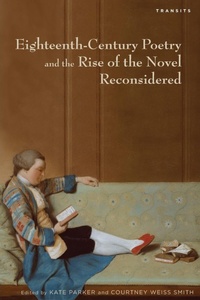
Eighteenth-Century Poetry and the Rise of the Novel Reconsidered
Published on 28. August 2015
Book
Paperback/Softback
280 pages
978-1-61148-702-2 (ISBN)
Description
Eighteenth-Century Poetry and the Rise of the Novel Reconsidered beginswith the brute fact that poetry jostledup alongside novels in the bookstallsof eighteenth-century England. Indeed,by exploringunexpected collisions and collusionsbetween poetry and novels, this volumeof exciting, new essays offers a reconsideration of the literary and cultural history of the period. Thenovel poached from and featured poetry, and the "modern" subjects and objects privileged by "rise of the novel" scholarship are only one part of a world full of animate things and people with indistinct boundaries.
Contributors: Margaret Doody, David Fairer, Sophie Gee, Heather Keenleyside, ShelleyKing, Christina Lupton, Kate Parker, Natalie Phillips, Aran Ruth, Wolfram Schmidgen, Joshua Swidzinski, and Courtney Weiss Smith.
Contributors: Margaret Doody, David Fairer, Sophie Gee, Heather Keenleyside, ShelleyKing, Christina Lupton, Kate Parker, Natalie Phillips, Aran Ruth, Wolfram Schmidgen, Joshua Swidzinski, and Courtney Weiss Smith.
Reviews / Votes
There is no shortage of scholarship on 18th-century fiction, and criticism of 18th-century verse is not far behind. For the most part, though, these are separate fields of study, and until now only G. Gabrielle Starr's Lyric Generations: Poetry and the Novel in the Long Eighteenth Century had taken their interaction seriously. Now two junior scholars, Parker and Smith, have brought together an international team of scholars to explore the relationships between the novel and poetry in 18th-century Britain. The contributors range from graduate students to the biggest names in the field, but all have produced learned, incisive, and original investigations into the points of contact between genres. The nine essays (and a chapter-length coda) range from close readings of individual works (Rape of the Lock, Night Thoughts, Pamela, Tristram Shandy) to ambitious attempts to rethink literary history itself. The contributors share no single 'program,' and they often disagree over both methods and conclusions. But they share a commitment to changing the traditional stories of the development of fiction and poetry. This major collection from Bucknell, a leader in 18th-century studies, is required reading for scholars. Summing Up: Essential. Graduate students, researchers, faculty. * Choice Reviews * Eighteenth-Century Poetry and the Rise of the Novel Reconsidered is a provocative and timely collection well worth the attention of the reader who wishes, as Smith states in her introductory remarks, to 'grapple with unexpected collisions and collusions between poetry and novels'. . . .[The book] counts among the year's best books in eighteenth-century studies. * Intelligencer * This provocative collection brings large historical and theoretical claims together with close attention to individual eighteenth-century texts and in particular to the workings of literary form. . . .Parker and Weiss Smith have produced a collection that provides a varied, engaging, and challenging snapshot of where eighteenth-century studies is now that we have begun the important work of bringing genres back into conversation with one another, and which suggests exciting directions for this discussion to go next. * Eighteenth-Century Fiction *More details
Series
Language
English
Place of publication
Cranbury
United States
Publishing group
Associated University Presses
Target group
College/higher education
Illustrations
6 BW Photos
Dimensions
Height: 234 mm
Width: 156 mm
Thickness: 15 mm
Weight
430 gr
ISBN-13
978-1-61148-702-2 (9781611487022)
Copyright in bibliographic data and cover images is held by Nielsen Book Services Limited or by the publishers or by their respective licensors: all rights reserved.
Schweitzer Classification
Other editions
Additional editions
E-Book
12/2013
1st Edition
Bucknell University Press,U.S.
€47.49
Available for download
Persons
Kate Parker is assistant professor of English at University of Wisconsin-La Crosse. Her article on Sade appeared in Eighteenth-Century Fiction. She is writing a book that explores how affective communities impact literary representations of selfhood in eighteenth-century Britain and France.
Courtney Weiss Smith is assistant professor of English at Wesleyan University. She is the author of articles on eighteenth-century literature and culture that have appeared in Eighteenth Century: Theory and Interpretation and SEL. Her current book project focuses on relationships between literature, religion and science in early eighteenth-century England.
Courtney Weiss Smith is assistant professor of English at Wesleyan University. She is the author of articles on eighteenth-century literature and culture that have appeared in Eighteenth Century: Theory and Interpretation and SEL. Her current book project focuses on relationships between literature, religion and science in early eighteenth-century England.
Content
Contents
Acknowledgments
List of Illustrations
Introduction: Poetry, Novels, People, Things 1
Courtney Weiss Smith
Part I: Reconsidering Genres: Rising, Borrowing, Circulating
1 Heroic Couplets and Eighteenth-Century Heroism: Pope's Complicated Characters
Sophie Gee
2 "The Battle Without Killing": Eliza Haywood and the Politics of Attempted Rape
Kate Parker
3 The Novel's Poem Envy: Mid-Century Fiction and the "Thing Poem"
Christina Lupton and Aran Ruth
4 "To delineate the human mind in its endless varieties": Integral Lyric and Characterization in the Tales of Amelia Opie
Shelley King
Part II: Reconsidering Subjects and Objects
5 Undividing the Subject of Literary History: From James Thomson's Poetry to Daniel Defoe's Novels
Wolfram Schmidgen
6 The Rise of the Novel and the Fall of Personification
Heather Keenleyside
7 "Light electric touches": Sterne, Poetry, and Empirical Erotics
David Fairer
8 "Great labour both of mind and tongue": Articulacy and Interiority in Young's Night Thoughts and Richardson's Clarissa
Joshua Swidzinski
9 The Art of Attention: Navigating Distraction and Rhythms of Focus in Eighteenth-Century Poetry
Natalie Phillips
Coda: Time, Space, and the Poetic Mind of the Novel
Margaret Doody
Bibliography
Notes on Contributors
Acknowledgments
List of Illustrations
Introduction: Poetry, Novels, People, Things 1
Courtney Weiss Smith
Part I: Reconsidering Genres: Rising, Borrowing, Circulating
1 Heroic Couplets and Eighteenth-Century Heroism: Pope's Complicated Characters
Sophie Gee
2 "The Battle Without Killing": Eliza Haywood and the Politics of Attempted Rape
Kate Parker
3 The Novel's Poem Envy: Mid-Century Fiction and the "Thing Poem"
Christina Lupton and Aran Ruth
4 "To delineate the human mind in its endless varieties": Integral Lyric and Characterization in the Tales of Amelia Opie
Shelley King
Part II: Reconsidering Subjects and Objects
5 Undividing the Subject of Literary History: From James Thomson's Poetry to Daniel Defoe's Novels
Wolfram Schmidgen
6 The Rise of the Novel and the Fall of Personification
Heather Keenleyside
7 "Light electric touches": Sterne, Poetry, and Empirical Erotics
David Fairer
8 "Great labour both of mind and tongue": Articulacy and Interiority in Young's Night Thoughts and Richardson's Clarissa
Joshua Swidzinski
9 The Art of Attention: Navigating Distraction and Rhythms of Focus in Eighteenth-Century Poetry
Natalie Phillips
Coda: Time, Space, and the Poetic Mind of the Novel
Margaret Doody
Bibliography
Notes on Contributors