

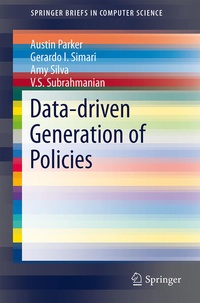
Data-driven Generation of Policies
Published on 4. January 2014
Book
Paperback/Softback
X, 50 pages
978-1-4939-0273-6 (ISBN)
Description
This Springer Brief presents a basic algorithm that provides a correct solution to finding an optimal state change attempt, as well as an enhanced algorithm that is built on top of the well-known trie data structure. It explores correctness and algorithmic complexity results for both algorithms and experiments comparing their performance on both real-world and synthetic data. Topics addressed include optimal state change attempts, state change effectiveness, different kind of effect estimators, planning under uncertainty and experimental evaluation. These topics will help researchers analyze tabular data, even if the data contains states (of the world) and events (taken by an agent) whose effects are not well understood. Event DBs are omnipresent in the social sciences and may include diverse scenarios from political events and the state of a country to education-related actions and their effects on a school system. With a wide range of applications in computer science and the social sciences, the information in this Springer Brief is valuable for professionals and researchers dealing with tabular data, artificial intelligence and data mining. The applications are also useful for advanced-level students of computer science.
More details
Series
Language
English
Place of publication
New York
United States
Target group
Professional and scholarly
Research
Illustrations
15 s/w Abbildungen
X, 50 p. 15 illus.
Dimensions
Height: 235 mm
Width: 155 mm
Thickness: 4 mm
Weight
108 gr
ISBN-13
978-1-4939-0273-6 (9781493902736)
DOI
10.1007/978-1-4939-0274-3
Schweitzer Classification
Other editions
Additional editions
Austin Parker | Gerardo I. Simari | Amy Sliva
Data-driven Generation of Policies
SpringerBriefs in Computer Science
E-Book
01/2014
1st Edition
Springer
€53.49
Available for download
Content
Introduction and Related Work.- Optimal State Change Attempts.- Different Kinds of Effect Estimators.- A Comparison with Planning under Uncertainty.- Experimental Evaluation.- Conclusions.