

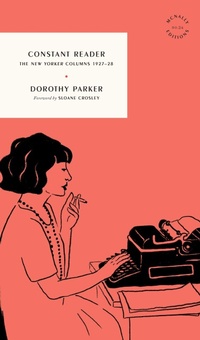
Constant Reader
The New Yorker Columns 192728
Published on 19. December 2024
Book
Paperback/Softback
224 pages
978-1-961341-25-8 (ISBN)
Description
When, in 1927, Dorothy Parker became a book critic for the New Yorker, she was already a legendary wit, a much-quoted member of the Algonquin Round Table, and an arbiter of literary taste. In the year that she spent as a weekly reviewer, under the rubric "Constant Reader," she created what is still the most entertaining book column ever written. Parker's hot takes have lost none of their heat, whether she's taking aim at the evangelist Aimee Semple MacPherson ("She can go on like that for hours. Can, hell - does"), praising Hemingway's latest collection ("He discards detail with magnificent lavishness"), or dissenting from the Tao of Pooh ("And it is that word 'hummy,' my darlings, that marks the first place in The House at Pooh Corner at which Tonstant Weader Fwowed up").
Introduced with characteristic wit and sympathy by Sloane Crosley, Constant Reader gathers the complete weekly New Yorker reviews that Parker published from October 1927 through November 1928, with gimlet-eyed appreciations of the high and low, from Isadora Duncan to Al Smith, Charles Lindbergh to Little Orphan Annie, Mussolini to Emily Post
Introduced with characteristic wit and sympathy by Sloane Crosley, Constant Reader gathers the complete weekly New Yorker reviews that Parker published from October 1927 through November 1928, with gimlet-eyed appreciations of the high and low, from Isadora Duncan to Al Smith, Charles Lindbergh to Little Orphan Annie, Mussolini to Emily Post
Reviews / Votes
"Does anyone know how hard it is to be that funny? . . . Read her book reviews. Read them now and see how good they are."-Fran Lebowitz
"In Parker's hands, the humble book review becomes an instrument as expressive as a lyric poem."
-Nicholas Frankel, The Wall Street Journal, Five Best Books by Great Wits
"All I wanted in this world was to come to New York and be Dorothy Parker. The funny lady. The only lady at the table. The woman who made her living by her wit . . . Who always got off the perfect line at the perfect moment, who never went home and lay awake wondering what she ought to have said because she had said exactly what she ought to have."
-Nora Ephron, Esquire
"The Constant Reader columns are not really book reviews; they are standup-comedy routines. You don't have to listen to her opinion, she says. If she didn't like the book, maybe that's just her hangover speaking."
-Joan Acocella, The New Yorker
"I was far more beguiled . . . by her New Yorker book reviews . . . [They] contain the best of what we've been trying to do all these years-we 'booksy-wooksies,' as she called us. She snuck into the tradition with a razor in her stocking, and we've been trying to slice things her way ever since."
-Christopher Lehmann-Haupt, The New York Times
"Can anyone ever get too much of Dorothy Parker? . . . Here is the happy news that McNally Editions is republishing her book column "Constant Reader," from The New Yorker, a gig that lasted only a year but whose critiques read as fresh and as wonderful as when they first appeared, in the late 1920s . . . Sloane Crosley provides a witty and perceptive foreword."
-Jim Kelly, Air Mail, Editor's Picks
"Parker's column helped to establish the New Yorker voice; wry, puckish, world-weary . . . When she turns to the books themselves, she is of course very funny, with jokes sustained over paragraphs, pages and months . . . This is the Dorothy Parker we recognize: glittering, at the peak of her humorous powers, in an eternal pre-Depression New York."
-Violet Hudson, Times Literary Supplement
"What gives her writing its peculiar tang is her gift for seeing something to laugh at in the bitterest tragedies of the human animal."
-Somerset Maugham
"A bestselling poet who moved on to fiction, Dorothy Parker . . . was equally innovative as a critic, pioneering a first-person style and busting the taboo on hatchet jobs by women . . . She was arguably the first female celebrity wit since the 17th century, outperforming her illustrious male peers."
-John Dugdale, The Guardian
"Constant Reader contains the kind of wit that no longer flourishes. I laughed loudly throughout and sobbed softly in memory. There would be fewer bad books published today if Mrs. Parker were alive to have at them."
-George Oppenheimer
"Length doesn't increase depth, necessarily, and just because her little characterizations of a book were short doesn't mean they weren't true."
-Gloria Steinem
More details
Series
Language
English
Place of publication
United States
Product notice
With flaps
Illustrations
Illustrations
Dimensions
Height: 212 mm
Width: 131 mm
Thickness: 20 mm
Weight
297 gr
ISBN-13
978-1-961341-25-8 (9781961341258)
Copyright in bibliographic data and cover images is held by Nielsen Book Services Limited or by the publishers or by their respective licensors: all rights reserved.
Schweitzer Classification
Persons
Dorothy Parker nee Rothschild (1898-1967), grew up on New York's Upper West Side. She became famous for her comic poems, her short stories, her reviews, and her repartee, as recorded by the columnist Wolcott Gibbs over lunches at the Algonquin hotel. A prolific magazine contributor in her youth and a successful screenwriter (she co-wrote the original A Star is Born), she struggled all her life with alcoholism and wrote very little in her later decades, though continued to be a vocal champion of progressive causes, especially civil rights. Sloane Crosley is the author of the essay collections I Was Told There'd Be Cake (a 2009 finalist for the Thurber Prize for American Humor), How Did You Get This Number, and Look Alive Out There (a 2019 Thurber Prize finalist); the novels The Clasp and Cult Classic; and, most recently, her memoir, Grief Is for People. A contributing editor at Vanity Fair, she lives in New York City.
Content
Foreword by Sloane Crosley
Oct 1, 1927: The Highly Recurrent Mr. Hamilton-Al Smith, and How He Grew-Bad News of May Sinclair
Oct 8, 1927: Mrs. Colby's Second Novel-The Private Papers of the Dead-The Philosopher Takes a Long Look at Himself
Oct 15, 1927: An American Du Barry-A Biography of Henry Ward Beecher
Oct 22, 1927: Re-enter Margot Asquith-Something Young-A Masterpiece from the French
Oct 29, 1927: A Book of Great Short Stories-Something About Cabell
Nov 5, 1927: The Professor Goes in for Sweetness and Light-Short Stories from One Who Knows How to Do Them-Sketches, Mostly Unpleasant-A Biography of a Much-Talked-About Lady
Nov 12, 1927: Mr. Morley Capers on a Toadstool-Mr. Milne Grows to Be Six
Nov 19, 1927: Adam and Eve and Lilith and Epigrams-Something More About Cabell
Nov 26. 1927: Madame Glyn Lectures on It, with Illustrations
Dec 3, 1927: The Most Popular Reading Matter
Dec 10, 1927: The Socialist Looks at Literature-A Lyricist Looks at His Neighbors
Dec 17, 1927: The Short Story, Through a Couple of the Ages
Dec 31, 1927: Mrs. Post Enlarges on Etiquette
Jan 7, 1928: More Troubles for Colonel Charles A. Lindbergh
Jan 14, 1928: Poor, Immortal Isadora
Jan 28, 1928: Re-enter Miss Hurst, Followed by Mr. Tarkington
Feb 4, 1928: A Good Novel, and a Great Story
Feb 11, 1928: Literary Rotarians
Feb 18, 1928: Excuse It, Please-Americans at Play-This Sentimental Grand Vizier
Feb 25, 1928: Our Lady of the Loudspeaker
Mar 10, 1928: Unfinished Endeavors
Mar 17, 1928: The Compleat Bungler
Mar 24, 1928: Ethereal Mildness
Mar 31, 1928: A Very Dull Article, Indeed
Apr 7, 1928: Mr. Lewis Lays It On with a Trowel
Apr 14, 1928: Mrs. Norris and the Beast
Apr 21, 1928: These Much Too Charming People
May 19, 1928: Hard-Boiled Virgins Are Faithful Lovers
May 26, 1928: Mr. See Sees It Through
Aug 25, 1928: Back to the Book-Shelf
Sep 15, 1928: Duces Wild
Sep 29, 1928: How It Feels to Be One Hundred and Forty-Six
Oct 20, 1928: Far from Well
Nov 17, 1928: Wallflower's Lament
Oct 1, 1927: The Highly Recurrent Mr. Hamilton-Al Smith, and How He Grew-Bad News of May Sinclair
Oct 8, 1927: Mrs. Colby's Second Novel-The Private Papers of the Dead-The Philosopher Takes a Long Look at Himself
Oct 15, 1927: An American Du Barry-A Biography of Henry Ward Beecher
Oct 22, 1927: Re-enter Margot Asquith-Something Young-A Masterpiece from the French
Oct 29, 1927: A Book of Great Short Stories-Something About Cabell
Nov 5, 1927: The Professor Goes in for Sweetness and Light-Short Stories from One Who Knows How to Do Them-Sketches, Mostly Unpleasant-A Biography of a Much-Talked-About Lady
Nov 12, 1927: Mr. Morley Capers on a Toadstool-Mr. Milne Grows to Be Six
Nov 19, 1927: Adam and Eve and Lilith and Epigrams-Something More About Cabell
Nov 26. 1927: Madame Glyn Lectures on It, with Illustrations
Dec 3, 1927: The Most Popular Reading Matter
Dec 10, 1927: The Socialist Looks at Literature-A Lyricist Looks at His Neighbors
Dec 17, 1927: The Short Story, Through a Couple of the Ages
Dec 31, 1927: Mrs. Post Enlarges on Etiquette
Jan 7, 1928: More Troubles for Colonel Charles A. Lindbergh
Jan 14, 1928: Poor, Immortal Isadora
Jan 28, 1928: Re-enter Miss Hurst, Followed by Mr. Tarkington
Feb 4, 1928: A Good Novel, and a Great Story
Feb 11, 1928: Literary Rotarians
Feb 18, 1928: Excuse It, Please-Americans at Play-This Sentimental Grand Vizier
Feb 25, 1928: Our Lady of the Loudspeaker
Mar 10, 1928: Unfinished Endeavors
Mar 17, 1928: The Compleat Bungler
Mar 24, 1928: Ethereal Mildness
Mar 31, 1928: A Very Dull Article, Indeed
Apr 7, 1928: Mr. Lewis Lays It On with a Trowel
Apr 14, 1928: Mrs. Norris and the Beast
Apr 21, 1928: These Much Too Charming People
May 19, 1928: Hard-Boiled Virgins Are Faithful Lovers
May 26, 1928: Mr. See Sees It Through
Aug 25, 1928: Back to the Book-Shelf
Sep 15, 1928: Duces Wild
Sep 29, 1928: How It Feels to Be One Hundred and Forty-Six
Oct 20, 1928: Far from Well
Nov 17, 1928: Wallflower's Lament