

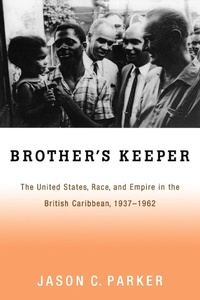
Brother's Keeper
The United States, Race, and Empire in the British Caribbean, 1937-1962
Published on 1. May 2008
Book
Paperback/Softback
264 pages
978-0-19-533202-5 (ISBN)
Description
The culmination of West Indian decolonization came at a dangerous moment in the Cold War Caribbean, amid aftershocks of the Cuban Revolution, a wave of Third World nationalism abroad, and civil rights conflicts in the United States. Dozens of countries entered in the atlas in one generation, many of them through bloody clashes. Yet the West Indian passage to independence was peaceful and managed to avoid the heavy-handed American intervention seen elsewhere in the hemisphere, not to mention Vietnam and other parts of the globe. In this book, Jason Parker explains why a policy of American restraint was exercised in the British Caribbean (Jamaica and Trinidad and Tobago), despite the long association of West Indians with black radicalism in the United States.
This book closely examines the dynamics of the decolonization of the British West Indies from the 1930s to its Cold War culmination, particularly those surrounding the creation and subsequent implosion of the West Indies Federation. Washington had long sought anticommunist stability and access to strategic assets in the Caribbean. Yet the American ability to pursue these objectives was limited by British sovereignty and West Indian agency. The British wanted to end their responsibility for the colonies while retaining influence there. West Indian nationalists sought an urgent transition from white supremacy and imperial rule, drawing on a transnational "diaspora diplomacy" based in Harlem to do so. The resulting Anglo-American-Caribbean relations swung between the transatlantic special relationship and the trans-Caribbean "protean partnership" of formal and diasporan diplomacy. This study uses archives in six countries to write an international history of these relations. It integrates that history into the tableau of inter-American relations, and explores the relationship between the Cold War and decolonization. In the West Indies, the former first slowed and then accelerated the latter--a process which was already underway, and one whose effects reverberate throughout the Third World into the present day.
This book closely examines the dynamics of the decolonization of the British West Indies from the 1930s to its Cold War culmination, particularly those surrounding the creation and subsequent implosion of the West Indies Federation. Washington had long sought anticommunist stability and access to strategic assets in the Caribbean. Yet the American ability to pursue these objectives was limited by British sovereignty and West Indian agency. The British wanted to end their responsibility for the colonies while retaining influence there. West Indian nationalists sought an urgent transition from white supremacy and imperial rule, drawing on a transnational "diaspora diplomacy" based in Harlem to do so. The resulting Anglo-American-Caribbean relations swung between the transatlantic special relationship and the trans-Caribbean "protean partnership" of formal and diasporan diplomacy. This study uses archives in six countries to write an international history of these relations. It integrates that history into the tableau of inter-American relations, and explores the relationship between the Cold War and decolonization. In the West Indies, the former first slowed and then accelerated the latter--a process which was already underway, and one whose effects reverberate throughout the Third World into the present day.
Reviews / Votes
This monograph is a rare synthesis of complementary themes in a "watershed" period in West Indian history... Happily, Brother's Keeper is a successful effort and constitutes a welcome contribution to the field... an engrossing tale with something for everyone. * Charlie Whitham, New West Indian Guide. * Parker has presented a convincing argument supported by excellent research and some persuasive writing ... an immensely impressive work of scholarship. * Spencer Mawby, Journal of American Studies *More details
Language
English
Place of publication
New York
United States
Target group
College/higher education
Illustrations
1 map
Dimensions
Height: 234 mm
Width: 156 mm
Thickness: 14 mm
Weight
406 gr
ISBN-13
978-0-19-533202-5 (9780195332025)
Copyright in bibliographic data and cover images is held by Nielsen Book Services Limited or by the publishers or by their respective licensors: all rights reserved.
Schweitzer Classification
Other editions
Additional editions

Jason C. Parker
Brother's Keeper
The United States, Race, and Empire in the British Caribbean, 1937-1962
E-Book
04/2008
1st Edition
OUP eBook
€16.49
Available for download
Jason C. Parker
Brother's Keeper
The United States, Race, and Empire in the British Caribbean, 1937-1962
E-Book
04/2008
1st Edition
OUP eBook
€14.49
Available for download
Person
Jason C. Parker is Assistant Professor of History at Texas A & M University.
Content
INTRODUCTION; CONCLUSION; NOTES; BIBLIOGRAPHY