

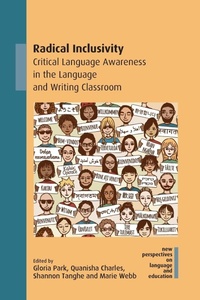
Radical Inclusivity
Critical Language Awareness in the Language and Writing Classroom
Published on 11. November 2025
Book
Paperback/Softback
218 pages
978-1-83668-033-8 (ISBN)
Description
This book contains a collection of chapters that blend theory and practice to share the hows and whys of implementing radical inclusivity in the language and writing classroom. It highlights the experiences and practices of global K-20 teachers and teacher educators and the many ways they promote these radically inclusive practices in their classrooms. The chapter authors outline what radical inclusivity is and how it can be embedded in classroom practice and pedagogy across teacher education, undergraduate classrooms, community engagement contexts and different institutional and programmatic settings. The book views teaching as a radical act of hope, and uses perspectives from Critical Language Awareness to support learners in developing critical perspectives on the intersections of language, identity, power and privilege. Structured as a theory-to-practice resource, the book is designed to provide teachers and graduate students with theoretical backgrounds and practical activities that can be integrated into language teacher education, as well as writing and language classrooms.
Reviews / Votes
Radical Inclusivity is a groundbreaking edited volume that explores the intersection of radical inclusion and Critical Language Awareness and illustrates how these concepts can be applied in diverse language and writing classrooms. This rich collection offers various transformative approaches to teaching and learning English suitable for 21st-century TESOL education. * Atsushi Iida, Aoyama Gakuin University, Japan * This important collection brings together language and writing teachers and teacher educators who demonstrate a real commitment to radical inclusivity and critical language awareness in classroom, community, and institutional spaces. Each chapter offers an authentic and accessible read of why and how inclusive practices are embraced in a particular context and leaves the reader challenged and energized to engage in similar work. * Sarah Henderson Lee, Minnesota State University, USA * Intersecting Critical Language Awareness pedagogy and radical inclusivity, this collection advances language and writing instruction by challenging how language and power should be interrogated in the classroom to empower students. Contributors highlight their CLA-informed pedagogies, which teachers, teacher educators, and programs and institutions committed to social justice will find beneficial and locally invaluable. * Tanita Saenkhum, University of Tennessee, Knoxville, USA *More details
Series
Language
English
Place of publication
Bristol
United Kingdom
Publishing group
Channel View Publications Ltd
Target group
Professional and scholarly
College/higher education
Dimensions
Height: 234 mm
Width: 156 mm
Thickness: 13 mm
Weight
380 gr
ISBN-13
978-1-83668-033-8 (9781836680338)
DOI
10.21832/PARK0345
Copyright in bibliographic data and cover images is held by Nielsen Book Services Limited or by the publishers or by their respective licensors: all rights reserved.
Schweitzer Classification
Other editions
Additional editions
Gloria Park | Quanisha Charles | Shannon Tanghe
Radical Inclusivity
Critical Language Awareness in the Language and Writing Classroom
Book
11/2025
Multilingual Matters
€161.20
Shipment within 3-4 weeks
Gloria Park | Quanisha Charles | Shannon Tanghe
Radical Inclusivity
Critical Language Awareness in the Language and Writing Classroom
E-Book
11/2025
Multilingual Matters
€14.49
Available for download
Persons
Gloria Park is Professor of Applied Linguistics and Program Co-Director of Graduate Studies in Composition & Applied Linguistics at Indiana University of Pennsylvania, USA.
Quanisha Charles is Associate Professor of English at North Central College, Illinois, USA.
Shannon Tanghe is Assistant Professor and ESL Program Coordinator, Metro State University, Minnesota, USA.
Marie Webb is a Continuing Lecturer at the University of California Santa Barbara, USA.
Quanisha Charles is Associate Professor of English at North Central College, Illinois, USA.
Shannon Tanghe is Assistant Professor and ESL Program Coordinator, Metro State University, Minnesota, USA.
Marie Webb is a Continuing Lecturer at the University of California Santa Barbara, USA.
Content
Contributors
Shawna Shapiro and Shenika Hankerson: Foreword: Seeds of Transformation: The Power of Critical Language Awareness and Radical Inclusivity
Quanisha Charles, Shannon Tanghe, Marie Webb and Gloria Park: Introduction: Critical Incidents in the Classroom: Realizing CLA and Radical Inclusivity Intersections
Part 1: What Does Radical Inclusivity Look Like in the Preparation of Undergraduate Writers?
Chapter 1. Laura Aull and Shawna Shapiro: Critical Language Awareness (CLA) Reading: Radical (and Rhetorical) Engagement with Texts
Chapter 2. Sean Oros: Fictional 'Truths' about Language: Using Creative Fiction for Radical Inclusion and Critical Language Awareness
Chapter 3. Sophia Minnillo: Toward Radical Inclusivity in First Year Composition: A Lesson for CLA, Translingual Writing and Metacognative Development
Chapter 4. Marie Webb: Radically Inclusive Teaching: A Lesson Utilizing the Learning about Written Languages (LaWL) Approach
Part 2: What Does Radical Inclusivity Look Like in the Preparation of Language and Writing Teachers?
Chapter 5. Havva Zorluel Ozer: Critical Language Awareness and Translingual Pedagogies in the Language Teacher Education Classroom: An Enactment
Chapter 6. Silvia Melo-Pfeifer and Vander Tavares: Linguistic Landscapes, Discussion Forums and Conscientizacao: A Pedagogical Ensemble to Address Linguistic Glottonormativity in Language Teacher Education
Chapter 7. Bedrettin Yazan, Ceren Kocaman and Kristen Lindahl: Critical Language Awareness in Language Teacher Education: How Can Critical Autoethnographic Narrative Help?
Chapter 8. Brian Hibbs: Increasing Pre-Service ESOL Teachers' Critical Language Awareness through Dialectical Variation
Chapter 9. Shannon Tanghe: Radical Inclusivity in Language Teacher Education: Addressing Linguistic Bias and Linguistic Discrimination
Part 3: What Does Radical Inclusivity Look Like in Community Engagement?
Chapter 10. Nils Olov Fors: Metrolingual Maps: Exploring Multilingual Practices in the Community
Chapter 11. Valerie A. Gray: The Dialogic Griot: Advocating for Communities through Story Mapping
Part 4: What Does Radical Inclusivity Look Like in Institutional and Programmatic Contexts?
Chapter 12. Kristene K. McClure and Rodrigo Martinez: Exploring NCTE Position Statements as Opportunities for Critical Awareness and Inclusivity
Chapter 13. Elizabeth S. Coleman: Trauma-Informed Practice in a Radically Inclusive Classroom
Chapter 14. Vance Schaefer and Tamara Warhol: Sparking Critical Awareness of Language Variation, Accent and Ideology through an Allyship Approach
Chapter 15. Abir Ward, Carroll Beauvais, Amy Bennett-Zendzian, Jessica Kent and Marie Satya McDonough: Partnering with Students with Disabilities: Informed Practices and Support Networks
Gloria Park, Quanisha Charles, Shannon Tanghe and Marie Webb: Afterword: Moving Forward with Shared Understanding and Responsibility
Index
Shawna Shapiro and Shenika Hankerson: Foreword: Seeds of Transformation: The Power of Critical Language Awareness and Radical Inclusivity
Quanisha Charles, Shannon Tanghe, Marie Webb and Gloria Park: Introduction: Critical Incidents in the Classroom: Realizing CLA and Radical Inclusivity Intersections
Part 1: What Does Radical Inclusivity Look Like in the Preparation of Undergraduate Writers?
Chapter 1. Laura Aull and Shawna Shapiro: Critical Language Awareness (CLA) Reading: Radical (and Rhetorical) Engagement with Texts
Chapter 2. Sean Oros: Fictional 'Truths' about Language: Using Creative Fiction for Radical Inclusion and Critical Language Awareness
Chapter 3. Sophia Minnillo: Toward Radical Inclusivity in First Year Composition: A Lesson for CLA, Translingual Writing and Metacognative Development
Chapter 4. Marie Webb: Radically Inclusive Teaching: A Lesson Utilizing the Learning about Written Languages (LaWL) Approach
Part 2: What Does Radical Inclusivity Look Like in the Preparation of Language and Writing Teachers?
Chapter 5. Havva Zorluel Ozer: Critical Language Awareness and Translingual Pedagogies in the Language Teacher Education Classroom: An Enactment
Chapter 6. Silvia Melo-Pfeifer and Vander Tavares: Linguistic Landscapes, Discussion Forums and Conscientizacao: A Pedagogical Ensemble to Address Linguistic Glottonormativity in Language Teacher Education
Chapter 7. Bedrettin Yazan, Ceren Kocaman and Kristen Lindahl: Critical Language Awareness in Language Teacher Education: How Can Critical Autoethnographic Narrative Help?
Chapter 8. Brian Hibbs: Increasing Pre-Service ESOL Teachers' Critical Language Awareness through Dialectical Variation
Chapter 9. Shannon Tanghe: Radical Inclusivity in Language Teacher Education: Addressing Linguistic Bias and Linguistic Discrimination
Part 3: What Does Radical Inclusivity Look Like in Community Engagement?
Chapter 10. Nils Olov Fors: Metrolingual Maps: Exploring Multilingual Practices in the Community
Chapter 11. Valerie A. Gray: The Dialogic Griot: Advocating for Communities through Story Mapping
Part 4: What Does Radical Inclusivity Look Like in Institutional and Programmatic Contexts?
Chapter 12. Kristene K. McClure and Rodrigo Martinez: Exploring NCTE Position Statements as Opportunities for Critical Awareness and Inclusivity
Chapter 13. Elizabeth S. Coleman: Trauma-Informed Practice in a Radically Inclusive Classroom
Chapter 14. Vance Schaefer and Tamara Warhol: Sparking Critical Awareness of Language Variation, Accent and Ideology through an Allyship Approach
Chapter 15. Abir Ward, Carroll Beauvais, Amy Bennett-Zendzian, Jessica Kent and Marie Satya McDonough: Partnering with Students with Disabilities: Informed Practices and Support Networks
Gloria Park, Quanisha Charles, Shannon Tanghe and Marie Webb: Afterword: Moving Forward with Shared Understanding and Responsibility
Index