

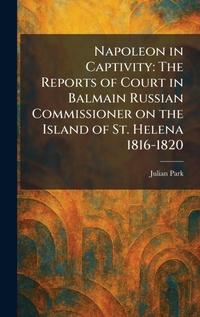
Napoleon in Captivity
Description
"Napoleon in Captivity: The Reports of Court in Balmain Russian Commissioner on the Island of St. Helena 1816-1820" offers a unique diplomatic window into the final years of Napoleon Bonaparte. Through the meticulous reports of Count Balmain, the Russian envoy stationed on the remote island of St. Helena, this work provides an authentic account of the former emperor's life in exile. The narrative captures the complex interpersonal dynamics between the British captors, the foreign commissioners, and the French retinue at Longwood House.
Focused on the period between 1816 and 1820, these dispatches reveal the political tensions and surveillance that defined Napoleon's confinement. Balmain's observations provide critical insight into the health, state of mind, and daily activities of the fallen leader, as well as the international intrigue that persisted even after his defeat at Waterloo. This historical collection serves as a vital primary source for scholars and enthusiasts of the Napoleonic era, offering a perspective that balances official duty with candid observation of one of history's most influential figures during his twilight years.
This work has been selected by scholars as being culturally important, and is part of the knowledge base of civilization as we know it. This work was reproduced from the original artifact, and remains as true to the original work as possible. Therefore, you may see the original copyright references, library stamps (as most of these works have been housed in our most important libraries around the world), and other notations in the work.
This work is in the public domain in the United States of America, and possibly other nations. Within the United States, you may freely copy and distribute this work, as no entity (individual or corporate) has a copyright on the body of the work.
As a reproduction of a historical artifact, this work may contain missing or blurred pages, poor pictures, errant marks, etc. Scholars believe, and we concur, that this work is important enough to be preserved, reproduced, and made generally available to the public. We appreciate your support of the preservation process, and thank you for being an important part of keeping this knowledge alive and relevant.