

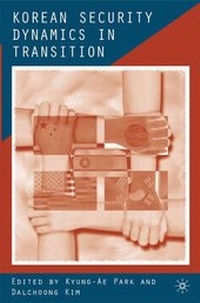
Korean Security Dynamics in Transition
Published on 18. October 2001
Book
Hardback
XIV, 209 pages
978-0-312-23874-2 (ISBN)
Description
This edited volume brings together the work of ten distinguished scholars and leading experts on Korean politics to critically analyze the key factors and issues that are shaping a newly emerging security regime on and around the Korean peninsula. The Korean security regime is expected to undergo a swift structural change in the coming years, given new trilateral U.S.-South Korea-Japan relations, U.S.-Japan security cooperation, and increasing rivalry between China and the U.S. and China and Japan. North Korea's most recent initiatives to reach out to the international community have resulted in historic agreements on diplomatic normalization talks with the U.S. and Japan in March 2000. These talks and the first high level visit by North Korean officials to the United States will restructure the security dynamics on the Korean peninsula.
Reviews / Votes
"At a time of extraordinary developments in inter-Korean relations, this book offers a valuable and highly informed analysis of these changes and their impact on the Northeast Asian region and the United States. Readable, informative, and balanced, Korean Security Dynamics in Transition should be widely read by scholars, policy-makers, and all members of the general public who have an interest in this critical and rapidly changing area of the world." - Professor Charles K. Armstrong, Center for Korean Research, Columbia UniversityMore details
Other editions
Additional editions
K. Park | D. Kim
Korean Security Dynamics in Transition
E-Book
06/2001
Palgrave MacMillan
from
€187.99
Available for download
Persons
KYUNG-AE PARK teaches in the Department of Political Science and holds the Korea Foundation Chair of the Institute of Asian Research at the University of British Columbia, Canada. She is currently President of the Association of Korean Political Studies in North America. She has previously taught at Mercer University and Franklin and Marshall College in the U.S. Park is co-author of China and North Korea: Politics of Integration and Modernization. She has recently made three trips to North Korea.
DALCHOONG KIM is currently President of the Sejong Institute in Seoul, Korea. He previously served as Dean of the Graduate School of Public Administration and Director of the Institute for East and West Studies at Yonsei University. He has been an adviser to the South Korean government in the field of Foreign Affairs since the 1970's.
DALCHOONG KIM is currently President of the Sejong Institute in Seoul, Korea. He previously served as Dean of the Graduate School of Public Administration and Director of the Institute for East and West Studies at Yonsei University. He has been an adviser to the South Korean government in the field of Foreign Affairs since the 1970's.
Content
Introduction The Nature and Evolution of the Legitimacy War between Pyongyang and Seoul South Korea's Security Strategies and Initiatives toward North Korea North Korea's Security Strategies and Initiatives toward South Korea The Future of U.S. Forces in Korea North Korea's Defensive Power and U.S.-North Korea Relations U.S.-North Korean Bilateral Relations and South Korean Security The Rise of U.S.-China Rivalry and Its Implications for the Korean Peninsula U.S.-Japan Security Cooperation and the Two Koreas China and Japan: Rivalry or Cooperation on the Korean Peninsula