

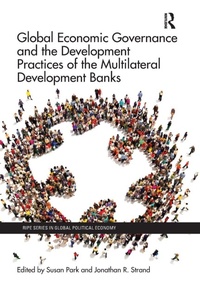
Global Economic Governance and the Development Practices of the Multilateral Development Banks
1st Edition
Published on 14. August 2020
Book
Paperback/Softback
234 pages
978-0-367-59818-1 (ISBN)
Description
As pillars of the post-1945 international economic system the Regional and Sub-Regional Development Banks (RSDBs) have long been considered mini-World Banks, reiterating the policy approach of the largest official multilateral development lender in the world. The main objective of the collection is to identify what role the RSDBs play in global economic governance and why.
This edited collection draws together cutting edge original research on these understudied institutions. In the burgeoning sub-field of global economic governance as well as the broader study of international organisations (IOs), too often the focus remains on the World Bank and the International Monetary Fund (IMF). Second-order IOs, such as the RSDBs, receive much less attention despite their longevity and regional importance. This volume corrects this oversight by bringing together methodologically diverse research on the RSDBs that interrogates the role and impact of these organisations in global economic governance.
The book investigates: the African Development Bank (AfDB); the Asian Development Bank (AsDB); the Inter-American Development Bank (IDB), and the European Bank for Reconstruction and Development (EBRD) and select sub-regional development banks in comparison to the World Bank Group. It will be of great interest to students and scholars of IPE, IR and Development Studies.
This edited collection draws together cutting edge original research on these understudied institutions. In the burgeoning sub-field of global economic governance as well as the broader study of international organisations (IOs), too often the focus remains on the World Bank and the International Monetary Fund (IMF). Second-order IOs, such as the RSDBs, receive much less attention despite their longevity and regional importance. This volume corrects this oversight by bringing together methodologically diverse research on the RSDBs that interrogates the role and impact of these organisations in global economic governance.
The book investigates: the African Development Bank (AfDB); the Asian Development Bank (AsDB); the Inter-American Development Bank (IDB), and the European Bank for Reconstruction and Development (EBRD) and select sub-regional development banks in comparison to the World Bank Group. It will be of great interest to students and scholars of IPE, IR and Development Studies.
More details
Series
Language
English
Place of publication
London
United Kingdom
Publishing group
Taylor & Francis Ltd
Target group
College/higher education
Postgraduate and Undergraduate
Dimensions
Height: 234 mm
Width: 156 mm
Thickness: 14 mm
Weight
401 gr
ISBN-13
978-0-367-59818-1 (9780367598181)
Copyright in bibliographic data and cover images is held by Nielsen Book Services Limited or by the publishers or by their respective licensors: all rights reserved.
Schweitzer Classification
Other editions
Additional editions
Susan Park | Jonathan R. Strand
Global Economic Governance and the Development Practices of the Multilateral Development Banks
Book
09/2015
1st Edition
Routledge
€231.80
Shipment within 10-20 days
Susan Park | Jonathan R. Strand
Global Economic Governance and the Development Practices of the Multilateral Development Banks
E-Book
08/2015
Routledge
€58.99
Available for download
Susan Park | Jonathan R. Strand
Global Economic Governance and the Development Practices of the Multilateral Development Banks
E-Book
08/2015
Routledge
€59.49
Available for download
Persons
Susan Park is an Associate Professor in International Relations at the University of Sydney. Susan has been a Visiting Scholar at George Washington University, the London School of Economics, at American University and a Visiting Scholar at the Centennial Centre for Political Science and Public Affairs in Washington, DC.
Jonathan R. Strand is an Associate Professor of Political Science at the University of Nevada, Las Vegas. Previously he taught at Niagara University and held a research position at the United Nations University's Institute of Advanced Studies (Japan).
Jonathan R. Strand is an Associate Professor of Political Science at the University of Nevada, Las Vegas. Previously he taught at Niagara University and held a research position at the United Nations University's Institute of Advanced Studies (Japan).
Content
Part One: Explaining the Policies of the MDBs Chapter One: Susan Park (University of Sydney) and Jonathan R. Strand (University of Nevada Las Vegas), Global Economic Governance and the Development Practices of the Multilateral Development Banks. Chapter Two: Yasumasa Komori (Michigan State University), The Asian Development Bank: Joining the Fight Against Corruption? Chapter Three: Kenneth J. Retzl (University of Nevada, Las Vegas), The Inter-American Development Bank, Poverty Alleviation, and the Millennium Development Goals. Chapter Four: Anders Uhlin (Lund University), Civil Society and Policy Reforms in the Asian Development Bank. Chapter Five: Karen A. Mingst (University of Kentucky), The African Development Bank: From Follower to Broker and Partner. Chapter Six: Daniel B. Braaten (Texas Lutheran University), Ambivalent Engagement: Human Rights and the Multilateral Development Banks Part Two: The Role of the MDBs in the International Political Economy Chapter Seven: Jonathan R. Strand and Michael W. Trevathan (University of Nevada, Las Vegas), Implications of Accommodating Rising Powers for the Regional Development Banks. Chapter Eight: Chris Humphrey (University of Zurich), The "Hassle Factor" of MDB Lending and Borrower Demand in Latin America. Chapter Nine: Stuart Shields (Manchester University), The European Bank for Reconstruction and Development as Organic Intellectual of Neoliberal Common Sense in Post-Communist Transition. Chapter Ten: Tina M. Zappile (Richard Stockton College), Sub-Regional Development Banks: Development as Usual? Chapter Eleven: Jonathan R. Strand (as above) and Susan Park (as above): The RDBs in the Twenty-First Century