

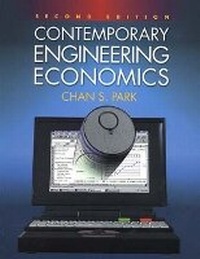
Contemporary Engineering Economics
2nd Edition
Published on 31. January 1997
Book
Paperback/Softback
840 pages
978-0-201-83598-4 (ISBN)
Description
The new edition of the bestselling text, Contemporary Engineering Economics, once again shows students the importance of how sound economic decision-making influences engineering design. Chan Park's logical and comprehensive coverage of the subject enables students to be participants in projects requiring financial analysis. The text is noted for its clear and accessible explanations, examples, and problems which build students' problems solving skills and confidence. By using an extensive set of engineering applications from a variety of disciplines, the author demonstrates the relevance and importance of engineering economics. The extensive use of computer tools underscores the textbook's contemporary approach.
More details
Edition
2nd edition
Language
English
Place of publication
United States
Publishing group
Pearson Education (US)
Target group
College/higher education
Dimensions
Height: 242 mm
Width: 194 mm
Thickness: 37 mm
Weight
1365 gr
ISBN-13
978-0-201-83598-4 (9780201835984)
Copyright in bibliographic data and cover images is held by Nielsen Book Services Limited or by the publishers or by their respective licensors: all rights reserved.
Schweitzer Classification
Other editions
New editions
Book
08/2001
3rd Edition
Pearson
€106.45
Article exhausted; check for reprint
Person
Dr. Chan S. Park is an Alumni Professor of Industrial & Systems Engineering at Auburn University. He holds industrial engineering degrees from Purdue University (M.S.) and the Georgia Institute of Technology (Ph.D.). He is a licensed professional engineer in the state of Florida.
Dr. Park has written numerous technical papers on economic decision analysis and manufacturing economics, and he is the co-author of Advanced Engineering Economics published by John Wiley and Sons (1990). He has received several research awards for his papers on economics, including the 1987 Alfred V. Bodine SME Award from the Society of Manufacturing Engineers for the best paper on machine tool economics; he is a two-time recipient of the Eugene L. Grant Award for the best paper published in The Engineering Economist (1990, 1991); and he has also received the Outstanding Publication Award from the Institute of Industrial Engineers (1991). Dr. Park has held office for the Institute of Industrial Engineers and the American Society of Engineering Education. He has been the manuscript editor for The Engineering Economist since 1987.
Dr. Park has written numerous technical papers on economic decision analysis and manufacturing economics, and he is the co-author of Advanced Engineering Economics published by John Wiley and Sons (1990). He has received several research awards for his papers on economics, including the 1987 Alfred V. Bodine SME Award from the Society of Manufacturing Engineers for the best paper on machine tool economics; he is a two-time recipient of the Eugene L. Grant Award for the best paper published in The Engineering Economist (1990, 1991); and he has also received the Outstanding Publication Award from the Institute of Industrial Engineers (1991). Dr. Park has held office for the Institute of Industrial Engineers and the American Society of Engineering Education. He has been the manuscript editor for The Engineering Economist since 1987.
Content
1. Engineering Economic Decisions. Economic Decisions. Role of Engineers in Business. Large-Scale Engineering Projects. Types of Engineering Economic Decisions. Short-Term Operational Economic Decisions. Summary. 2. Equivalence and Interest Formulas. Interest: The Cost of Money. Economic Equivalence. Development of Interest Formulas. Unconventional Equivalence Calculations. Computer Notes. Summary. Self-Test Questions. Problems. 3. Extending Equivalence to Real World Transactions. Nominal and Effective Interest Rates. Equivalence Calculations When Payment Periods and Compounding. Periods Coincide. Equivalence Calculations When Payments Periods Differ from Compounding Periods. Equivalence Calculations with Continuous Payments. Changing Interest Rates. Commercial Loan Transactions. Variable Mortgages. Investment in Bonds. Computer Notes. Summary. Self-Test Questions. Problems. 4. Present Worth Analysis. Describing Project Cash Flows. Initial Project Screening Method. Present Worth Analysis. Variations to PW Analysis. Comparing Mutually Exclusive Projects. Computer Notes. Summary. Self-Test Questions. Problems. 5. Annual Equivalent Worth Analysis. Annual Equivalent Criterion. Applying Annual Worth Analysis. Mutually Exclusive Projects. Design Economics. Computer Notes. Summary. Self-Test Questions. Problems. 6. Rate of Return Analysis. Rate of Return. Computational Methods for Determining i. Internal Rate of Return Criterion. Mutually Exclusive Alternatives. Computer Notes. Summary. Self-Test Questions. Problems. Appendix 6A: Computing IRR for Nonsimple Investments. Predicting Multiple is. Net Investment Test. External Interest Rate for Mixed Investments. Calculation of Return on Invested Capital. Summary. Problems. 7. Depreciation. Asset Depreciation. Some Factors of Asset Depreciation. Book Depreciation Methods. Tax Depreciation Methods. Depletion. Additions or Improvements to Depreciable Assets. Computer Notes. Summary. Self-Test Questions. Problems. 8. Income Taxes. Net Income. Corporate Income Taxes. Tax Treatment of Gains or Losses for Depreciable Assets. Income Tax Rate for Economic Analysis. Summary. Self-Test Questions. Problems. 9. Developing Project Cash Flows. Project Proposals and Classifications. Incremental Cash Flows. Developing Cash Flow Statements. Generalized Cash Flow Approach. Computer Notes. Summary. Self-Test Questions. Problems. Appendix 9A: Lease Versus Buy Decisions. General Elements of Leases. Lease-or-Buy Decision by the Lessee. The Lessors Point of View. Summary. Problems. 10. Replacement Decisions. Comparison Between Defender and Challenger. Economic Service Life. Replacement Analysis When Required Service is Long. Computer Notes. Summary. Self-Test Problems Problems. 11. Inflation and Economic Analysis. The Meaning and Measure of Inflation. Equivalence Calculation Under Inflation. Effects of Inflation on Project Cash Flows. Rate of Return Analysis Under Inflation. Computer Notes. Summary. Self-Test Questions. Problems. 12. Project Risk and Uncertainty. Origins of Project Risk. Methods of Describing Project Risk. Probability Concepts for Investment Decisions. Probability Distribution of NPW. Computer Notes. Summary. Self-Test Questions. Problems. Appendix 12A: Risk Simulation. Computer Simulation. Model Building. Monte Carlo Sampling. Simulation Output Analysis. Dependent Random Variables. Summary. Problems. 13. Capital Budgeting Decisions. Methods of Financing. Cost of Capital. Choice of Minimum Attractive Rate of Return. Summary. Self-Test Questions. Problems. 14. Economic Analyses in the Public Sector. The Framework of Benefit-Cost Analysis. Valuation of Benefits and Costs. Benefit-Cost Ratios. Analysis of Public Projects Based on Cost-Effectiveness. Summary. Self-Test Questions. Problems. Appendix A: Interest Factors for Discrete Compounding. Appendix B: Internet Tool - World Wide Web Site for Contemporary Engineering Economics. Answers to Self-Test Questions and Selected Problems.