

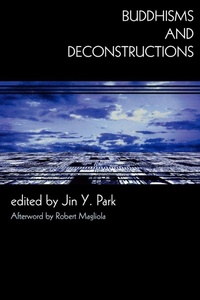
Buddhisms and Deconstructions
Published on 10. March 2006
Book
Paperback/Softback
312 pages
978-0-7425-3418-6 (ISBN)
Description
Buddhisms and Deconstructions considers the connection between Buddhism and Derridean deconstruction, focusing on the work of Robert Magliola. Fourteen distinguished contributors discuss deconstruction and various Buddhisms-Indian, Tibetan, and Chinese (Chan)-followed by an afterword in which Magliola responds directly to his critics.
Reviews / Votes
This set of essays crystallizes decades of important developments in the dialogue between Buddhism and post-modern thought, revealing their relevance to each other and to the future of philosophical reflection East and West. -- John Makransky, associate professor of Buddhism and comparative theology, Boston College These essays seriously engage the philosophical parallels between Buddhism and deconstruction in a manner that is both well-informed and largely free of jargon. In their depth and breadth, they deliver the kind of mutual elucidation that all philosophical dialogue aspires to, without skirting the serious challenges of truly cross-cultural philosophizing. Buddhisms and Deconstructions helps us better appreciate the profound and subtle implications of the Buddhist notions of dependent arising, emptiness and the two truths, by bringing them together with deconstruction to address such problems as self and identity, language, and referentiality. -- William Waldron, department of religion, Middlebury College It could serve as an accessible introduction to an often difficult subject.... Buddhisms and Deconstructions provide a number of enjoyable reads....and reveals, with much clarity and depth, a breadth of philosophical insight comparing Buddhist and Derridean thought. -- Victor Forte * Springer Science and Business Media * The gem of this collection is Magliola's response...more intriguing are his replies, both positive and critical, to other essays in this book. * Journal of Chinese Religions * Buddhisms and Deconstructions generously provides us with an intriguing reading in search of a Middle Path that goes beyond all opposition and dualism, envisioning a mutual-enriching dialogue by way of cross-bordering, beyond all limits, categorizations, and self-enclosure. -- Vincent Shen, Lee Chair in Chinese Thought and Culture, Department of Philosophy and Department of East Asian Studies, University of Toronto Buddhisms and Deconstructions, edited by Jin Y. Park, contains a number of fascinating articles dealing with a comparison between two systems of thought, one a long-standing tradition from the East and the other a contemporary movement in the West....Park and her colleagues had convincingly demonstrated multiple levels of connection and why deconstructionism works so well in a Buddhist context. Therefore, it is clear that the contributors have gone a long way toward achieving the goal of forcing out of stagnancy and reinvigorating the noble task of linking Buddhism with Western philosophy. -- Steven Heine, Florida International University * Philosophy East and West *More details
Series
Language
English
Place of publication
United States
Publishing group
Bloomsbury Publishing Plc
Target group
College/higher education
Dimensions
Height: 229 mm
Width: 152 mm
Thickness: 19 mm
Weight
512 gr
ISBN-13
978-0-7425-3418-6 (9780742534186)
Copyright in bibliographic data and cover images is held by Nielsen Book Services Limited or by the publishers or by their respective licensors: all rights reserved.
Schweitzer Classification
Other editions
Additional editions
E-Book
03/2006
1st Edition
Rowman & Littlefield Publishers
€47.49
Available for download
Persons
Jin Y. Park is assistant professor in the department of philosophy and religion at American University.
Content
Part 1 Introduction
Part 2 Part One: Buddhism and Deconstruction
Chapter 3 1. Naming the Unnameable: Dependant Co-arising and Difference
Chapter 4 2. Nagarjuna and Deconstruction
Part 5 Part Two: Buddhism Deconstructs
Chapter 6 3. Derridean and Madhyamika Buddhist Theories of Deconstruction
Chapter 7 4. Indra's Postmodern Net
Part 8 Part Three: Deconstructing Buddhism
Chapter 9 5. Deconstructive and Foundationalist Tendencies in Indian and Tibetan Buddhism
Chapter 10 6. Ji Zang's Suynata-Speech: Derridean Denegation with Buddhist Negations
Part 11 Part Four: Chan/Zen Buddhist Deconstruction
Chapter 12 7. The Chan Deconstruction of Buddha Nature
Chapter 13 8. Sudao: Repeating the Question in Chan Discourse
Part 14 Part Five: Deconstructing Life-Worlds
Chapter 15 9. The Veil Rent in Twain: A Buddhist Reading of Robert Magliola's Deconstructive Chiasm
Chapter 16 10. emmanuel, robert
Part 17 Part Six: Questioning the Self, Questioning the Dialogue
Chapter 18 11. Sartre, Phenomenology and the Buddhist No-Self Theory
Chapter 19 12. Self and Self Image
Chapter 20 13. Zen Flesh, Bones and Blood: Deconstructing Inter-Religious Dialogue
Part 21 Afterword
Part 22 Selected Bibliography
Part 23 Glossary of Chinese Characters
Part 24 Credits
Part 25 Contributors
Part 2 Part One: Buddhism and Deconstruction
Chapter 3 1. Naming the Unnameable: Dependant Co-arising and Difference
Chapter 4 2. Nagarjuna and Deconstruction
Part 5 Part Two: Buddhism Deconstructs
Chapter 6 3. Derridean and Madhyamika Buddhist Theories of Deconstruction
Chapter 7 4. Indra's Postmodern Net
Part 8 Part Three: Deconstructing Buddhism
Chapter 9 5. Deconstructive and Foundationalist Tendencies in Indian and Tibetan Buddhism
Chapter 10 6. Ji Zang's Suynata-Speech: Derridean Denegation with Buddhist Negations
Part 11 Part Four: Chan/Zen Buddhist Deconstruction
Chapter 12 7. The Chan Deconstruction of Buddha Nature
Chapter 13 8. Sudao: Repeating the Question in Chan Discourse
Part 14 Part Five: Deconstructing Life-Worlds
Chapter 15 9. The Veil Rent in Twain: A Buddhist Reading of Robert Magliola's Deconstructive Chiasm
Chapter 16 10. emmanuel, robert
Part 17 Part Six: Questioning the Self, Questioning the Dialogue
Chapter 18 11. Sartre, Phenomenology and the Buddhist No-Self Theory
Chapter 19 12. Self and Self Image
Chapter 20 13. Zen Flesh, Bones and Blood: Deconstructing Inter-Religious Dialogue
Part 21 Afterword
Part 22 Selected Bibliography
Part 23 Glossary of Chinese Characters
Part 24 Credits
Part 25 Contributors