

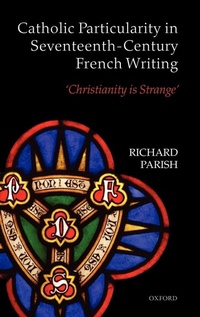
Catholic Particularity in Seventeenth-Century French Writing
'Christianity is Strange'
Published on 28. July 2011
Book
Hardback
240 pages
978-0-19-959666-9 (ISBN)
Description
le christianisme est etrange' - Pascal, Pensees
Pascal's assertion that 'Christianity is strange', provides the theme for Richard Parish's exploration of Catholic particularity, as it was expressed in the writing of the French seventeenth century. This was a period of quite exceptional fertility in a range of genres: apologetics, sermons, devotional manuals, catechisms, martyr tragedies, lyric poetry, polemic and spiritual autobiography. Parish examines a broad cross-section of this corpus with reference to the topics of apologetics, physicality, language, discernment, polemics and salvation; and draws evidence both from canonical figures (Pascal, Bossuet, Fenelon, St Francois de Sales, Madame Guyon) and from less easily-available texts.
Parish aims to consider all those distinctive features that the heritage of the Catholic Reformation brought to the surface in France, and to do so in support of the numerous ways in which Christian doctrine could be understood as being strange: it is by turns contrary to expectations, paradoxical, divisive, carnal and inexpressible. These features are exploited imaginatively in the more conventional literary forms, didactically in pulpit oratory and empirically in the accounts of personal spiritual experience. In addition they are manifested polemically in debates surrounding penance, authority, inspiration and eschatology, and often push orthodoxy to its limits and beyond in the course of their articulation.
This volume provides an unsettling account of a belief system to which early-modern France often unquestioningly subscribed, and shows how the element of cultural assimilation of Catholic Christianity into much of Western Europe only tenuously contains a subversive and counter-intuitive creed. The degree to which that remains the case will be for the reader to decide.
Pascal's assertion that 'Christianity is strange', provides the theme for Richard Parish's exploration of Catholic particularity, as it was expressed in the writing of the French seventeenth century. This was a period of quite exceptional fertility in a range of genres: apologetics, sermons, devotional manuals, catechisms, martyr tragedies, lyric poetry, polemic and spiritual autobiography. Parish examines a broad cross-section of this corpus with reference to the topics of apologetics, physicality, language, discernment, polemics and salvation; and draws evidence both from canonical figures (Pascal, Bossuet, Fenelon, St Francois de Sales, Madame Guyon) and from less easily-available texts.
Parish aims to consider all those distinctive features that the heritage of the Catholic Reformation brought to the surface in France, and to do so in support of the numerous ways in which Christian doctrine could be understood as being strange: it is by turns contrary to expectations, paradoxical, divisive, carnal and inexpressible. These features are exploited imaginatively in the more conventional literary forms, didactically in pulpit oratory and empirically in the accounts of personal spiritual experience. In addition they are manifested polemically in debates surrounding penance, authority, inspiration and eschatology, and often push orthodoxy to its limits and beyond in the course of their articulation.
This volume provides an unsettling account of a belief system to which early-modern France often unquestioningly subscribed, and shows how the element of cultural assimilation of Catholic Christianity into much of Western Europe only tenuously contains a subversive and counter-intuitive creed. The degree to which that remains the case will be for the reader to decide.
Reviews / Votes
This book combines a comprehensive understanding of reference works and a great knowledge used as always with pertinence, as well as methodological rigor and analytical finesse ... Richard Parish's book is an interdisciplinary work that thinkers in theology, philosophy, literature and history will enormously benefit from. * Michael O'Dwyer, Revue Bossuet * What is perhaps most impressive about this book is the cumulative effect of the various chapters, which revisit various important questions without ever being repetitive. It represents an essential contribution to scholarship on one of the most fascinating ages of religious thought. * Nicholas Hammond, Modern Language Review * Parish provides much food for thought, and, inevitably, some potential for debate. * John Campbell, French Studies * Parish presents a dense argument cogently and attractively ... a highly stimulating discussion of a period with which Anglophone students deserve nearer aquaintance. * Thomas Palmer, Expository Times * Parish succeeds in his project of "constructive defamiliarization," showing that Christianity was and is strange. In the process, he eludicates a vibrant written religious culture. To the delight of specialists and nonspecialists alike, every quotation is given in both English and French, making this book an excellent way into early modern French Catholicism, regardless of one's disciplinary interests. * Christopher J. Lane, The Sixteenth Century Journal *More details
Language
English
Place of publication
Oxford
United Kingdom
Target group
College/higher education
Professional and scholarly
Dimensions
Height: 240 mm
Width: 161 mm
Thickness: 18 mm
Weight
529 gr
ISBN-13
978-0-19-959666-9 (9780199596669)
Copyright in bibliographic data and cover images is held by Nielsen Book Services Limited or by the publishers or by their respective licensors: all rights reserved.
Schweitzer Classification
Other editions
Additional editions
Richard Parish
Catholic Particularity in Seventeenth-Century French Writing
'Christianity is Strange'
E-Book
07/2011
OUP eBook
€66.49
Available for download
Person
Content
Introduction ; 1. Particularity and apologetics ; 2. Particularity and physicality ; 3. Particularity and language (i): talking about God ; 4. Particularity and language (ii): talking for God ; 5. Particularity and discernment ; 6. Particularity and polemic (i): Jansenism ; 7. Particularity and polemic (ii): Quietism ; 8. Particularity and salvation ; Conclusion