

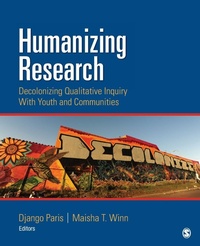
Humanizing Research
Decolonizing Qualitative Inquiry With Youth and Communities
1st Edition
Published on 11. April 2013
Book
Paperback/Softback
304 pages
978-1-4522-2539-5 (ISBN)
Description
*Winner of the 2015 Outstanding Book Award from the American Educational Research Association's Qualitative Research Special Interest Group (SIG).*
What does it mean to conduct research for justice with youth and communities who are marginalized by systems of inequality based on race, ethnicity, sexuality, citizenship status, gender, and other categories of difference? In this collection, editors Django Paris and Maisha Winn have selected essays written by top scholars in education on humanizing approaches to qualitative and ethnographic inquiry with youth and their communities. Vignettes, portraits, narratives, personal and collaborative explorations, photographs, and additional data excerpts bring the findings to life for a better understanding of how to use research for positive social change.
What does it mean to conduct research for justice with youth and communities who are marginalized by systems of inequality based on race, ethnicity, sexuality, citizenship status, gender, and other categories of difference? In this collection, editors Django Paris and Maisha Winn have selected essays written by top scholars in education on humanizing approaches to qualitative and ethnographic inquiry with youth and their communities. Vignettes, portraits, narratives, personal and collaborative explorations, photographs, and additional data excerpts bring the findings to life for a better understanding of how to use research for positive social change.
Reviews / Votes
"The text is written in an engaging, conversational tone and presents powerful stories that will connect with students and others interested in empowering under-represented groups (focused on adolescents/youth) through community based research." -- Susan Letvak "This text is a rich repository, covers wide variety of oppressed research participants and a must read for emerging and valuable sub-field of humanizing research within qualitative research paradigm." -- Shailesh Shukla "I find it to be an overall excellent addition to the conversation on humanizing qualitative research and in general on the conversation on Critical Qualitative Research and its possible directions for development." -- Patricio R. OrtizMore details
Language
English
Place of publication
Thousand Oaks
United States
Target group
College/higher education
Dimensions
Height: 235 mm
Width: 191 mm
Thickness: 17 mm
Weight
575 gr
ISBN-13
978-1-4522-2539-5 (9781452225395)
Copyright in bibliographic data and cover images is held by Nielsen Book Services Limited or by the publishers or by their respective licensors: all rights reserved.
Schweitzer Classification
Persons
Django Paris is a James A. and Cherry A. Banks Associate Professor of Multicultural Education and the director of the Banks Center for Educational Justice at The University of Washington at Seattle. He was previously an Assistant Professor of Language and Literacy in the College of Education at Michigan State University, and faculty at Arizona State University. Paris received a B.A. in English from the University of California, Berkeley, an M.A. and a Ph.D. from Stanford University. He spent 6 years as an English Language Arts teacher in California, Arizona and the Dominican Republic before entering graduate school. Paris is also Associate Director of the Bread Loaf School of English, a summer graduate program of Middlebury College. He has published research in numberous journals including the Harvard Educational Review, Educational Researcher, and the International Journal of Qualitative Studies in Education. He has recently published a book entitled Culturally Sustaining Pedagogies: Teaching and Learning for Justice in a changing World with Columbia University Press (2017) and Language Across Difference with Cambridge University Press (2011). Maisha T. Winn obtained her Ph.D. at University of California, Berkeley. Prior to that, she was a public elementary and high school teacher in Sacramento, CA. Currently, she is the Susan J. Cellmer Chair of English Education in Curriculum and Instruction at the University of Wisconsin, Madison. She has published research in a range of Journals (Harvard Educational Review, Race, Ethnicity and Education, Anthropology and Education Quarterly, Journal of African American History, and Research in the Teaching of English, Written Communication and English Education). She published Writing in Rhythm: Spoken Word Poetry in Urban Classrooms (published under Maisha T. Fisher by Teachers College Press), Girl Time: Literary, Justice and the School-to-prison pipeline (Teachers College Press), Writing instruction in the culturally relevant classroom (co-authored with Latrise Johnson for NCTE), and Education and Incarceration (co-edited with Erica Meiners for Routledge).
Content
Part I: Trust, Feeling, and Change: What We Learn, What We Share, What We Do
Chapter 1: Too Close to the Work/There is Nothing Right Now - Daysi Strong, Maria Duarte, Christina Gomez, Eric Meiners
Chapter 2: The Space Between: Listening and Story-ing as Foundations for Projects in Humanization (PiH) - Valerie Kinloch, Timothy San Pedro
Chapter 3: Conducting Humanizing Research with LGBTQQ Youth through Dialogic Communication, Consciousness Raising, and Action - Mollie Blackburn
Part II: Navigating Institutions and Communities as Participatory Activist Researchers: Tensions, Possibilities, and Transformations
Chapter 4: Humanizing Research in Dehumanizing Spaces: The Challenges of Conducting Participatory Action Research with Youth in Schools - Jason Irizarry, Tara Brown
Chapter 5: Activist Ethnography with Indigenous Youth--Lessons from Humanizing Research on Language and Education - Teresa L. McCarty, Leisy T. Wyman, Sheilah E. Nichols
Chapter 6: Critical Media Ethnography: Youth Media Research - Korina Jocson
Part III: The Complex Nature of Power, Relationships, and Responsibilities
Chapter 7: La Carta de Responsabilidad: The Problem of Exiting the Field - Ariana Mangual Figueroa
Chapter 8: Critical A Double-Dutch Methodology: A Kinetic Approach to Qualitative Educational Research - Keisha Green
Chapter 9: Revisiting the Keres Study: Learning from the Past to Engage Indigenous Youth, Elders and Teachers in Intergenerational Collaborative Research and Praxis - Eunice Romero-Little, Christine Sims, A-Dae Romero
Part IV: Revisiting Old Conversations toward New Approaches in Humanizing Research
Chapter 10: The Ethnographic Method in Educational Research: Why I Study Culture, and Why It Matters - David E. Kirkland
Chapter 11: Critical for Whom?: Theoretical and Methodological Dilemmas in Critical Approaches to Language Reseach - Mariana Souto-Manning
Chapter 12: R-words: Refusing Research - Eve Tuck, K. Wayne Yang
Epilogue: Reflecting Forward on Humanizing Approaches - Maisha Winn
Chapter 1: Too Close to the Work/There is Nothing Right Now - Daysi Strong, Maria Duarte, Christina Gomez, Eric Meiners
Chapter 2: The Space Between: Listening and Story-ing as Foundations for Projects in Humanization (PiH) - Valerie Kinloch, Timothy San Pedro
Chapter 3: Conducting Humanizing Research with LGBTQQ Youth through Dialogic Communication, Consciousness Raising, and Action - Mollie Blackburn
Part II: Navigating Institutions and Communities as Participatory Activist Researchers: Tensions, Possibilities, and Transformations
Chapter 4: Humanizing Research in Dehumanizing Spaces: The Challenges of Conducting Participatory Action Research with Youth in Schools - Jason Irizarry, Tara Brown
Chapter 5: Activist Ethnography with Indigenous Youth--Lessons from Humanizing Research on Language and Education - Teresa L. McCarty, Leisy T. Wyman, Sheilah E. Nichols
Chapter 6: Critical Media Ethnography: Youth Media Research - Korina Jocson
Part III: The Complex Nature of Power, Relationships, and Responsibilities
Chapter 7: La Carta de Responsabilidad: The Problem of Exiting the Field - Ariana Mangual Figueroa
Chapter 8: Critical A Double-Dutch Methodology: A Kinetic Approach to Qualitative Educational Research - Keisha Green
Chapter 9: Revisiting the Keres Study: Learning from the Past to Engage Indigenous Youth, Elders and Teachers in Intergenerational Collaborative Research and Praxis - Eunice Romero-Little, Christine Sims, A-Dae Romero
Part IV: Revisiting Old Conversations toward New Approaches in Humanizing Research
Chapter 10: The Ethnographic Method in Educational Research: Why I Study Culture, and Why It Matters - David E. Kirkland
Chapter 11: Critical for Whom?: Theoretical and Methodological Dilemmas in Critical Approaches to Language Reseach - Mariana Souto-Manning
Chapter 12: R-words: Refusing Research - Eve Tuck, K. Wayne Yang
Epilogue: Reflecting Forward on Humanizing Approaches - Maisha Winn