

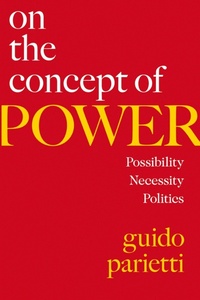
On the Concept of Power
Possibility, Necessity, Politics
Published on 25. March 2025
Book
Paperback/Softback
272 pages
978-0-19-780683-8 (ISBN)
Description
"Power" is the central organizing concept for politics. However, despite decades of debate across political science, sociology, and philosophy, scholars have not yet settled on a proper definition of power. Existing definitions fail because they are either circular or so far removed from the ordinary, quotidien meaning of power that they cannot credibly claim to be about the same concept. Political science has looked at how power works, but according to Guido Parietti, fails to define what power means.
In On the Concept of Power, Parietti proposes a more proper definition of power--as the condition of having available possibilities and representing them as such--and examines its implications for the study of politics, both empirical and normative. By neglecting the category of possibility, significant portions of political science and philosophy become incapable of conceptualizing power, and therefore politics. Specifically, Parietti asserts that the main failure of political science is in obscuring power's correspondence to the category of possibility in favor of causality and probability; political philosophy, on the other hand, tends to prioritize various forms of a teleologically oriented normativity. All these approaches end up discarding possibility in favor of oriented potentialities, ultimately anchored to various forms of necessity, and are therefore incapable of properly conceptualizing power in accordance with its meaning in ordinary language. Bringing together different disciplinary discourses, On the Concept of Power concludes by examining the conditions for power to have an actual referent; in other words, for politics to appear in our world. In this original and ambitious critique of the prevailing approaches to political theory and political science, Parietti examines what it means to have power and what may endanger our access to and exercise of it.
In On the Concept of Power, Parietti proposes a more proper definition of power--as the condition of having available possibilities and representing them as such--and examines its implications for the study of politics, both empirical and normative. By neglecting the category of possibility, significant portions of political science and philosophy become incapable of conceptualizing power, and therefore politics. Specifically, Parietti asserts that the main failure of political science is in obscuring power's correspondence to the category of possibility in favor of causality and probability; political philosophy, on the other hand, tends to prioritize various forms of a teleologically oriented normativity. All these approaches end up discarding possibility in favor of oriented potentialities, ultimately anchored to various forms of necessity, and are therefore incapable of properly conceptualizing power in accordance with its meaning in ordinary language. Bringing together different disciplinary discourses, On the Concept of Power concludes by examining the conditions for power to have an actual referent; in other words, for politics to appear in our world. In this original and ambitious critique of the prevailing approaches to political theory and political science, Parietti examines what it means to have power and what may endanger our access to and exercise of it.
Reviews / Votes
Parietti makes a large contribution to our understanding of the vexed and contested concept of power. In addition to spot-on critiques of others' views, he develops a refreshingly original 'Arendtian' analysis of power. * Terence Ball, Professor Emeritus, Political Science and Philosophy, Arizona State University * Parietti's analysis of 'power' makes a vital contribution to our understanding of this key political concept. Taking issue with the dominant conceptualizations of 'power' as a thing, an object, or a potentiality tied to a determined end, Parietti invites us to understand it instead as a modal category that denotes open possibilities. This rethinking, inspired by Hannah Arendt's political thought, results in a meticulously researched and lucid account of 'power' that should be of great interest to political theorists, philosophers, and social scientists working on this concept. * Ayten Guendogdu, Tow Associate Professor of Political Science, Barnard College * If you think you know what 'power' means, Guido Parietti's book will make you think again, and help you along. On the Concept of Power is at once a bracing polemic and a patient reconstruction of the fundamentally 'modal' character of this elusive concept. Any scholar of politics will learn a lot from Parietti, whether they're inspired by his perspective, provoked to disagreement, or both! * Patchen Markell, Associate Professor of Government, Cornell University * Guido Parietti's On the Concept of Power is a major contribution to the history of philosophy and to social scientific analyses of power. * John P. McCormick, Professor of Political Science, University of Chicago * Bridging the gap between philosophical and social science disciplines, Parietti presents the two sides of power - its subjective representation and its objective effect. And both are unavoidable if we want to understand when an actor has power or does not have power. * Morten Bonke, Information * Parietti has given us something rare-a genuinely important, interdisciplinary book-which shows us how clarity about concepts, and especially about the concept of power, is necessary for speaking intelligently about our shared world. * S.N. Jaffe, Contemporary Political Theory *More details
Language
English
Place of publication
New York
United States
Target group
College/higher education
Edition type
New edition
Product notice
Paperback (trade)
Unsewn / adhesive bound
Dimensions
Height: 234 mm
Width: 155 mm
Thickness: 18 mm
Weight
386 gr
ISBN-13
978-0-19-780683-8 (9780197806838)
Copyright in bibliographic data and cover images is held by Nielsen Book Services Limited or by the publishers or by their respective licensors: all rights reserved.
Schweitzer Classification
Other editions
Additional editions
Book
08/2022
Oxford University Press Inc
€63.20
Shipment within 15-20 days
E-Book
05/2022
OUP eBook
€21.99
Available for download
E-Book
05/2022
OUP eBook
€21.99
Available for download
Person
Guido Parietti is Assistant Professor of Political Theory and Constitutional Democracy at James Madison College, Michigan State University.
Content
Foreword by Steven Lukes
Introduction
1. On Extant Definitions
2. The Meaning of Power
3. Power and Political Science: Causality, Probability, Necessity
4. Power and Political Theory: Domination, Normativity, Teleology
5. Power and the Space of Appearances
Bibliography
Introduction
1. On Extant Definitions
2. The Meaning of Power
3. Power and Political Science: Causality, Probability, Necessity
4. Power and Political Theory: Domination, Normativity, Teleology
5. Power and the Space of Appearances
Bibliography