

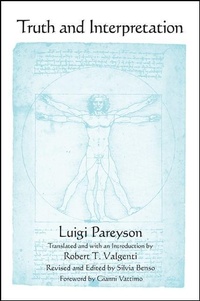
Truth and Interpretation
Published on 1. August 2013
Book
Hardback
252 pages
978-1-4384-4749-0 (ISBN)
Description
A resolute defense of philosophy and hermeneutics against the threats of dogmatism and relativism.
Luigi Pareyson (1918-1991) was one of the most important Italian philosophers to emerge after World War II and stands shoulder to shoulder with fellow hermeneutic thinkers Hans-Georg Gadamer and Paul Ricoeur. The product of a well-developed theory of interpretation that stretches back to the late 1940s, his 1971 masterpiece Truth and Interpretation provides the historical impetus and theoretical framework for the questions of existence, art, and politics that would motivate his most famous students, Umberto Eco and Gianni Vattimo. In a time when the meaning of truth as an interpretation is challenged by the chaotic din of media on the one side and the violent force of absolute claims from science, religion, and political economy on the other, Pareyson's meditation on the value of thinking that is shaped by the traditions of philosophy and yet responds to contemporary demands remains timely and pressing more than forty years after its initial publication.
Luigi Pareyson (1918-1991) was one of the most important Italian philosophers to emerge after World War II and stands shoulder to shoulder with fellow hermeneutic thinkers Hans-Georg Gadamer and Paul Ricoeur. The product of a well-developed theory of interpretation that stretches back to the late 1940s, his 1971 masterpiece Truth and Interpretation provides the historical impetus and theoretical framework for the questions of existence, art, and politics that would motivate his most famous students, Umberto Eco and Gianni Vattimo. In a time when the meaning of truth as an interpretation is challenged by the chaotic din of media on the one side and the violent force of absolute claims from science, religion, and political economy on the other, Pareyson's meditation on the value of thinking that is shaped by the traditions of philosophy and yet responds to contemporary demands remains timely and pressing more than forty years after its initial publication.
More details
Series
Language
English
Place of publication
Albany, NY
United States
Target group
Professional and scholarly
US School Grade: College Graduate Student and over
Product notice
sewn/stitched
Paper over boards
Dimensions
Height: 234 mm
Width: 155 mm
Thickness: 23 mm
Weight
517 gr
ISBN-13
978-1-4384-4749-0 (9781438447490)
Copyright in bibliographic data and cover images is held by Nielsen Book Services Limited or by the publishers or by their respective licensors: all rights reserved.
Schweitzer Classification
Other editions
Additional editions
Luigi Pareyson | Silvia Benso
Truth and Interpretation
E-Book
09/2013
1st Edition
De Gruyter
€35.99
Available for download
Persons
Robert T. Valgenti is Associate Professor of Philosophy at Lebanon Valley College. Silvia Benso is Professor of Philosophy at the Rochester Institute of Technology.
Content
Acknowledgments
Translator's Note
Foreword by Gianni Vattimo
Translator's Introduction: Luigi Pareyson's Vindication of Philosophy by Robert T. Valgenti
Preface
Introduction: Expressive Thought and Revelatory Thought
Part I: Truth and History
1. Permanent Values and Historical Process
2. The Originarity of Interpretation
Part II: Truth and Ideology
3. Philosophy and Ideology
4. The Destiny of Ideology
Part III: Truth and Philosophy
5. The Necessity of Philosophy
6. Philosophy and Common Sense
Bibliography
Index
Translator's Note
Foreword by Gianni Vattimo
Translator's Introduction: Luigi Pareyson's Vindication of Philosophy by Robert T. Valgenti
Preface
Introduction: Expressive Thought and Revelatory Thought
Part I: Truth and History
1. Permanent Values and Historical Process
2. The Originarity of Interpretation
Part II: Truth and Ideology
3. Philosophy and Ideology
4. The Destiny of Ideology
Part III: Truth and Philosophy
5. The Necessity of Philosophy
6. Philosophy and Common Sense
Bibliography
Index