

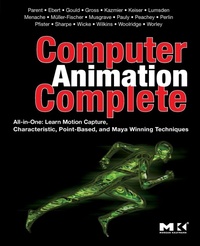
Computer Animation Complete
All-in-One: Learn Motion Capture, Characteristic, Point-Based, and Maya Winning Techniques
Published on 13. October 2009
Book
Paperback/Softback
544 pages
978-0-12-375078-5 (ISBN)
Description
A compilation of key chapters from the top MK computer animation books available today - in the areas of motion capture, facial features, solid spaces, fluids, gases, biology, point-based graphics, and Maya. The chapters provide CG Animators with an excellent sampling of essential techniques that every 3D artist needs to create stunning and versatile images. Animators will be able to master myriad modeling, rendering, and texturing procedures with advice from MK's best and brightest authors.
Divided into five parts (Introduction to Computer Animation and Technical Background, Motion Capture Techniques, Animating Substances, Alternate Methods, and Animating with MEL for MAYA), each one focusing on specific substances, tools, topics, and languages, this is a MUST-HAVE book for artists interested in proficiency with the top technology available today! Whether you're a programmer developing new animation functionality or an animator trying to get the most out of your current animation software, Computer Animation Complete: will help you work more efficiently and achieve better results. For programmers, this book provides a solid theoretical orientation and extensive practical instruction information you can put to work in any development or customization project. For animators, it provides crystal-clear guidance on determining which of your concepts can be realized using commercially available products, which demand custom programming, and what development strategies are likely to bring you the greatest success.
Divided into five parts (Introduction to Computer Animation and Technical Background, Motion Capture Techniques, Animating Substances, Alternate Methods, and Animating with MEL for MAYA), each one focusing on specific substances, tools, topics, and languages, this is a MUST-HAVE book for artists interested in proficiency with the top technology available today! Whether you're a programmer developing new animation functionality or an animator trying to get the most out of your current animation software, Computer Animation Complete: will help you work more efficiently and achieve better results. For programmers, this book provides a solid theoretical orientation and extensive practical instruction information you can put to work in any development or customization project. For animators, it provides crystal-clear guidance on determining which of your concepts can be realized using commercially available products, which demand custom programming, and what development strategies are likely to bring you the greatest success.
Reviews / Votes
"Computer Animation Complete sets the stage with a well written introduction. In this section, the first chapter discusses some of the key events in the history of animation to introduce the principles of animation and film making. This chapter is written at a non-technical level and makes very interesting reading for anyone interested in animation. The target audience, however, is experienced animators. This book does not disappoint." --School Tech Talk Blog and MacDirectory.comMore details
Language
English
Place of publication
San Francisco
United States
Publishing group
Elsevier Science & Technology
Target group
Professional and scholarly
This book is intended primarily for Computer graphic (CG) artists including animators, graphics designers and programmers, game developers, and technical directors as well as professionals in digital design and visualization, and visual effects artists in the entertainment industry, including interactive gaming and production houses (e.g., computer graphics companies such as Pixar, PDI, Dreamworks).
Product notice
Paperback (trade)
Illustrations
318 illustrations
Dimensions
Height: 237 mm
Width: 190 mm
Thickness: 32 mm
Weight
1085 gr
ISBN-13
978-0-12-375078-5 (9780123750785)
Copyright in bibliographic data and cover images is held by Nielsen Book Services Limited or by the publishers or by their respective licensors: all rights reserved.
Schweitzer Classification
Other editions
Additional editions
Rick Parent
Computer Animation Complete
All-in-One: Learn Motion Capture, Characteristic, Point-Based, and Maya Winning Techniques
E-Book
10/2009
Morgan Kaufmann
€58.95
Available for download
Person
Rick Parent is a Professor Emeritus in the Computer Science and Engineering Department of Ohio State University (OSU). As a graduate student, Rick worked at the Computer Graphics Research Group (CGRG) at OSU under the direction of Charles Csuri. In 1977, he received his Ph.D. from the Computer and Information Science (CIS) Department, majoring in Artificial Intelligence. For the next three years, he worked at CGRG first as a Research Associate, and then as Associate Director. In 1980 he co-founded and was President of The Computer Animation Company. In 1985, he joined the faculty of the CIS Department (now the Department of Computer Science and Engineering, or CSE) at Ohio State. Rick's research interests include various aspects of computer animation with special focus on animation of the human figure.
Content
Part I: Introduction to Computer Animation
1. Introduction
2. Technical Background
Part II: Motion Capture Techniques
3. Motion Capture Primer
4. The Motion Data
5. Setting Up Your Character
Part III: Animating Substances
6. Animating Facial Features
7. Animating Solid Spaces
8. Animating Fluids and Gases
9. Animating Biology
Part IV: Other Methods
10. Point-Based Animation
11. X3D Event Animation and Interpolation
Part V: Animating with MEL for MAYA
12. Maya Under the Hood
13. MEL Animation
14. The Basics of MEL Commands
15. Examples Using MEL with Solid Body Dynamics
16. Examples Using MEL in Character Rigging
1. Introduction
2. Technical Background
Part II: Motion Capture Techniques
3. Motion Capture Primer
4. The Motion Data
5. Setting Up Your Character
Part III: Animating Substances
6. Animating Facial Features
7. Animating Solid Spaces
8. Animating Fluids and Gases
9. Animating Biology
Part IV: Other Methods
10. Point-Based Animation
11. X3D Event Animation and Interpolation
Part V: Animating with MEL for MAYA
12. Maya Under the Hood
13. MEL Animation
14. The Basics of MEL Commands
15. Examples Using MEL with Solid Body Dynamics
16. Examples Using MEL in Character Rigging