

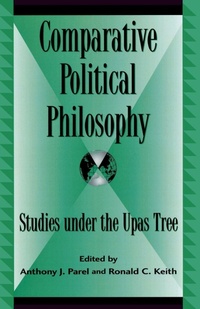
Comparative Political Philosophy
Studies under the Upas Tree
2nd Edition
Published on 8. April 2003
Book
Paperback/Softback
298 pages
978-0-7391-0610-5 (ISBN)
Description
This Lexington Books edition of Comparative Political Philosophy brings back into print a volume that was one of the first to move beyond a Eurocentric bias in the study of political philosophy and provide a well-balanced critique of the perilous transition from tradition to modernity. The book is evidence of the benefits to be reaped from comparison, from a reading of Aristotle together with the Arthashastra, of Mahatma Gandhi with Eric Voegelin, of Voltaire with Confucius. Focusing on key texts from Chinese, Indian, Western and Islamic political philosophy, chapter authors both describe the very different contexts from which philosophic traditions arose and discover basic tenets they have in common. In a new introduction, editors Anthony J. Parel and Ronald C. Keith discuss the changes in political contexts since the book's first publication, and they underscore the increasing importance of the comparative approach.
Reviews / Votes
Comparative Political Philosophy breaks the taboo of treating nonwestern political thinking as untouchable. . . . The publication of this book is an act of courage, and a landmark in the literature on political philosophy. * The Book Review *More details
Series
Edition
2nd edition
Language
English
Place of publication
United States
Publishing group
Bloomsbury Publishing Plc
Target group
College/higher education
Professional and scholarly
Dimensions
Height: 216 mm
Width: 140 mm
Thickness: 17 mm
Weight
418 gr
ISBN-13
978-0-7391-0610-5 (9780739106105)
Copyright in bibliographic data and cover images is held by Nielsen Book Services Limited or by the publishers or by their respective licensors: all rights reserved.
Schweitzer Classification
Persons
Anthony Parel is Professor Emeritus of Political Science at the University of Calgary. He is the author of Gandhi, Freedom, and Self-Rule (Lexington, 2000). Ronald Keith is Head of the Department of Political Science at the University of Calgary, and is the author of numerous articles on China.
Content
Chapter 1 Introduction to the Second Edition
Chapter 2 The Comparative Study of Political Philosophy
Chapter 3 Classical Western Political Philosophy
Chapter 4 Modern Western Political Philosophy
Chapter 5 Law and Society in Confucian Thought
Chapter 6 Mao Zedong and His Political Thought
Chapter 7 What Good is Democracy? The Alternatives in China and the West
Chapter 8 Of Artha and the Arthasastra
Chapter 9 Mahatma Gandhi's Critique of Modernity
Chapter 10 Farabi and Greek Political Philosophy
Chapter 11 Khomeini's Doctrine of Legitimacy
Chapter 2 The Comparative Study of Political Philosophy
Chapter 3 Classical Western Political Philosophy
Chapter 4 Modern Western Political Philosophy
Chapter 5 Law and Society in Confucian Thought
Chapter 6 Mao Zedong and His Political Thought
Chapter 7 What Good is Democracy? The Alternatives in China and the West
Chapter 8 Of Artha and the Arthasastra
Chapter 9 Mahatma Gandhi's Critique of Modernity
Chapter 10 Farabi and Greek Political Philosophy
Chapter 11 Khomeini's Doctrine of Legitimacy