

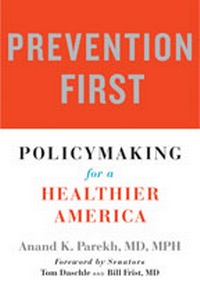
Prevention First
Policymaking for a Healthier America
Published on 28. January 2020
Book
Hardback
232 pages
978-1-4214-3365-3 (ISBN)
Description
Deaths from preventable disease have decreased life expectancy in the United States for the first time in a century. This book argues that we must deal with the crisis by embracing prevention as our nation's top health sector priority.
In Prevention First, Dr. Anand K. Parekh, chief medical advisor of the Bipartisan Policy Center, argues that disease prevention must be our nation's top health policy priority. Building a personal culture of prevention, he writes, is not enough; elected officials and policymakers must play a greater role in reducing preventable deaths. Drawing on his experiences as a clinician, public servant, and policy advisor, Dr. Parekh provides examples of prevention in action from across the country, giving readers a view into why prevention-first policies are important and how they can be accomplished. Throughout the book, he demonstrates that, in order to optimize health in America, we must leverage health insurance programs to promote disease prevention, expand primary care, attend to the social determinants of health, support making the healthier choice the easy choice for individuals, and increase public health investments.
Describing the areas of common ground to be found in public health and prevention, even between the entrenched sides in the healthcare policy debate, Dr. Parekh establishes a foundation on which healthcare policy makers and advocates can build. Providing concrete steps that federal policymakers should take to promote prevention both within and outside our healthcare sector, Prevention First not only sounds the alarm about the terrible consequences of preventable disease but serves as a rallying cry that we can and must do better in this country to reduce preventable deaths.
In Prevention First, Dr. Anand K. Parekh, chief medical advisor of the Bipartisan Policy Center, argues that disease prevention must be our nation's top health policy priority. Building a personal culture of prevention, he writes, is not enough; elected officials and policymakers must play a greater role in reducing preventable deaths. Drawing on his experiences as a clinician, public servant, and policy advisor, Dr. Parekh provides examples of prevention in action from across the country, giving readers a view into why prevention-first policies are important and how they can be accomplished. Throughout the book, he demonstrates that, in order to optimize health in America, we must leverage health insurance programs to promote disease prevention, expand primary care, attend to the social determinants of health, support making the healthier choice the easy choice for individuals, and increase public health investments.
Describing the areas of common ground to be found in public health and prevention, even between the entrenched sides in the healthcare policy debate, Dr. Parekh establishes a foundation on which healthcare policy makers and advocates can build. Providing concrete steps that federal policymakers should take to promote prevention both within and outside our healthcare sector, Prevention First not only sounds the alarm about the terrible consequences of preventable disease but serves as a rallying cry that we can and must do better in this country to reduce preventable deaths.
More details
Language
English
Place of publication
Baltimore, MD
United States
Target group
Professional and scholarly
Illustrations
Not illustrated
Dimensions
Height: 229 mm
Width: 152 mm
Thickness: 21 mm
Weight
454 gr
ISBN-13
978-1-4214-3365-3 (9781421433653)
DOI
10.1353/book.68977
Copyright in bibliographic data and cover images is held by Nielsen Book Services Limited or by the publishers or by their respective licensors: all rights reserved.
Schweitzer Classification
Other editions
New editions

Book
12/2024
2nd Edition
Johns Hopkins University Press
€29.00
Shipment within 10-20 days
Additional editions
E-Book
01/2020
Johns Hopkins University Press
€31.99
Available for download
Persons
Anand K. Parekh, MD, MPH, a board-certified internal medicine physician, is the chief medical advisor at the Bipartisan Policy Center. Previously, he completed a decade of service at the US Department of Health and Human Services. As a deputy assistant secretary for health from 2008 to 2015, he developed and implemented national initiatives focused on prevention, wellness, and care management.
Content
Foreword, by Senators Tom Daschle and Bill Frist, MD
Preface
Acknowledgments
Introduction: The State of Disease Prevention
Part 1: Prevention within the Healthcare Setting
Chapter 1. How Do You Insert Prevention into Healthcare's Value Equation?
Chapter 2. Why Is Strengthening Primary Care So Important for Prevention?
Chapter 3. Where Should Healthcare Look outside the Walls of the Clinical Setting?
Chapter 4. Social Determinants and Healthcare: Is It Time to Go Upstream?
Part 2: Prevention outside the Healthcare Setting
Chapter 5. Personal Responsibility or Policy, Systems, and Environmental Change?
Chapter 6. Why Do We Take Public Health for Granted?
Chapter 7. Public Health Emergency Preparedness: The Great Uniter?
Chapter 8. Is Global Health US Health?
Conclusion: Twenty-First-Century Urgent Challenges and Promising Opportunities
Epilogue
Notes
Index
Preface
Acknowledgments
Introduction: The State of Disease Prevention
Part 1: Prevention within the Healthcare Setting
Chapter 1. How Do You Insert Prevention into Healthcare's Value Equation?
Chapter 2. Why Is Strengthening Primary Care So Important for Prevention?
Chapter 3. Where Should Healthcare Look outside the Walls of the Clinical Setting?
Chapter 4. Social Determinants and Healthcare: Is It Time to Go Upstream?
Part 2: Prevention outside the Healthcare Setting
Chapter 5. Personal Responsibility or Policy, Systems, and Environmental Change?
Chapter 6. Why Do We Take Public Health for Granted?
Chapter 7. Public Health Emergency Preparedness: The Great Uniter?
Chapter 8. Is Global Health US Health?
Conclusion: Twenty-First-Century Urgent Challenges and Promising Opportunities
Epilogue
Notes
Index