

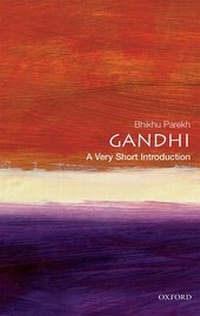
Gandhi
A Very Short Introduction
Published on 22. February 2001
Book
Paperback/Softback
160 pages
978-0-19-285457-5 (ISBN)
Description
Gandhi (1869-1948) was one of the few men in history to fight simultaneously on moral, religious, political, social, economic, and cultural fronts. During his time as a lawyer in South Africa he developed his strategy of non-violence: the idea of opposing unjust laws by non-violent protest, which he made the basis of his successful struggle against British rule in India.
In this Very Short Introduction to Gandhi's life and thought, Bhikhu Parekh outlines both Gandhi's major philosophical insights and the limitations of his thought. He looks at Gandhi's cosmocentric anthropology, his spiritual view of politics, his unique form of liberal communitarianism, and his theories of oppression, non-violent action, and active citizenship. He also considers how the success of Gandhi's principles was limited by his lack of coherent theories of evil, and of state and power, and how his hostility to modern civilization impeded his appreciation of its complexity.
Gandhi's life and thought has had an enormous impact both within and outside India, and he continues to be widely revered, as one of the greatest moral and political leaders of the twentieth century.
ABOUT THE SERIES: The Very Short Introductions series from Oxford University Press contains hundreds of titles in almost every subject area. These pocket-sized books are the perfect way to get ahead in a new subject quickly. Our expert authors combine facts, analysis, perspective, new ideas, and enthusiasm to make interesting and challenging topics highly readable.
In this Very Short Introduction to Gandhi's life and thought, Bhikhu Parekh outlines both Gandhi's major philosophical insights and the limitations of his thought. He looks at Gandhi's cosmocentric anthropology, his spiritual view of politics, his unique form of liberal communitarianism, and his theories of oppression, non-violent action, and active citizenship. He also considers how the success of Gandhi's principles was limited by his lack of coherent theories of evil, and of state and power, and how his hostility to modern civilization impeded his appreciation of its complexity.
Gandhi's life and thought has had an enormous impact both within and outside India, and he continues to be widely revered, as one of the greatest moral and political leaders of the twentieth century.
ABOUT THE SERIES: The Very Short Introductions series from Oxford University Press contains hundreds of titles in almost every subject area. These pocket-sized books are the perfect way to get ahead in a new subject quickly. Our expert authors combine facts, analysis, perspective, new ideas, and enthusiasm to make interesting and challenging topics highly readable.
More details
Series
Language
English
Place of publication
Oxford
United Kingdom
Illustrations
halftones and line drawings
Dimensions
Height: 179 mm
Width: 113 mm
Thickness: 8 mm
Weight
132 gr
ISBN-13
978-0-19-285457-5 (9780192854575)
Copyright in bibliographic data and cover images is held by Nielsen Book Services Limited or by the publishers or by their respective licensors: all rights reserved.
Schweitzer Classification
Other editions
Additional editions
Bhikhu Parekh
Gandhi: A Very Short Introduction
E-Book
02/2001
1st Edition
OUP Oxford
€8.79
Available for download
Person
Bhikhu Parekh is Professor of Political Theory at the University of Hull. His publications include Ghandhi's Political Philosophy, Crisis and Change in Contemporary India, The Decolonization of Imagination, and Critical Assessments of Jeremy Bentham (4 volumes).
Content
List of Illustrations ; 1. Life and Work ; 2. Religious thought ; 3. Human Nature ; 4. Satyagraha ; 5. The Critique of Modernity ; 6. The Vision of a Non-Violent Society ; 7. Critical Appreciation ; Glossary ; Further Reading ; Index