

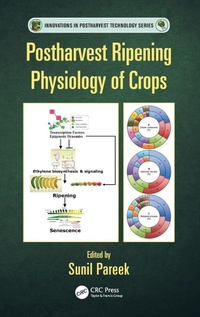
Postharvest Ripening Physiology of Crops
1st Edition
Published on 3. February 2016
Book
Hardback
643 pages
978-1-4987-0380-2 (ISBN)
Description
Postharvest Ripening Physiology of Crops is a comprehensive interdisciplinary reference source for the various aspects of fruit ripening and postharvest behavior. It focuses on the postharvest physiology, biochemistry, and molecular biology of ripening and provides an overview of fruits and vegetables, including chapters on the postharvest quality of ornamental plants and molecular biology of flower senescence.
It describes various developments that have taken place in the last decade with respect to identifying and altering the function of ripening-related genes. Taking clues from studies in grape and tomato as model fruits, the book reviews a few case studies and gives you a detailed account of molecular regulation of fruit ripening, and signal transduction and internal atmospheres in relation to fruit ripening. It also presents an overview of methods utilized in fruit proteomics, as well as a global proteome and systems biology analysis of fruits during ripening, and discusses the basics of dormancy, its molecular and physiological basis, and methods to break the dormancy.
The book provides an overview of the most important metabolic pathways and genes that control volatile biosynthesis in model fruits, including tropical, subtropical, and temperate fruits, with a special emphasis on fruit ripening and the role of ethylene during this process. It presents a brief description of the composition of volatiles in various fruit species and addresses the influences of preharvest factors and postharvest technologies on fruit aroma, basic mechanisms responsible for postharvest flavor change in fresh produce, and the potential impacts of various postharvest technologies on flavor.
It describes various developments that have taken place in the last decade with respect to identifying and altering the function of ripening-related genes. Taking clues from studies in grape and tomato as model fruits, the book reviews a few case studies and gives you a detailed account of molecular regulation of fruit ripening, and signal transduction and internal atmospheres in relation to fruit ripening. It also presents an overview of methods utilized in fruit proteomics, as well as a global proteome and systems biology analysis of fruits during ripening, and discusses the basics of dormancy, its molecular and physiological basis, and methods to break the dormancy.
The book provides an overview of the most important metabolic pathways and genes that control volatile biosynthesis in model fruits, including tropical, subtropical, and temperate fruits, with a special emphasis on fruit ripening and the role of ethylene during this process. It presents a brief description of the composition of volatiles in various fruit species and addresses the influences of preharvest factors and postharvest technologies on fruit aroma, basic mechanisms responsible for postharvest flavor change in fresh produce, and the potential impacts of various postharvest technologies on flavor.
More details
Series
Language
English
Place of publication
Bosa Roca
United States
Publishing group
Taylor & Francis Inc
Target group
College/higher education
Professional and scholarly
Professional Reference
Illustrations
78 s/w Abbildungen, 42 s/w Tabellen
42 Tables, black and white; 78 Illustrations, black and white
Dimensions
Height: 240 mm
Width: 161 mm
Thickness: 41 mm
Weight
1180 gr
ISBN-13
978-1-4987-0380-2 (9781498703802)
Copyright in bibliographic data and cover images is held by Nielsen Book Services Limited or by the publishers or by their respective licensors: all rights reserved.
Schweitzer Classification
Other editions
Additional editions
Sunil Pareek
Postharvest Ripening Physiology of Crops
E-Book
02/2016
1st Edition
CRC Press
€264.99
Available for download
Sunil Pareek
Postharvest Ripening Physiology of Crops
E-Book
02/2016
1st Edition
CRC Press
€265.99
Available for download
Person
Dr. Sunil Pareek obtained his PhD in Horticulture (PHT) from Rajasthan Agricultural University, Bikaner, India. He is an Associate Professor (PHT) in the Department of Agriculture and Environmental Sciences, National Institute of Food Technology Entrepreneurship and Management (NIFTEM), Kundli, India. Dr. Pareek is principal or co-principal investigator on several fruit, tuber crop, processed products, and integrated farming projects. He has published extensively and is the recipient of the University Outstanding Services Award 2014, Outstanding Team Research Award 2014, Young Scientist Award 2012, HS Mehta Young Scientist Award 2012, JISL Fellowship 2014, and the Fellow Award of the Confederation of Horticultural Associations of India.
Content
Ripening Physiology: An Overview. Postharvest Physiology of Fruits and Vegetables. Postharvest Quality of Ornamental Plants. Physiology and Molecular Biology of Flower Senescence. Respiratory Metabolism. Stomata and Postharvest Physiology. Water Loss from Harvested Horticultural Commodities. Lysophospholipids and Postharvest Quality of Fruits, Vegetables, and Cut Flowers. Fruit Skin Color and the Role of Pigments during Fruit Ripening. Molecular Regulation of Fruit Ripening. Advances in Ethylene Signal Transduction in Fruits and Vegetables. Internal Atmosphere of Fruits: Role and Significance in Ripening and Storability. Proteomics of Fruit Development and Ripening. Potato Tuber Dormancy and Postharvest Sprout Control. Calcium Deficiency Disorders in Plants. Fresh Fruit Aroma: An Integrative Overview for a Complex Flavor Trait. Flavor and Aroma Compounds of Some Exotic Tropical Fruits and Berries: Biosynthetic Pathways and Metabolism. Impact of Postharvest Technologies on the Flavor of Fresh Fruits and Vegetables.