

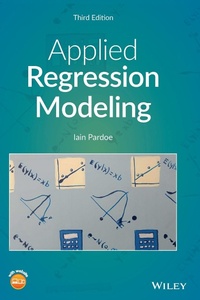
Applied Regression Modeling
Published on 7. December 2020
Book
Hardback
384 pages
978-1-119-61586-6 (ISBN)
Description
This book provides a concise treatment of statistical regression modelling together with three detailed case studies for undergraduate students and professional master students with limited background in calculus. All sections have been retained from the second edition, with the author clarifying sections and reworking the more challenging topics. The author has added more end-of-chapter exercises and has added coverage of several new topics. All methods are clearly illustrated using datasets that are available in a variety of formats on the book's supplemental website. Detailed instructions for applying the methods are provided for many software packages, including SPSS, Minitab, DataDesk, SAS, JMP, R, Eviews, Stata, Statistica, and Excel.The book introduces modeling extensions that illustrate more advanced regression techniques, including logistic regression, Poisson regression, discrete choice models, multilevel models, Bayesian modeling, and time series and forecasting.The writing is clear and careful, avoiding overly technical language. There is extensive cross-referencing, an exhaustive index, an appendix with all notation and formulas collected together, a mathematics refresher, a list of references, and a glossary of terms. Illustrations, graphs, and computer software output appears throughout. Detailed exercises collected together at the end of each chapter are carefully chosen to illustrate concepts and aid understanding. Brief solutions for half of the exercises are provided in an appendix while complete solutions to all the exercises are available in an Instructor's Manual. Supplemental exercises are available on the book's website. In addition, Instructor and student resources are available on the book's website, including datasets, software information, presentation slides, supplemental exercises, and videos covering particular topics and software demonstrations.
More details
Edition
3rd Edition
Language
English
Place of publication
Hoboken
United States
Publishing group
John Wiley and Sons Ltd
Target group
Professional and scholarly
Illustrations
Illustrations, unspecified
Dimensions
Height: 260 mm
Width: 183 mm
Thickness: 23 mm
Weight
827 gr
ISBN-13
978-1-119-61586-6 (9781119615866)
Schweitzer Classification
Other editions
Additional editions
Previous edition
Iain Pardoe
Applied Regression Modeling
Book
07/2012
2nd Edition
Wiley
Unfortunately, price unknown
Article exhausted; check for reprint
Person
Content
Preface xv
Acknowledgments xix
Glossary xxi
Introduction xxxi
I.1 Statistics in practice xxxi
I.2 Learning statistics xxxv
1 Foundations 1
1.1 Identifying and summarizing data 2
1.2 Population distributions 8
1.3 Selecting individuals at random--probability 17
1.4 Random sampling 20
1.4.1 Central limit theorem--normal version 22
1.4.2 Central limit theorem--t-version 25
1.5 Interval estimation 29
1.6 Hypothesis testing 36
1.6.1 The rejection region method 37
1.6.2 The p-value method 42
1.6.3 Hypothesis test errors 49
1.7 Random errors and prediction 50
1.8 Chapter summary 57
Problems 59
2 Simple linear regression 71
2.1 Probability model for and 72
2.2 Least squares criterion 83
2.3 Model evaluation 92
2.3.1 Regression standard error 94
2.3.2 Coefficient of determination--R2 . 98
2.3.3 Slope parameter 107
2.4 Model assumptions 122
2.4.1 Checking the model assumptions 124
2.4.2 Testing the model assumptions 134
2.5 Model interpretation 135
2.6 Estimation and prediction 136
2.6.1 Confidence interval for the population mean, E( ) 137
2.6.2 Prediction interval for an individual -value 141
2.7 Chapter summary 147
2.7.1 Review example 149
Problems 156
3 Multiple linear regression 175
3.1 Probability model for ( 1, 2, ) and 177
3.2 Least squares criterion 184
3.3 Model evaluation 195
3.3.1 Regression standard error 196
3.3.2 Coefficient of determination--R2
. 199
3.3.3 Regression parameters--global usefulness test 214
3.3.4 Regression parameters--nested model test 223
3.3.5 Regression parameters--individual tests 236
3.4 Model assumptions 255
3.4.1 Checking the model assumptions 256
3.4.2 Testing the model assumptions 265
3.5 Model interpretation 270
3.6 Estimation and prediction 273
3.6.1 Confidence interval for the population mean, E( ) 274
3.6.2 Prediction interval for an individual -value 277
3.7 Chapter summary 283
Problems 286
4 Regression model building I 299
4.1 Transformations 302
4.1.1 Natural logarithm transformation for predictors 302
4.1.2 Polynomial transformation for predictors 312
4.1.3 Reciprocal transformation for predictors 321
4.1.4 Natural logarithm transformation for the response 328
4.1.5 Transformations for the response and predictors 336
4.2 Interactions 343
4.3 Qualitative predictors 357
4.3.1 Qualitative predictors with two levels 358
4.3.2 Qualitative predictors with three or more levels 374
4.4 Chapter summary 392
Problems 395
5 Regression model building II 413
5.1 Influential points 416
5.1.1 Outliers 416
5.1.2 Leverage 424
5.1.3 Cook's distance 429
5.2 Regression pitfalls 435
5.2.1 Nonconstant variance 435
5.2.2 Autocorrelation 442
5.2.3 Multicollinearity 450
5.2.4 Excluding important predictor variables 458
5.2.5 Overfitting 463
5.2.6 Extrapolation 465
5.2.7 Missing data 469
5.2.8 Power and sample size 475
5.3 Model building guidelines 478
5.4 Model selection 484
5.5 Model interpretation using graphics 491
5.6 Chapter summary 504
Problems 508
C Notation and formulas 635
C.1 Univariate data 635
C.2 Simple linear regression 637
C.3 Multiple linear regression 639