

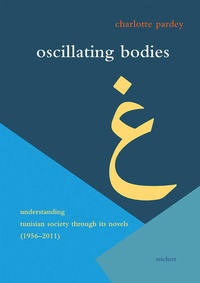
Oscillating Bodies
Understanding Tunisian Society through its Novels (1956-2011)
Published on 11. March 2022
Book
Hardback
256 pages
978-3-95490-380-1 (ISBN)
Description
Oscillating Bodies offers insights into Tunisian society that are more than numbers and statistics. To do so, author Charlotte Pardey approaches the country and its people through carefully selected contemporary Tunisian novels. With specific consideration for the depiction and use of the human body in the novels a society appears that oscillates between different poles, such as that of tradition and modernity as well as various cultural influences. The book's five chapters describe Tunisia from its independence in 1956 until the revolutionary upheavals of 2010/2011 through novels.
Most Tunisian novels are written in Arabic or French. As a result, the country has two separate literary traditions that are very rarely "read together". Generally, Tunisian literature has not yet received a lot of attention in literary studies. If works were dealt with at all, they were analyzed and discussed separately according to language boundaries by Arabic or French Literature specialists. Oscillating Bodies now reads arabophone and francophone Tunisian novel together and shows them in fruitful dialogue with each other. In addition to this, time and again, reference is made to other literary traditions (such as the literatures of France, North Africa, and the Levant.
The notion of oscillation not only allows to read Tunisian society, it is also employed to analyze the descriptions of bodies in the novels. Through the concept of embodiment (Thomas J. Csordas), the bodily being-in-the-world, the novel's employment of human is explored. Other concepts are drawn upon (hauntology, abjection, fitna), that all contain an oscillating movement which allows to discuss specific aspects human bodies in literature such as presence, materiality, and visibility. It also connects oscillation and the bodily being-in-the-world in literature.
Oscillating Bodies can be read with various objectives: On the one hand it offers an introduction to Tunisian novels, its central motives, and themes. It lays the ground for future research that can join its effort in giving Tunisian literature its proper place in literary research. To do so, Oscillating Bodies makes arabophone and francophone novels accessible to an anglophone audience. On the other hand, the book offers insights into Tunisian society and explores the social context of the 2010/2011 revolutionary upheavals. Finally, through the concept of oscillation, it offers a perspective to read the post-colonial situation, a perspective that also lends itself for the study of other post-colonial societies and their literatures.
Most Tunisian novels are written in Arabic or French. As a result, the country has two separate literary traditions that are very rarely "read together". Generally, Tunisian literature has not yet received a lot of attention in literary studies. If works were dealt with at all, they were analyzed and discussed separately according to language boundaries by Arabic or French Literature specialists. Oscillating Bodies now reads arabophone and francophone Tunisian novel together and shows them in fruitful dialogue with each other. In addition to this, time and again, reference is made to other literary traditions (such as the literatures of France, North Africa, and the Levant.
The notion of oscillation not only allows to read Tunisian society, it is also employed to analyze the descriptions of bodies in the novels. Through the concept of embodiment (Thomas J. Csordas), the bodily being-in-the-world, the novel's employment of human is explored. Other concepts are drawn upon (hauntology, abjection, fitna), that all contain an oscillating movement which allows to discuss specific aspects human bodies in literature such as presence, materiality, and visibility. It also connects oscillation and the bodily being-in-the-world in literature.
Oscillating Bodies can be read with various objectives: On the one hand it offers an introduction to Tunisian novels, its central motives, and themes. It lays the ground for future research that can join its effort in giving Tunisian literature its proper place in literary research. To do so, Oscillating Bodies makes arabophone and francophone novels accessible to an anglophone audience. On the other hand, the book offers insights into Tunisian society and explores the social context of the 2010/2011 revolutionary upheavals. Finally, through the concept of oscillation, it offers a perspective to read the post-colonial situation, a perspective that also lends itself for the study of other post-colonial societies and their literatures.
More details
Person
Charlotte Pardey (*1986) first studied Oriental Studies (BA) and then Arabic Literature and Culture (MA) at Philipps-Universität Marburg with exchange semesters in Syria and Turkey. Afterwards she earned a second Master degree in Comparative Literature (Africa/Asia) at the School of Oriental and African Studies, University of London. She returned to the department of Arabic Studies at the Centre for Near and Middle Eastern Studies in Marburg as a PhD student under the supervision of Professor Friederike Pannewick. Her dissertation was supported by a doctoral scholarship of the German Academic Scholarship Foundation (Studienstiftung des Deutschen Volkes). From March 2017 until December 2020, Charlotte Pardey was a postdoctoral researcher in Friederike Pannewick's research group "Turning Points | Figures of Thought" (2012-2020, DFG, Leibniz-Prize) and focused on literatures of the Maghreb in her research.