

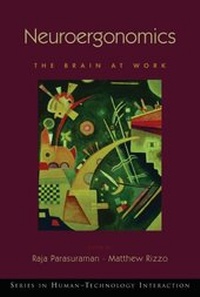
Neuroergonomics
The brain at work
Published on 16. November 2006
Book
Paperback/Softback
442 pages
978-0-19-517761-9 (ISBN)
Description
Neuroergonomics can be defined as the study of brain and behaviour at work. It combines two disciplines - neuroscience, the study of brain function, and human factors, the study of how to match technology with the capabilities and limitations of people so they can work effectively and safely. The goal of merging these two fields is to use the startling discoveries of human brain and physiological functioning both to inform the design of technologies in the workplace and home, and to provide new training methods that enhance performance, expand capabilities, and optimise the fit between people and technology. Research in the area of neuroergonomics has blossomed in recent years with the emergence of noninvasive techniques for monitoring human brain function that can be used to study various aspects of human behaviour in relation to technology and work, including mental workload, visual attention, working memory, motor control, human-automation interaction, and adaptive automation. This volume provides the first systematic overview of this emerging area, describing the theoretical background, basic research, major methods, as well as the new and future areas of application.This collection will benefit a number of readers: the experienced researcher investigating related questions in human factors and cognitive neuroscience, the student wishing to get a rapid but systematic overview of the field, and the designer interested in novel approaches and new ideas for application.
Reviews / Votes
For a comprehensive understanding of the field of neuroergonomics, this is the book. The editors and contributors are distinguished researchers and this is a landmark book for this fairly young field, though the actual components of neuroscience and ergonomics have a much longer history. Doody's NotesMore details
Language
English
Place of publication
New York
United States
Target group
College/higher education
Professional and scholarly
Illustrations
80 s/w Abbildungen
28 colour and 80 black & white illustrations
Dimensions
Height: 260 mm
Width: 185 mm
Thickness: 27 mm
Weight
897 gr
ISBN-13
978-0-19-517761-9 (9780195177619)
Copyright in bibliographic data and cover images is held by Nielsen Book Services Limited or by the publishers or by their respective licensors: all rights reserved.
Schweitzer Classification
Other editions
Additional editions
Book
04/2008
Oxford University Press Inc
€76.75
Shipment within 15-20 days
E-Book
11/2006
1st Edition
OUP eBook
€44.99
Available for download
Persons
Editor
Professor of Psychology, Director of Cognitive Science LaboratoryProfessor of Psychology, Director of Cognitive Science Laboratory, The Catholic University of America, Washington DC, USA
Professor of Neurology, Director of the Division of Neuroergonomics, and Professor of Industrial Engineering and Public PolicyProfessor of Neurology, Director of the Division of Neuroergonomics, and Professor of Industrial Engineering and Public Policy, The University of Iowa, USA
Content
PART I: INTRODUCTION; 1. Introduction to Neuroergonomics; PART II: NEUROERGONOMICS METHODS; 2. Electrocephalography (EEG) in Neuroergonomics; 3. Event-related Potentials (ERPs) in Neuroergonomics; 4. Functional Magnetic Resonance Imaging (fMRI): Advanced Methods and Applications to Driving; 5. Optical Imaging of Brain Function; 6. Transcranial Doppler Sonography; 7. Eye Movements as a Window on Perception and Cognition; 8. The Brain in the Wild: Tracking Human Behavior in Natural and Naturalistic Settings; PART III: PERCEPTION, COGNITION, AND EMOTION; 9. Spatial Navigation; 10. Cerebral blood flow and vigilance; 11. Executive Functions; 12. The Neurology of Emotions and Feelings, and Their Role in Behavioral Decisions; PART IV: STRESS, FATIGUE, AND PHYSICAL WORK; 13. Stress and Neuroergonomics; 14. Sleep and Circadian Control of Neurobehavioral Function; 15. Physical Neuroergonomics; PART V: TECHNOLOGY APPLICATIONS; 16. Adaptive Automation; 17. Virtual Reality and Neuroergonomics; 18. The Role of Emotion-inspired Abilities in Relational Robots; PART VI: SPECIAL POPULATIONS; 20. EEG Brain-computer Interface; 21. Artificial Vision; 22. Neurorehabilitation-robotics and Neuroprosthetics; 23. Medical Safety and Neuroergonomics; PART VII: CONCLUSIONS; 24. Future Prospects for Neuroergonomics