

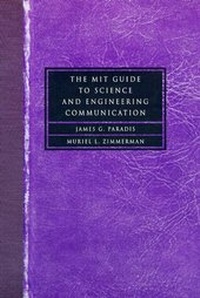
The MIT Guide to Science and Engineering Communication
Published on 30. January 1997
Book
Hardback
290 pages
978-0-262-16142-8 (ISBN)
Description
Good communication makes a difference. Any successful scientist or
engineer will have multiple communication tasks connected with any project. Drawing
on their considerable experience teaching both college students and science
professionals, James Paradis and Muriel Zimmerman have written a handbook that
treats four kinds of literacy -- written, oral, graphic, electronic -- as crucial
and inseparable to science and engineering communication.The MIT Guide emphasizes
processes and forms that will help in creating documents and includes numerous
realistic examples. A special feature of the book is its acceptance of the fact that
most work in science these days is collaborative and that writing is often a group
rather than a solitary activity. There is also a strong emphasis on the central role
of the computer in creating and disseminating technical materials.First, Paradis and
Zimmerman observe, it is essential to consider science and engineering as
communication. The most effective engineers and scientists are skilled writers, and
the first chapter shows how important good communication is to a successful career
in science. The chapters that follow address such topics as: defining your audience
and aims; organizing and drafting documents; revising for organization and style;
developing graphics; conducting meetings; memos, letters, and e-mail; proposals;
progress reports; reports and journal articles; instructional materials; electronic
texts; oral presentations; job search strategies; document design for page and
screen; strategies for searching the literature; and citation and reference
styles.
engineer will have multiple communication tasks connected with any project. Drawing
on their considerable experience teaching both college students and science
professionals, James Paradis and Muriel Zimmerman have written a handbook that
treats four kinds of literacy -- written, oral, graphic, electronic -- as crucial
and inseparable to science and engineering communication.The MIT Guide emphasizes
processes and forms that will help in creating documents and includes numerous
realistic examples. A special feature of the book is its acceptance of the fact that
most work in science these days is collaborative and that writing is often a group
rather than a solitary activity. There is also a strong emphasis on the central role
of the computer in creating and disseminating technical materials.First, Paradis and
Zimmerman observe, it is essential to consider science and engineering as
communication. The most effective engineers and scientists are skilled writers, and
the first chapter shows how important good communication is to a successful career
in science. The chapters that follow address such topics as: defining your audience
and aims; organizing and drafting documents; revising for organization and style;
developing graphics; conducting meetings; memos, letters, and e-mail; proposals;
progress reports; reports and journal articles; instructional materials; electronic
texts; oral presentations; job search strategies; document design for page and
screen; strategies for searching the literature; and citation and reference
styles.
More details
Language
English
Place of publication
Cambridge, Mass.
United States
Publishing group
MIT Press Ltd
Target group
College/higher education
Professional and scholarly
Illustrations
110
Dimensions
Height: 229 mm
Width: 152 mm
Thickness: 22 mm
Weight
590 gr
ISBN-13
978-0-262-16142-8 (9780262161428)
Copyright in bibliographic data and cover images is held by Nielsen Book Services Limited or by the publishers or by their respective licensors: all rights reserved.
Schweitzer Classification
Persons
Muriel L. Zimmerman is Senior Lecturer and Coordinator of the Programs in
Technical Communication in the Writing Program at the University of California,
Santa Barbara.
Technical Communication in the Writing Program at the University of California,
Santa Barbara.