

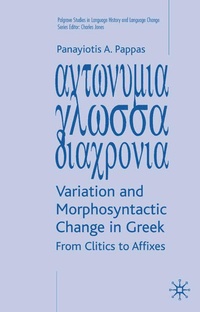
Variation and Morphosyntactic Change in Greek
From Clitics to Affixes
Published on 19. December 2003
Book
Hardback
XXVIII, 185 pages
978-1-4039-1334-0 (ISBN)
Description
This book deals with some of the major theoretical and descriptive concerns of the historical linguist. The author presents a variationist analysis of weak object pronoun placement in Greek during a transitional period of the language when these elements exhibited both clitic-like and affix-like behaviour. The statistical analysis of the data, providing the first accurate description of the pattern of variation, is used in showing that existing accounts fall short of a full explanation. An alternative approach forces re-evaluation of the role of generalizations in linguistic explanation.
Reviews / Votes
'...likely to remain the standard reference work on the subject for the foreseeable future...meticulously documented and researched...[its] scholarship [is] always displayed selectively and appropriately. The comparative sections are highly illuminating for those interested in clitics from a more general perspective. Undeniably a major scholarly contribution to its field.' - Professor Geoffrey Horrocks, St John's College, Cambridge
More details
Series
Edition
2004
Language
English
Place of publication
London
United Kingdom
Publishing group
Palgrave USA
Target group
College/higher education
Professional and scholarly
Illustrations
XXVIII, 185 p.
Dimensions
Height: 209 mm
Width: 132 mm
Thickness: 17 mm
Weight
331 gr
ISBN-13
978-1-4039-1334-0 (9781403913340)
DOI
10.1057/9780230504714
Schweitzer Classification
Other editions
Additional editions
E-Book
12/2003
Palgrave Macmillan
€53.49
Available for download
Person
PANAYIOTIS A. PAPPAS is Assistant Professor of Linguistics at Simon Fraser University in Vancouver, Canada. His research interests include variation and language change, diachronic syntax and morphology, sociolinguistics and Greek linguistics.
Content
List of Figures List of Tables Preface List of Abbreviations Introduction Methodology Data Analysis Linguistic Parameters Non-linguistic Parameters Previous Proposals A Diachronic Perspective Theoretical Implications Appendix Notes References Index