

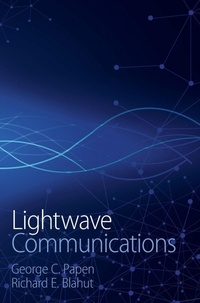
Lightwave Communications
Published on 10. January 2019
Book
Hardback
970 pages
978-1-108-42756-2 (ISBN)
Description
This pioneering, course-tested text is the first to combine communications theory with the physics of optical communications. Comprehensive and rigorous, it brings together an in-depth treatment of the physical characteristics of the guided lightwave channel with the study of modern methods of algorithmic-based communication in time and space. The many different levels at which a lightwave communication signal can be described are integrated to provide a unified explanation of how a commonplace bit stream is transformed into a physical lightwave, how that lightwave travels through an optical fiber, and how it is then transformed back into the bit stream. Background fundamentals such as linear systems and electromagnetics are explained in relation to modern topics such as channel models, encoding, modulation and interference, and end-of-chapter problems are provided throughout. This is an essential text for students taking courses on optical communications, as well as researchers and professionals working in the area.
More details
Language
English
Place of publication
Cambridge
United Kingdom
Target group
College/higher education
Illustrations
Worked examples or Exercises
Dimensions
Height: 250 mm
Width: 175 mm
Thickness: 56 mm
Weight
1823 gr
ISBN-13
978-1-108-42756-2 (9781108427562)
Copyright in bibliographic data and cover images is held by Nielsen Book Services Limited or by the publishers or by their respective licensors: all rights reserved.
Schweitzer Classification
Other editions
Additional editions
George C. Papen
Lightwave Communications
E-Book
01/2019
Cambridge University Press
€78.99
Available for download
George C. Papen | Richard E. Blahut
Lightwave Communications
E-Book
01/2019
Cambridge University Press
€94.99
Available for download
Persons
George C. Papen is a Professor in the Department of Electrical and Computer Engineering at the University of California, San Diego. Richard E. Blahut is the Emeritus Henry Magnuski Professor in the Department of Electrical and Computer Engineering at the University of Illinois, Urbana-Champaign, having served as the Department Head from 2001 to 2008. He has authored a series of advanced textbooks on the mathematical aspects of theoretical informatics, is a member of the US National Academy of Engineering, and a Fellow of the Institute of Electrical and Electronics Engineers (IEEE).
Content
1. Introduction; 2. Background; 3. The guided lightwave channel; 4. The linear lightwave channel; 5. The nonlinear lightwave channel; 6. Random signals; 7. Lightwave components; 8. The electrical channel; 9. The information channel; 10. Modulation and demodulation; 11. Interference; 12. Channel estimation; 13. Channel codes; 14. The information capacity of a lightwave channel; 15. The quantum optics model; 16. The quantum lightwave channel.