

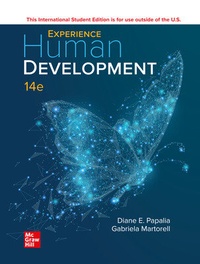
ISE Experience Human Development
14th Edition
Published on 3. March 2020
Book
Paperback/Softback
768 pages
978-1-260-57087-8 (ISBN)
Description
Experience the human side of development.
Papalia helps students experience the human side of development by exposing them to culture and diversity, immersing them in practical application, and helping them study smarter through personalized learning and reporting.
Papalia helps students experience the human side of development by exposing them to culture and diversity, immersing them in practical application, and helping them study smarter through personalized learning and reporting.
More details
Edition
14th edition
Language
English
Place of publication
OH
United States
Target group
College/higher education
US School Grade: From College Freshman to College Graduate Student
Illustrations
75 Illustrations
Dimensions
Height: 274 mm
Width: 213 mm
Thickness: 33 mm
Weight
1515 gr
ISBN-13
978-1-260-57087-8 (9781260570878)
Copyright in bibliographic data and cover images is held by Nielsen Book Services Limited or by the publishers or by their respective licensors: all rights reserved.
Schweitzer Classification
Persons
As a professor, Diane E. Papalia has taught thousands of undergraduates at the University of Wisconsin-Madison. She received her bachelor's degree, majoring in psychology, from Vassar College and both her master's degree in child development and family relations and her Ph.D. in life-span developmental psychology from West Virginia University. She has published numerous articles in such professional journals as Human Development, International Journal of Aging and Human Development, Sex Roles, Journal of Experimental Child Psychology and Journal of Gerontology. Most of these papers have dealt with her major research focus, cognitive development from childhood through old age.
Gabriela Alicia Martorell was born in Seattle, Washington, but moved as a toddler to Guatemala. At eight, she returned to the United States and lived in Northern California until leaving for her undergraduate training at the University of California, Davis. After obtaining her B.S. in Psychology, she earned her Ph.D. in Developmental and Evolutionary Psychology with an interdisciplinary emphasis in Human Development from the University of California, Santa Barbara. She now works as a Full Professor of Psychology at Virginia Wesleyan University and serves as the chair of the Institutional Review Board. Gabi maintains an active teaching schedule and teaches courses in Introductory Psychology, Lifespan Human Development, Infant Development, Child Development, Adolescent Development, Culture and Development, Evolutionary Psychology, Research Methods, Original Research Project and Capstone community-based learning courses in Early Childhood Education and Adulthood and Aging. She is committed to teaching, mentoring, and advising. She recently concluded a 5-year longitudinal National Science Foundation grant focused on the retention of higher education students from traditionally underrepresented groups in science, technology, engineering, and math. She is also a volunteer trainer for Court Appointed Special Advocates, and a group fitness instructor for the YMCA of South Hampton Roads.
Gabriela Alicia Martorell was born in Seattle, Washington, but moved as a toddler to Guatemala. At eight, she returned to the United States and lived in Northern California until leaving for her undergraduate training at the University of California, Davis. After obtaining her B.S. in Psychology, she earned her Ph.D. in Developmental and Evolutionary Psychology with an interdisciplinary emphasis in Human Development from the University of California, Santa Barbara. She now works as a Full Professor of Psychology at Virginia Wesleyan University and serves as the chair of the Institutional Review Board. Gabi maintains an active teaching schedule and teaches courses in Introductory Psychology, Lifespan Human Development, Infant Development, Child Development, Adolescent Development, Culture and Development, Evolutionary Psychology, Research Methods, Original Research Project and Capstone community-based learning courses in Early Childhood Education and Adulthood and Aging. She is committed to teaching, mentoring, and advising. She recently concluded a 5-year longitudinal National Science Foundation grant focused on the retention of higher education students from traditionally underrepresented groups in science, technology, engineering, and math. She is also a volunteer trainer for Court Appointed Special Advocates, and a group fitness instructor for the YMCA of South Hampton Roads.
Content
Part 1 About Human Development
1 The Study of Human Development
2 Theory and Research
Part 2 Beginnings
3 Forming a New Life
4 Birth and Physical Development during the First Three Years
5 Cognitive Development during the First Three Years
6 Psychosocial Development during the First Three Years
Part 3 Early Childhood
7 Physical and Cognitive Development in Early Childhood
8 Psychosocial Development in Early Childhood
Part 4 Middle Childhood
9 Physical and Cognitive Development in Middle Childhood
10 Psychosocial Development in Middle Childhood
Part 5 Adolescence
11 Physical and Cognitive Development in Adolescence
12 Psychosocial Development in Adolescence
Part 6 Emerging and Young Adulthood
13 Physical and Cognitive Development in Emerging and Young Adulthood
14 Psychosocial Development in Emerging and Young Adulthood
Part 7 Middle Adulthood
15 Physical and Cognitive Development in Middle Adulthood
16 Psychosocial Development in Middle Adulthood
Part 8 Late Adulthood
17 Physical and Cognitive Development in Late Adulthood
18 Psychosocial Development in Late Adulthood
Part 9 The End of Life
19 Dealing with Death and Bereavement
1 The Study of Human Development
2 Theory and Research
Part 2 Beginnings
3 Forming a New Life
4 Birth and Physical Development during the First Three Years
5 Cognitive Development during the First Three Years
6 Psychosocial Development during the First Three Years
Part 3 Early Childhood
7 Physical and Cognitive Development in Early Childhood
8 Psychosocial Development in Early Childhood
Part 4 Middle Childhood
9 Physical and Cognitive Development in Middle Childhood
10 Psychosocial Development in Middle Childhood
Part 5 Adolescence
11 Physical and Cognitive Development in Adolescence
12 Psychosocial Development in Adolescence
Part 6 Emerging and Young Adulthood
13 Physical and Cognitive Development in Emerging and Young Adulthood
14 Psychosocial Development in Emerging and Young Adulthood
Part 7 Middle Adulthood
15 Physical and Cognitive Development in Middle Adulthood
16 Psychosocial Development in Middle Adulthood
Part 8 Late Adulthood
17 Physical and Cognitive Development in Late Adulthood
18 Psychosocial Development in Late Adulthood
Part 9 The End of Life
19 Dealing with Death and Bereavement