

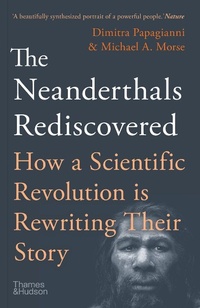
The Neanderthals Rediscovered
How A Scientific Revolution Is Rewriting Their Story
3rd Edition
Published on 5. May 2022
Book
Paperback/Softback
256 pages
978-0-500-29640-0 (ISBN)
Description
There is a little Neanderthal in all of us. Although they have been extinct for 40,000 years, our genetic inheritance means that they are not entirely gone. Since the publication of the first Neanderthal genome in 2010, our understanding of the Neanderthals - and our connection to them - has changed dramatically. Once stereotyped as simple and brutish, recent discoveries by archaeologists and geneticists have painted a different picture of Neanderthals, and one more familiar to us: they buried their dead, cared for the sick, and even painted cave walls. We can now delve into their DNA to trace their evolution in Europe and movements across Asia, and piece together how they lived and died in amazing detail.
This fully updated edition presents cutting-edge research on our fascinating hominin relatives: their interbreeding with humans and other species including the recently discovered Denisovans, their social behaviours such as smiling to indicate friendliness, and the genes they have passed down to us that could be affecting our health. By confronting our differences and similarities to the Neanderthals, this book addresses the biggest question of all: what it means to be human.
This fully updated edition presents cutting-edge research on our fascinating hominin relatives: their interbreeding with humans and other species including the recently discovered Denisovans, their social behaviours such as smiling to indicate friendliness, and the genes they have passed down to us that could be affecting our health. By confronting our differences and similarities to the Neanderthals, this book addresses the biggest question of all: what it means to be human.
Reviews / Votes
'A beautifully synthesized portrait of a powerful people' - Nature '[A] compelling and engaging account ... Prepare to have your prejudices shattered and your understanding of humanity challenged' - Clive Gamble, University of Southampton 'Excellent and absorbing' - Current World ArchaeologyMore details
Edition
Third edition
Language
English
Place of publication
London
United Kingdom
Edition type
Revised edition
Illustrations
57 Illustrations, black and white; 20 Illustrations, color
Dimensions
Height: 200 mm
Width: 131 mm
Thickness: 20 mm
Weight
240 gr
ISBN-13
978-0-500-29640-0 (9780500296400)
Copyright in bibliographic data and cover images is held by Nielsen Book Services Limited or by the publishers or by their respective licensors: all rights reserved.
Schweitzer Classification
Persons
Dimitra Papagianni is a Palaeolithic and stone tool specialist, who has taught at Cambridge and Oxford. Michael A. Morse is a historian of science with a specialty in the history of British archaeology, and the author of How the Celts Came to Britain.
Content
Introduction
1. A Long Underestimated Type of Human
2. The First Europeans: 1 million to 600,000 years ago
3. Defeating the Cold: 600,000 to 250,000 years ago
4. Meet the Neanderthals: 250,000 to 130,000 years ago
5. An End to Isolation: 130,000 to 60,000 years ago
6. Endgame: 60,000 to 25,000 years ago
7. Still With Us?
1. A Long Underestimated Type of Human
2. The First Europeans: 1 million to 600,000 years ago
3. Defeating the Cold: 600,000 to 250,000 years ago
4. Meet the Neanderthals: 250,000 to 130,000 years ago
5. An End to Isolation: 130,000 to 60,000 years ago
6. Endgame: 60,000 to 25,000 years ago
7. Still With Us?