

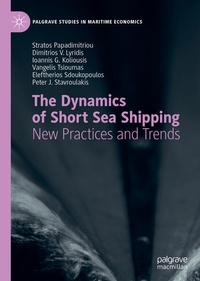
The Dynamics of Short Sea Shipping
New Practices and Trends
Published on 3. December 2018
Book
Hardback
XI, 190 pages
978-3-319-98043-0 (ISBN)
Description
This book belongs to the
Port Economics and Global Supply Chain Management
strand of the
Palgrave Studies in Maritime Economics
book series, commissioned by Hercules Haralambides.
This book discusses the main drivers that affect the introduction and growth of short sea shipping services. It describes and analyses the main operational concepts of short sea shipping and introduces relevant administrative and strategic approaches that enable its sustainable execution. Short Sea Shipping (SSS) comprises freight and passenger mobility by waterborne transport at a limited range, without crossing an ocean. Being a direct competitor to land-based transport modes, it uses ports and inland waterways to complement traditional transportation systems, increase capacity, improve flexibility, and contribute towards the goal of sustainable mobility. The reader will be introduced to various aspects of short sea shipping including benefits and shortfalls, relevant regulations and policies, and the applicability of short sea services within a given case or scenario.
This book discusses the main drivers that affect the introduction and growth of short sea shipping services. It describes and analyses the main operational concepts of short sea shipping and introduces relevant administrative and strategic approaches that enable its sustainable execution. Short Sea Shipping (SSS) comprises freight and passenger mobility by waterborne transport at a limited range, without crossing an ocean. Being a direct competitor to land-based transport modes, it uses ports and inland waterways to complement traditional transportation systems, increase capacity, improve flexibility, and contribute towards the goal of sustainable mobility. The reader will be introduced to various aspects of short sea shipping including benefits and shortfalls, relevant regulations and policies, and the applicability of short sea services within a given case or scenario.
Reviews / Votes
"This book provides a thorough understanding of short sea shipping and its interrelations with environmental, economic, social, and political factors. . The book offers an abundance of information with respect to the supply and demand of short sea shipping markets, the key routes and major corridors used by short sea shipping, and the economic factors affecting short sea shipping and its strategic planning within maritime clusters." (Constantinos Chlomoudis, Maritime Economics & Logistics, Vol. 22, 2020)
More details
Series
Edition
2018 ed.
Language
English
Place of publication
Cham
Switzerland
Publishing group
Springer International Publishing
Target group
Professional and scholarly
Illustrations
26 farbige Abbildungen, 5 s/w Abbildungen
XI, 190 p. 31 illus., 26 illus. in color.
Dimensions
Height: 216 mm
Width: 153 mm
Thickness: 16 mm
Weight
383 gr
ISBN-13
978-3-319-98043-0 (9783319980430)
DOI
10.1007/978-3-319-98044-7
Schweitzer Classification
Other editions
Additional editions

Stratos Papadimitriou | Dimitrios V. Lyridis | Ioannis G. Koliousis
The Dynamics of Short Sea Shipping
New Practices and Trends
Book
02/2020
Palgrave Macmillan
€106.99
Shipment within 7-9 days

Stratos Papadimitriou | Dimitrios V. Lyridis | Ioannis G. Koliousis
The Dynamics of Short Sea Shipping
New Practices and Trends
E-Book
11/2018
1st Edition
Palgrave Macmillan
€96.29
Available for download
Persons
Stratos Papadimitriou
is Professor at the University of Piraeus, Greece, teaching transport planning and logistic systems courses. He has served as an advisor to Ministers of Transport and the European Union and has been involved in managing various research projects regarding transport planning and logistics.
Dimitrios V. Lyridis is Associate Professor, and Head of the Laboratory of Maritime Transport at the National Technical University of Athens, Greece. His main scientific areas of interest are maritime transport and logistics, shipping finance and environmental protection.
Ioannis G. Koliousis is Lecturer in Operations and Supply Chain Management at Coventry University, UK. He is an expert in the fields of transport planning, cargo and freight logistics, critical infrastructure security and safety.
Vangelis Tsioumas is a full-time faculty and program coordinator for shipping management at The American College of Greece - DEREE.
Eleftherios Sdoukopoulos is a PhD candidate at the University of Piraeus and an associate researcher at the Hellenic Institute of Transport, Greece.
Peter J. Stavroulakis is a mechanical and production engineer, with a master's in business administration and a master's in the health sciences occupational and environmental health.
Dimitrios V. Lyridis is Associate Professor, and Head of the Laboratory of Maritime Transport at the National Technical University of Athens, Greece. His main scientific areas of interest are maritime transport and logistics, shipping finance and environmental protection.
Ioannis G. Koliousis is Lecturer in Operations and Supply Chain Management at Coventry University, UK. He is an expert in the fields of transport planning, cargo and freight logistics, critical infrastructure security and safety.
Vangelis Tsioumas is a full-time faculty and program coordinator for shipping management at The American College of Greece - DEREE.
Eleftherios Sdoukopoulos is a PhD candidate at the University of Piraeus and an associate researcher at the Hellenic Institute of Transport, Greece.
Peter J. Stavroulakis is a mechanical and production engineer, with a master's in business administration and a master's in the health sciences occupational and environmental health.
Content
1. Introduction.- 2. Supply, Demand, and Major Short Sea Shipping Networks in Europe.- 3. Strategic Planning of Short Sea Shipping Within Maritime Clusters.- 4. Social and Environmental Impacts of Short Sea Shipping.- 5. Regulatory Framework.- 6. 'Motorways of the Sea' (MoS) and Related European Policies.- 7. Short Sea Shipping in Various Regions.