

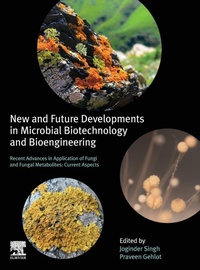
New and Future Developments in Microbial Biotechnology and Bioengineering
Recent Advances in Application of Fungi and Fungal Metabolites: Current Aspects
Published on 21. September 2020
Book
Hardback
302 pages
978-0-12-821005-5 (ISBN)
Description
New and Future Developments in Microbial Biotechnology and Bioengineering presents an account of recent developments and applied aspects of fungi and its metabolites for human welfare. The fungi and its metabolites are employed in diverse fields of agri-food, biochemistry, chemical engineering, diagnostics, pharmaceuticals and medical device development. The book contains chapters by the eminent researchers working with fungi and fungal metabolites who explain their importance and potential in manifold prospects. The book includes a description of various fungal metabolites and their chemistry and biotechnology.
More details
Language
English
Place of publication
United States
Target group
Professional and scholarly
Researchers at universities, scientists and students, industries, and government agencies interested in bioprocess engineering/microbial biotechnology, agriculture, food producing, biomedicine, drug manufacture and all disciplines related to microbial biotechnology
Product notice
Laminated cover
Dimensions
Height: 279 mm
Width: 216 mm
Thickness: 18 mm
Weight
988 gr
ISBN-13
978-0-12-821005-5 (9780128210055)
Copyright in bibliographic data and cover images is held by Nielsen Book Services Limited or by the publishers or by their respective licensors: all rights reserved.
Schweitzer Classification
Other editions
Additional editions
Joginder Singh Panwar | Praveen Gehlot
New and Future Developments in Microbial Biotechnology and Bioengineering
Recent Advances in Application of Fungi and Fungal Metabolites: Current Aspects
E-Book
09/2020
Elsevier
€195.00
Available for download
Persons
Joginder Singh Panwar is a Professor in the Department of Botany at Nagaland University, Lumami, India. His previous appointments include a professorship at the School of Bioengineering and Biosciences, Lovely Professional University, and a Young Scientist position at the Microbial Biotechnology and Biofertilizer Laboratory at Jai Narain Vyas University, funded by the Department of Science and Technology, Government of India. He is an active member of several scientific societies, including the Association of Microbiologists of India and the European Federation of Biotechnology. Dr. Singh has an extensive publication record across books and journals, and he also regularly serves as a reviewer for numerous prestigious international journals He has published extensively with Elsevier and Springer both in journals and books. He serves as a reviewer for many prestigious journals. He actively participates and presents at national and international scientific conferences and events.
Dr. Praveen Gehlot is Associate Professor, Department of Botany, Jai Narain Vyas University Jodhpur. He did his PhD from JNV University Jodhpur, under the able guidance of Prof. D.K. Purohit. He has about 18 years of teaching and research experience. He has been an awardee of Young Scientist under FAST Track Scheme by Department of Science and Technology, New Delhi and later worked as a Pool-Officer of Council of Scientific and Industrial Research, New Delhi. Earlier, he taught at Budha Institute of Technology and Science Research College, Jodhpur and Government Bangor PG College, Pali, Rajasthan and subsequently served as an Associate Professor and Head, Department of Microbiology, Maharaja Ganga Singh University, Bikaner, Rajasthan. Dr. Gehlot worked out three major research projects sponsored by UGC, DST and CSIR, New Delhi. He has published more than 80 research papers, book chapters and review articles in journals of international and national repute and has edited three book entitled "Pyrenomycetes Fungi?, "Arbuscular Mycorrhizal Fungi? and "Microbes: In Action? published by AgroBios, India and "Fungi and their Role in Sustainable Development: Current Perspectives? published by Springer International. He attended several International and National Seminars, Symposia, Conferences and chaired technical sessions and presented papers in some of them. He is an active member Mycological Society of India, Society of Mycology and Plant Pathology, India, Association of Microbiologists of India, Indian Science Congress Association, etc.
Dr. Praveen Gehlot is Associate Professor, Department of Botany, Jai Narain Vyas University Jodhpur. He did his PhD from JNV University Jodhpur, under the able guidance of Prof. D.K. Purohit. He has about 18 years of teaching and research experience. He has been an awardee of Young Scientist under FAST Track Scheme by Department of Science and Technology, New Delhi and later worked as a Pool-Officer of Council of Scientific and Industrial Research, New Delhi. Earlier, he taught at Budha Institute of Technology and Science Research College, Jodhpur and Government Bangor PG College, Pali, Rajasthan and subsequently served as an Associate Professor and Head, Department of Microbiology, Maharaja Ganga Singh University, Bikaner, Rajasthan. Dr. Gehlot worked out three major research projects sponsored by UGC, DST and CSIR, New Delhi. He has published more than 80 research papers, book chapters and review articles in journals of international and national repute and has edited three book entitled "Pyrenomycetes Fungi?, "Arbuscular Mycorrhizal Fungi? and "Microbes: In Action? published by AgroBios, India and "Fungi and their Role in Sustainable Development: Current Perspectives? published by Springer International. He attended several International and National Seminars, Symposia, Conferences and chaired technical sessions and presented papers in some of them. He is an active member Mycological Society of India, Society of Mycology and Plant Pathology, India, Association of Microbiologists of India, Indian Science Congress Association, etc.
Content
1. The fungal resources: current utilization, future prospects and challenges
2. Recent advancement and biomedical applications of fungal metabolites
3. Thermophilic fungi: Diversity, Physiology, Genetics and Applications
4. Endophytic fungi: Novel source of bioactive fungal metabolites
5. Lichens: Fungal symbionts and their secondary metabolites
6. Lichen metabolites: An unadulterated cradle of bioactive compounds
7. Septin proteins and their role in regulation in fungi and yeast
8. Bioactive terpenoids from wild mushrooms
9. Arbuscular Mycorrhizal Fungi: Source of secondary metabolite production in medicinal plant
10. Bioactive secondary metabolites of endophytic fungi from medicinal plants
11. Bioactive natural products of endophytic fungi origin: production, activity and biotechnology
12. Genus Penicillium: Advances and application in the modern era
13. Aspergillus terreus: Taxonomy, biology and bioactive secondary metabolites with potential applications
14. Bioprospect potential of gasteroid mushrooms of the genus Astraeus
15. Chemical Creativity of Termitomyces mushrooms
2. Recent advancement and biomedical applications of fungal metabolites
3. Thermophilic fungi: Diversity, Physiology, Genetics and Applications
4. Endophytic fungi: Novel source of bioactive fungal metabolites
5. Lichens: Fungal symbionts and their secondary metabolites
6. Lichen metabolites: An unadulterated cradle of bioactive compounds
7. Septin proteins and their role in regulation in fungi and yeast
8. Bioactive terpenoids from wild mushrooms
9. Arbuscular Mycorrhizal Fungi: Source of secondary metabolite production in medicinal plant
10. Bioactive secondary metabolites of endophytic fungi from medicinal plants
11. Bioactive natural products of endophytic fungi origin: production, activity and biotechnology
12. Genus Penicillium: Advances and application in the modern era
13. Aspergillus terreus: Taxonomy, biology and bioactive secondary metabolites with potential applications
14. Bioprospect potential of gasteroid mushrooms of the genus Astraeus
15. Chemical Creativity of Termitomyces mushrooms