

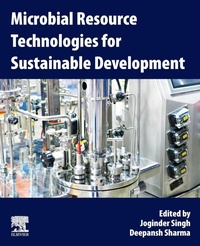
Microbial Resource Technologies for Sustainable Development
Published on 24. June 2022
Book
Paperback/Softback
492 pages
978-0-323-90590-9 (ISBN)
Description
Microbial Resource Technologies for Sustainable Development describes the production and uses of microbial cells and metabolites and reviews the microbial resource technologies associated with providing sustainable solutions options in future endeavors in managing microbial resources. The book includes the recent development and scientific demonstrations of microbial technologies in the relationship between microbes and the environment, focusing on its effective resource management to achieve agricultural and environmental sustainability. Topics covered in the book include recent applications and exploration of the development of Marine Microbial Technologies for marine resources, soil microbes as biopolymers for enhancing mechanical properties of soil, and more.
Other topics discussed include rhizosphere microbiome for enhancement of the cereal crops, endophytic fungal communities in crops grown under different farming systems, microbiota of termite for lignocellulose breakdown, microbial consortium technologies to produce biomethane from waste effluents, microbial technologies for sustainable food additives production, biological synthesis of the nanoparticles, fungal cellulases, and efficient biofuel and acetic acid production using waste residues with an emphasis on the commercial exploitation of such microbial technologies.
Other topics discussed include rhizosphere microbiome for enhancement of the cereal crops, endophytic fungal communities in crops grown under different farming systems, microbiota of termite for lignocellulose breakdown, microbial consortium technologies to produce biomethane from waste effluents, microbial technologies for sustainable food additives production, biological synthesis of the nanoparticles, fungal cellulases, and efficient biofuel and acetic acid production using waste residues with an emphasis on the commercial exploitation of such microbial technologies.
More details
Language
English
Place of publication
Philadelphia
United States
Target group
Professional and scholarly
Product notice
Paperback (trade)
Dimensions
Height: 235 mm
Width: 191 mm
Thickness: 25 mm
Weight
839 gr
ISBN-13
978-0-323-90590-9 (9780323905909)
Copyright in bibliographic data and cover images is held by Nielsen Book Services Limited or by the publishers or by their respective licensors: all rights reserved.
Schweitzer Classification
Other editions
Additional editions
Joginder Singh Panwar | Deepansh Sharma
Microbial Resource Technologies for Sustainable Development
E-Book
06/2022
Elsevier
€200.00
Available for download
Persons
Joginder Singh Panwar is a Professor in the Department of Botany at Nagaland University, Lumami, India. His previous appointments include a professorship at the School of Bioengineering and Biosciences, Lovely Professional University, and a Young Scientist position at the Microbial Biotechnology and Biofertilizer Laboratory at Jai Narain Vyas University, funded by the Department of Science and Technology, Government of India. He is an active member of several scientific societies, including the Association of Microbiologists of India and the European Federation of Biotechnology. Dr. Singh has an extensive publication record across books and journals, and he also regularly serves as a reviewer for numerous prestigious international journals He has published extensively with Elsevier and Springer both in journals and books. He serves as a reviewer for many prestigious journals. He actively participates and presents at national and international scientific conferences and events.
Dr. Deepansh Sharma is presently working as assistant professor at the Amity Institute of Microbial Technology, Amity University, Rajasthan, India. He joined the world of academia in 2015 at Lovely Professional University, Phagwara, India, after receiving his doctoral degree in microbiology with a specialization in biosurfactants research. He is M. Phil (Microbiology) from CCS University, Meerut, and M.Sc. (Microbiology) from Gurukula Kangri University, Haridwar, India, with ICAR-ASRB-NET. He has over eight years of research and teaching experience. He has successfully completed several recent food fermentation industrial consultancy projects. Dr. Sharma is a recipient of the DAAD (Germany) short-term fellowship for doctoral studies in Karlsruhe Institute of Technology, Karlsruhe, Germany. Dr. Sharma has published over 25 research papers and reviews in national and international journals and consortium proceedings along with 5 book chapters on various aspects of the microbial world. He is author of Biosurfactants of Lactic Acid Bacteria and Biosurfactants in Food (2016) published by Springer International Publishing. His research interests include biosurfactants, bacteriocins, and microbial food additives.
Dr. Deepansh Sharma is presently working as assistant professor at the Amity Institute of Microbial Technology, Amity University, Rajasthan, India. He joined the world of academia in 2015 at Lovely Professional University, Phagwara, India, after receiving his doctoral degree in microbiology with a specialization in biosurfactants research. He is M. Phil (Microbiology) from CCS University, Meerut, and M.Sc. (Microbiology) from Gurukula Kangri University, Haridwar, India, with ICAR-ASRB-NET. He has over eight years of research and teaching experience. He has successfully completed several recent food fermentation industrial consultancy projects. Dr. Sharma is a recipient of the DAAD (Germany) short-term fellowship for doctoral studies in Karlsruhe Institute of Technology, Karlsruhe, Germany. Dr. Sharma has published over 25 research papers and reviews in national and international journals and consortium proceedings along with 5 book chapters on various aspects of the microbial world. He is author of Biosurfactants of Lactic Acid Bacteria and Biosurfactants in Food (2016) published by Springer International Publishing. His research interests include biosurfactants, bacteriocins, and microbial food additives.
Content
1. Survival and thriving behaviour of bacteria in microbial jungle
2. Microbial Consortium: A New Approach in Sustainable Development
3. Soil microbes as biopolymers for enhancing mechanical properties of soil: A sustainable approach
4. The structure, function and utility of rhizosphere microbiome of cereal crops
5. Importance of diverse soil microbial community in crop rotation for sustainable agriculture
6. Impact of pertinent endophytic fungal communities and their secondary metabolites on crops
7. Microbial technologies for acetic acid production from fruit waste
8. Metabolic interaction network of gut microbiota in Termite for lignocellulose breakdown
9. Biomethane: A sustainable bio-energy source from potential waste effluents
10. Microbial symbiotic implications in exploring novel antibiotics
11. Advancement in the use of microbes as primers for monitoring water quality
12. Microbial resources for efficient lignocellulosic conversion to ethanol production
13. Biological synthesis of metal nanoparticles by microorganism: A sustainable approach
14. Microbial technologies for sustainable food additives production
15. Bioactive peptides production using microbial resources
16. Soil Health Sustenance through Varied Fertility Management Approaches for Increasing Microbial Load under Temperate Climatic Conditions: A Practical Approach
17. Microbial biodesulfurization: A sustainable technology for biorefining of fossil fuels
18. Fungal cellulases: An overview and applications
19. Hybrid nano and microbial consortium technologies to harvest biofuel (biomethane) from organic and agri waste
20. Electrochemically active bacteria as platform technology in microbial electrochemical system (MES)
21. Microbes Enhancing Assimilation and Utilization of Minerals Promoting Plant Health
22. Chromium removal by microorganisms as sustainable a water treatment strategy
23. Improvement of ecological sustainability of in situ bioremediation through coordinated approaches
2. Microbial Consortium: A New Approach in Sustainable Development
3. Soil microbes as biopolymers for enhancing mechanical properties of soil: A sustainable approach
4. The structure, function and utility of rhizosphere microbiome of cereal crops
5. Importance of diverse soil microbial community in crop rotation for sustainable agriculture
6. Impact of pertinent endophytic fungal communities and their secondary metabolites on crops
7. Microbial technologies for acetic acid production from fruit waste
8. Metabolic interaction network of gut microbiota in Termite for lignocellulose breakdown
9. Biomethane: A sustainable bio-energy source from potential waste effluents
10. Microbial symbiotic implications in exploring novel antibiotics
11. Advancement in the use of microbes as primers for monitoring water quality
12. Microbial resources for efficient lignocellulosic conversion to ethanol production
13. Biological synthesis of metal nanoparticles by microorganism: A sustainable approach
14. Microbial technologies for sustainable food additives production
15. Bioactive peptides production using microbial resources
16. Soil Health Sustenance through Varied Fertility Management Approaches for Increasing Microbial Load under Temperate Climatic Conditions: A Practical Approach
17. Microbial biodesulfurization: A sustainable technology for biorefining of fossil fuels
18. Fungal cellulases: An overview and applications
19. Hybrid nano and microbial consortium technologies to harvest biofuel (biomethane) from organic and agri waste
20. Electrochemically active bacteria as platform technology in microbial electrochemical system (MES)
21. Microbes Enhancing Assimilation and Utilization of Minerals Promoting Plant Health
22. Chromium removal by microorganisms as sustainable a water treatment strategy
23. Improvement of ecological sustainability of in situ bioremediation through coordinated approaches