

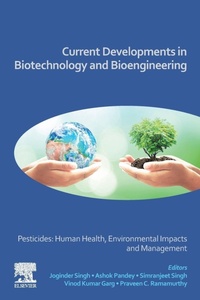
Current Developments in Biotechnology and Bioengineering
Pesticides: Human Health, Environmental Impacts and Management
Published on 14. March 2023
Book
Paperback/Softback
530 pages
978-0-323-91900-5 (ISBN)
Description
Pesticides: Human Health, Environmental Impacts and Management considers microbial degradation and environmental management of pesticides, covers microbial options as an alternative to chemical pesticides, explores plant-microbe interactions for reduced applications of pesticides in the agricultural fields, discusses the enhancement of microbial pesticides degradation, explains function of engineered microorganisms for effective pesticide degradation, describes potential indigenous/effective microbes for effective pesticide degradation processes, and presents research on microbes for sustainable agricultural and environmental practices.
More details
Language
English
Place of publication
Philadelphia
United States
Target group
Professional and scholarly
Product notice
Paperback (trade)
Dimensions
Height: 229 mm
Width: 152 mm
Thickness: 27 mm
Weight
705 gr
ISBN-13
978-0-323-91900-5 (9780323919005)
Copyright in bibliographic data and cover images is held by Nielsen Book Services Limited or by the publishers or by their respective licensors: all rights reserved.
Schweitzer Classification
Other editions
Additional editions
Joginder Singh Panwar | Ashok Pandey | Simranjeet Singh
Current Developments in Biotechnology and Bioengineering
Pesticides: Human Health, Environmental Impacts and Management
E-Book
03/2023
Elsevier
€220.00
Available for download
Persons
Joginder Singh Panwar is a Professor in the Department of Botany at Nagaland University, Lumami, India. His previous appointments include a professorship at the School of Bioengineering and Biosciences, Lovely Professional University, and a Young Scientist position at the Microbial Biotechnology and Biofertilizer Laboratory at Jai Narain Vyas University, funded by the Department of Science and Technology, Government of India. He is an active member of several scientific societies, including the Association of Microbiologists of India and the European Federation of Biotechnology. Dr. Singh has an extensive publication record across books and journals, and he also regularly serves as a reviewer for numerous prestigious international journals He has published extensively with Elsevier and Springer both in journals and books. He serves as a reviewer for many prestigious journals. He actively participates and presents at national and international scientific conferences and events.
Prof. Ashok Pandey is currently Executive Director, Centre for Energy and Environmental Sustainability-India, Lucknow. His major research and technological development interests are industrial and environmental biotechnology and energy biosciences, focusing on biomass to biofuels and chemicals, waste to wealth and energy, etc.
Dr. Simranjeet Singh is presently working as post-doctoral fellow in Interdisciplinary Centre for Water Research, Indian Institute of Science, Bangalore. Previously he was working as Project Scientist at Punjab Biotechnology Incubators, Mohali (India). Dr. Singh has been conferred the "Young Scientist? award by the IOSRD in 2018. He has more than 65 research and review articles and 33 book chapters. He is an active member of various scientific societies and organizations including, Asian Chemical society, Society for the Green Environment and editorial board member of Mini Review in Organic chemistry. Prof. Vinod Kumar Garg is presently working as Professor at the Department of Environmental Science and Technology, Central University of Punjab, Bathinda, Punjab, India. Previously, he has worked at Guru Jambheshwar University of Science and Technology and CCS Haryana Agricultural University, Hisar, India, in different capacities. He is an active member of various scientific societies and organizations including, Biotech Research Society of India, Indian Nuclear Society etc. He was elected Fellow of Biotech Research Society of India in 2011. He has completed several research projects funded by various funding agencies. He was awarded "Thomson Reuters Research Excellence - India Citation Awards 2012?.
Prof. Praveen C Ramamurthy received M. Sc. in Polymer science in 1995 from University of Mysore and PhD degree from Clemson University in the year 2004. He worked as a R&D Engineer in Therm-O-Disc, Mansfield, OH, USA and Research Scientist in Hoku Scientific, Honolulu, Hawaii, USA. He joined IISc in the year 2007 and currently a Professor in the Department of Materials Engineering. He is also Associate faculty in Centre for Nano Science and Engineering and Inter Disciplinary Centre for Energy Research. His current research focuses on organic electronics including synthesis of conjugated polymer for the application in photovoltaics, and sensors and device package application with focus on stability and large area device fabrication. He has over 190 peer reviewed papers published and 18 patents to his credit.
Prof. Ashok Pandey is currently Executive Director, Centre for Energy and Environmental Sustainability-India, Lucknow. His major research and technological development interests are industrial and environmental biotechnology and energy biosciences, focusing on biomass to biofuels and chemicals, waste to wealth and energy, etc.
Dr. Simranjeet Singh is presently working as post-doctoral fellow in Interdisciplinary Centre for Water Research, Indian Institute of Science, Bangalore. Previously he was working as Project Scientist at Punjab Biotechnology Incubators, Mohali (India). Dr. Singh has been conferred the "Young Scientist? award by the IOSRD in 2018. He has more than 65 research and review articles and 33 book chapters. He is an active member of various scientific societies and organizations including, Asian Chemical society, Society for the Green Environment and editorial board member of Mini Review in Organic chemistry. Prof. Vinod Kumar Garg is presently working as Professor at the Department of Environmental Science and Technology, Central University of Punjab, Bathinda, Punjab, India. Previously, he has worked at Guru Jambheshwar University of Science and Technology and CCS Haryana Agricultural University, Hisar, India, in different capacities. He is an active member of various scientific societies and organizations including, Biotech Research Society of India, Indian Nuclear Society etc. He was elected Fellow of Biotech Research Society of India in 2011. He has completed several research projects funded by various funding agencies. He was awarded "Thomson Reuters Research Excellence - India Citation Awards 2012?.
Prof. Praveen C Ramamurthy received M. Sc. in Polymer science in 1995 from University of Mysore and PhD degree from Clemson University in the year 2004. He worked as a R&D Engineer in Therm-O-Disc, Mansfield, OH, USA and Research Scientist in Hoku Scientific, Honolulu, Hawaii, USA. He joined IISc in the year 2007 and currently a Professor in the Department of Materials Engineering. He is also Associate faculty in Centre for Nano Science and Engineering and Inter Disciplinary Centre for Energy Research. His current research focuses on organic electronics including synthesis of conjugated polymer for the application in photovoltaics, and sensors and device package application with focus on stability and large area device fabrication. He has over 190 peer reviewed papers published and 18 patents to his credit.
Editor
Nagaland University, india
Executive Director, Centre for Energy and Environmental Sustainability-India, Lucknow, India
Post-doctoral fellow, Interdisciplinary Centre for Water Research, Indian Institute of Science, Bangalore, India
Professor, Department of Environmental Science and Technology, Central University of Punjab, India
Professor, Department of Materials Engineering, Indian Institute of Science, Bangalore, India
Content
1.Impact and prospects of pesticides on human and Environment health
2.Pesticide pollution in freshwater and its impact on community health
3.Pesticide Pollution in Freshwater: Occurrence, Distribution, Impact, and Remediation
4.Persistence of pesticides residues with chemical food preservatives in fruits and vegetables
5.Dietary intake of pesticide residues through vegetables
6.Dietary intake of pesticide residues through fruits
7.Genome editing of microbes for degradation of pesticides
8.Evolution of biodegradation pathways for efficient microbial based management of pesticides
9.Plant hormones for the regulation of pesticide metabolism
10.Depleted mineralization of pesticides on soil microbial diversity
11.Health impacts of pesticides farm applicators
12.Impact of pesticides on natural populations of insects in the agricultural field
13.Microbial enzymes for biodegradation and detoxification of pesticides
14.Role of cloning and modification of genes pesticide decomposition
15.Influence of subsoil microbial community across different depths on the biodegradation of pesticides
16.Use of pesticide and mechanism of resistance development in plants
17.Impact of pesticides on microbial diversity
18.Removal pesticides in wastewater by Fenton systems: Enhanced degradation by chelating agents and solar irradiation
19.Environmental Impacts of Synthetic and Bio Fungicides
2.Pesticide pollution in freshwater and its impact on community health
3.Pesticide Pollution in Freshwater: Occurrence, Distribution, Impact, and Remediation
4.Persistence of pesticides residues with chemical food preservatives in fruits and vegetables
5.Dietary intake of pesticide residues through vegetables
6.Dietary intake of pesticide residues through fruits
7.Genome editing of microbes for degradation of pesticides
8.Evolution of biodegradation pathways for efficient microbial based management of pesticides
9.Plant hormones for the regulation of pesticide metabolism
10.Depleted mineralization of pesticides on soil microbial diversity
11.Health impacts of pesticides farm applicators
12.Impact of pesticides on natural populations of insects in the agricultural field
13.Microbial enzymes for biodegradation and detoxification of pesticides
14.Role of cloning and modification of genes pesticide decomposition
15.Influence of subsoil microbial community across different depths on the biodegradation of pesticides
16.Use of pesticide and mechanism of resistance development in plants
17.Impact of pesticides on microbial diversity
18.Removal pesticides in wastewater by Fenton systems: Enhanced degradation by chelating agents and solar irradiation
19.Environmental Impacts of Synthetic and Bio Fungicides