

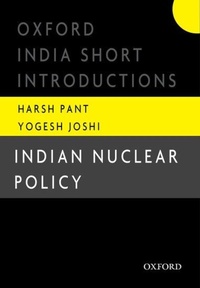
Indian Nuclear Policy
Oxford India Short Introductions
Published on 4. October 2018
Book
Paperback/Softback
218 pages
978-0-19-948902-2 (ISBN)
Description
India's first Prime, Minister Jawaharlal Nehru, laid the foundations of an elaborate atomic energy program in 1948, just a year after India's independence. Yet, it took Indian decision-makers more than 50 years to declare the country a nuclear-weapon state in May 1998. Once India crossed the nuclear rubicon, it has managed to transform itself into a major nuclear power. This short introduction provides a clear and succinct account of the evolution of Indian nuclear policy over seven decades since Independence. Situating India's nuclear behaviour in its quest for global status, demands of national security, vagaries of domestic politics and the idiosyncrasies of the individuals who led its nuclear program, it explains how India's engagement with the atom is unique in international nuclear history and politics.
Utilizing the recently declassified archival documents and oral history interviews, the five chapters follow a linear historical narrative explaining how India's nuclear pioneers established the nuclear program after independence; India's development of a 'nuclear weapons option after the Chinese nuclear test of 1964; its nuclear refrain after the 1974 PNE; its pathways to nuclearisation in the decade of 1980s and 1990s; and finally its rise as a nuclear weapons power after the 1998 nuclear test.
Utilizing the recently declassified archival documents and oral history interviews, the five chapters follow a linear historical narrative explaining how India's nuclear pioneers established the nuclear program after independence; India's development of a 'nuclear weapons option after the Chinese nuclear test of 1964; its nuclear refrain after the 1974 PNE; its pathways to nuclearisation in the decade of 1980s and 1990s; and finally its rise as a nuclear weapons power after the 1998 nuclear test.
Reviews / Votes
Indian Nuclear Policy is an interesting historical presentation of India's debut on the world stage in the atomic age. * Ivan Ware, H-Net *More details
Series
Language
English
Place of publication
New Delhi
India
Target group
Professional and scholarly
Product notice
Paperback (trade)
Unsewn / adhesive bound
Dimensions
Height: 183 mm
Width: 124 mm
Thickness: 15 mm
Weight
181 gr
ISBN-13
978-0-19-948902-2 (9780199489022)
Copyright in bibliographic data and cover images is held by Nielsen Book Services Limited or by the publishers or by their respective licensors: all rights reserved.
Schweitzer Classification
Other editions
Additional editions
Harsh V. Pant | Yogesh Joshi
Indian Nuclear Policy
E-Book
07/2018
1st Edition
OUP
€15.83
Available for download
Persons
Harsh V Pant is distinguished fellow and head of strategic studies at Observer Research Foundation, New Delhi. He holds a joint appointment as professor of International Relations in Defence Studies Department and the India Institute at King's College London. He is also a non-resident fellow with the Wadhwani Chair in US-India Policy Studies at the Center for Strategic and International Studies, Washington, DC. His current research is focused on Asian security issues. His most recent books include Indian Foreign Policy: An Overview (Manchester University Press, and OrientBlack Swan), Handbook of Indian Defence Policy (Routledge), and The US-India Nuclear Pact: Policy, Process and Great Power Politics (Oxford University Press). Pant is a columnist for the Diplomat and writes regularly for various media outlets including the Japan Times, the Wall Street Journal, the National (UAE), and the Indian Express.
Yogesh Joshi is a Stanton Nuclear Security Fellow at Center for International Security and Cooperation (CISAC), Stanford University. He has a PhD in International Politics from Jawaharlal Nehru University specializing in Indian foreign and security policy. He has held fellowships at George Washington University, King's College London and Carnegie Endowment for International Peace, Washington DC. He has co-authored two books: The US 'Pivot' and Indian Foreign Policy: Asia's Emerging Balance of Power (Palgrave Macmillan, 2015) and India and Nuclear Asia: Forces, Doctrines and Dangers (Georgetown University Press, Forthcoming 2018). At Stanford, he is finishing a book manuscript on the history of India's nuclear submarine program.
Yogesh Joshi is a Stanton Nuclear Security Fellow at Center for International Security and Cooperation (CISAC), Stanford University. He has a PhD in International Politics from Jawaharlal Nehru University specializing in Indian foreign and security policy. He has held fellowships at George Washington University, King's College London and Carnegie Endowment for International Peace, Washington DC. He has co-authored two books: The US 'Pivot' and Indian Foreign Policy: Asia's Emerging Balance of Power (Palgrave Macmillan, 2015) and India and Nuclear Asia: Forces, Doctrines and Dangers (Georgetown University Press, Forthcoming 2018). At Stanford, he is finishing a book manuscript on the history of India's nuclear submarine program.
Author
ProfessorProfessor, Defence Studies Department and the India Institute, King's College, London
Nuclear Security Post-Doctoral FellowNuclear Security Post-Doctoral Fellow, Center for International Security and Cooperation (CISAC), Freeman Spogli Institute for International Studies (FSI), Stanford University
Content
Preface
Acknowledgements
Introduction
1 The Promise of the Atomic Age
2 Perils of a Nuclear Neighbour
3 The Failed Policy of Nuclear Refrain
4 Pathway to a Nuclear Weapon State
5 A Major Nuclear Power
References
Index
About the Authors
Acknowledgements
Introduction
1 The Promise of the Atomic Age
2 Perils of a Nuclear Neighbour
3 The Failed Policy of Nuclear Refrain
4 Pathway to a Nuclear Weapon State
5 A Major Nuclear Power
References
Index
About the Authors