

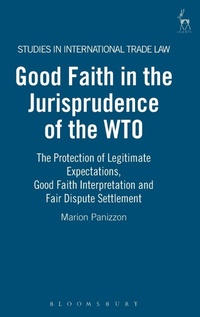
Good Faith in the Jurisprudence of the WTO
The Protection of Legitimate Expectations, Good Faith Interpretation and Fair Dispute Settlement
Published on 19. October 2006
Book
Hardback
434 pages
978-1-84113-620-2 (ISBN)
Description
What does the concept of good faith express? This book is the first to discuss what good faith means in international trade law. As a reference guide for scholars and practitioners it analyses the case law of WTO dispute settlement practice. The book describes how, why and when the concept of good faith links the WTO Agreements with other public international norms. The concept of good faith appears frequently in treaties and customary rules, but is most often considered a general principle of law. WTO law uses the corrolaries of pacta sunt servanda, the prohibition of abus de droit and the protection of legitimate expectation alongside the principle of good faith. An analysis of GATT 1947 and WTO case law reveals that the function of good faith varies. The Panel reports and the Appellate Body decisions make different use of it. The Appellate Body is prepared to apply the principle to WTO provisions only, while Panels use it more freely and substantively; that is, they apply good faith to fill lacunae in any of the WTO covered agreements.
Also, adjudicators use the principle differently, depending on whether it relates to the agreements covered by the WTO or the procedural law of WTO dispute settlement. As it applies to the former, good faith is used to strike a balance between, on the one hand, the obligation to liberalise trade, and on the other hand, the right to invoke an exception to trade liberalisation for the protection of the environment, culture, public morals, human life or health. In this way, good faith safeguards the gains of multilateral trade liberalisation against unlawful interests such as disguised protectionism. The book also introduces the novel field of WTO procedural law governing trade dispute litigation. In the Dispute Settlement Understanding (DSU), good faith appears in the standard of review, rules of evidence and fact-finding, standing, duty of prior consultation, right of establishment of a panel, ex officio investigations, withdrawal of notices of appeal, and the raising of objections. In all these areas it ensures that the rules of dispute resolution are not abused.
The Appellate Body has even gone so far as to derive a new standard from the principle of good faith that demands that disputes are settled fairly, promptly and effectively. Insights into good faith in WTO law are not only important for trade law professionals. Current applications and future operations of the principle are likely to be of strategic value for answering the increasingly pressing question of how WTO law and other international agreements ought to be reconciled.
Also, adjudicators use the principle differently, depending on whether it relates to the agreements covered by the WTO or the procedural law of WTO dispute settlement. As it applies to the former, good faith is used to strike a balance between, on the one hand, the obligation to liberalise trade, and on the other hand, the right to invoke an exception to trade liberalisation for the protection of the environment, culture, public morals, human life or health. In this way, good faith safeguards the gains of multilateral trade liberalisation against unlawful interests such as disguised protectionism. The book also introduces the novel field of WTO procedural law governing trade dispute litigation. In the Dispute Settlement Understanding (DSU), good faith appears in the standard of review, rules of evidence and fact-finding, standing, duty of prior consultation, right of establishment of a panel, ex officio investigations, withdrawal of notices of appeal, and the raising of objections. In all these areas it ensures that the rules of dispute resolution are not abused.
The Appellate Body has even gone so far as to derive a new standard from the principle of good faith that demands that disputes are settled fairly, promptly and effectively. Insights into good faith in WTO law are not only important for trade law professionals. Current applications and future operations of the principle are likely to be of strategic value for answering the increasingly pressing question of how WTO law and other international agreements ought to be reconciled.
Reviews / Votes
The question of the role and interpretation of the principle of good faith has not been comprehensively addressed so far. For this reason, Panizzon's analysis is particularly valuable. Panizzon provides a comprehensive analysis of the application of the principle of good faith by the judicial WTO bodies. As the very detailed bibliography ... shows, the author has consulted a variety of sources on interpretation methods, not only referring to international law but also to dispute settlement in general and to WTO law in particular. Panizzon's detailed examination of the role, concepts and interpretation of good faith within the legal framework of the WTO is an interesting and absolutely recommendable contribution to the analyses on the interpretation of WTO law in general and to the discussion on the interpretation of international law principles in that context in particular. Silke Steiner Austrian Review of International European Law Volume 12, 2010More details
Series
Language
English
Place of publication
Oxford
United Kingdom
Publishing group
Bloomsbury Publishing PLC
Target group
College/higher education
Professional and scholarly
Dimensions
Height: 240 mm
Width: 161 mm
Thickness: 28 mm
Weight
816 gr
ISBN-13
978-1-84113-620-2 (9781841136202)
Copyright in bibliographic data and cover images is held by Nielsen Book Services Limited or by the publishers or by their respective licensors: all rights reserved.
Schweitzer Classification
Other editions
Additional editions

Marion Panizzon
Good Faith in the Jurisprudence of the WTO
The Protection of Legitimate Expectations, Good Faith Interpretation and Fair Dispute Settlement
E-Book
10/2006
1st Edition
Hart Publishing
€155.99
Available for download
Person
Marion Panizzon Dr iur (Bern) LL.M. (Duke) is Senior Research Fellow in International Economic Law at the World Trade Institute of the Universities of Bern, Neuchatel and Fribourg. She is a former fellow of Georgetown University's Institute of International Economic Law.
Content
1 Introduction
2 Concepts and Contents of Good Faith in International Law
3 Good Faith and its Corrolaries in the Law of the WTO Agreements
4 The Normativity of Good Faith in the WTO Legal System
5 Scholarly Views and Judicial Arguments on the Functions of WTO Good Faith
6 Protection of Legitimate Expectations as GATT-specific Good Faith
7 Good Faith Interpretation of the WTO Agreements
8 Good Faith Non-interpretation by the Appellate Body
9 Towards a WTO-specific Good Faith Interpretation?
10 Good Faith Rules and Procedures of WTO Dispute Settlement
11 The Good Faith Standard of Factual Review
12 Legitimate Expectations as to the Precedential Value of Dispute Settlement Reports
13 Conclusions
2 Concepts and Contents of Good Faith in International Law
3 Good Faith and its Corrolaries in the Law of the WTO Agreements
4 The Normativity of Good Faith in the WTO Legal System
5 Scholarly Views and Judicial Arguments on the Functions of WTO Good Faith
6 Protection of Legitimate Expectations as GATT-specific Good Faith
7 Good Faith Interpretation of the WTO Agreements
8 Good Faith Non-interpretation by the Appellate Body
9 Towards a WTO-specific Good Faith Interpretation?
10 Good Faith Rules and Procedures of WTO Dispute Settlement
11 The Good Faith Standard of Factual Review
12 Legitimate Expectations as to the Precedential Value of Dispute Settlement Reports
13 Conclusions