

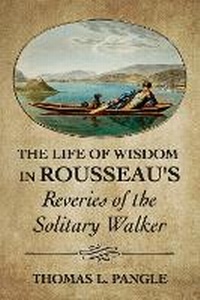
The Life of Wisdom in Rousseau's "Reveries of the Solitary Walker"
Published on 15. April 2023
Book
Hardback
246 pages
978-1-5017-6922-1 (ISBN)
Description
The Life of Wisdom in Rousseau's "Reveries of the Solitary Walker" is the first complete exegesis and interpretation of Rousseau's final and culminating work, showing its full philosophic and moral teaching. The Reveries has been celebrated as a work of literature that is an acknowledged acme of French prose writing. Thomas L. Pangle argues that this aesthetic appreciation necessitates an in-depth interpretation of the writing's complex and multileveled intended teaching about the normatively best way of life-and how essential this is for a work that was initially bewildering.
Rousseau stands out among modern political philosophers in that he restored, to political philosophy, what Socrates and his students (from Plato and Xenophon through Aristotle and the Stoics and Cicero) had made central-and that the previous modern, Enlightenment philosophers had eclipsed: the study of the life and soul of the exemplary, independent sage, as possessor of "human wisdom." Rousseau made this again the supreme theme and source of norms for political philosophy and for humanity's moral as well as civic existence.
In his analysis of The Reveries, Pangle uncovers Rousseau's most profound exploration and articulation of his own life, personality, soul, and thought as "the man of nature enlightened by reason." He describes, in Rousseau's final work, the fullest embodiment of the experiential wisdom from which flows and to which points Rousseau's political and moral philosophy, his theology, and his musical and literary art.
Rousseau stands out among modern political philosophers in that he restored, to political philosophy, what Socrates and his students (from Plato and Xenophon through Aristotle and the Stoics and Cicero) had made central-and that the previous modern, Enlightenment philosophers had eclipsed: the study of the life and soul of the exemplary, independent sage, as possessor of "human wisdom." Rousseau made this again the supreme theme and source of norms for political philosophy and for humanity's moral as well as civic existence.
In his analysis of The Reveries, Pangle uncovers Rousseau's most profound exploration and articulation of his own life, personality, soul, and thought as "the man of nature enlightened by reason." He describes, in Rousseau's final work, the fullest embodiment of the experiential wisdom from which flows and to which points Rousseau's political and moral philosophy, his theology, and his musical and literary art.
More details
Language
English
Place of publication
Ithaca
United States
Product notice
Paper over boards
Dimensions
Height: 229 mm
Width: 152 mm
Thickness: 24 mm
Weight
907 gr
ISBN-13
978-1-5017-6922-1 (9781501769221)
Copyright in bibliographic data and cover images is held by Nielsen Book Services Limited or by the publishers or by their respective licensors: all rights reserved.
Schweitzer Classification
Other editions
Additional editions
Thomas L. Pangle
The Life of Wisdom in Rousseau's "Reveries of the Solitary Walker"
E-Book
04/2023
Cornell University Press
€23.49
Available for download
Person
Thomas L. Pangle is the Joe R. Long Chair in Democratic Studies in the Department of Government at the University of Texas at Austin, Codirector of the Thomas Jefferson Center for the Study of Core Texts and Ideas, and a Lifetime Fellow of the Royal Society of Canada.
Content
Introduction
1. "First Walk"-Rousseau's Introduction
2. "Second Walk"-Nature, Mortality, God
3. "Third Walk"-A Spiritual-Religious Autobiography
4. "Fourth Walk"-The Virtue of Truthfulness
5. "Fifth Walk"-Happiness
6. "Sixth Walk"-Goodness versus Virtue
7. "Seventh Walk"-Botany as Consuming "Amusement"
8. "8"-Renewed Self-exploration
9. "9" and "10"-The Solitary Walker's "Truly Loving Heart"
1. "First Walk"-Rousseau's Introduction
2. "Second Walk"-Nature, Mortality, God
3. "Third Walk"-A Spiritual-Religious Autobiography
4. "Fourth Walk"-The Virtue of Truthfulness
5. "Fifth Walk"-Happiness
6. "Sixth Walk"-Goodness versus Virtue
7. "Seventh Walk"-Botany as Consuming "Amusement"
8. "8"-Renewed Self-exploration
9. "9" and "10"-The Solitary Walker's "Truly Loving Heart"