

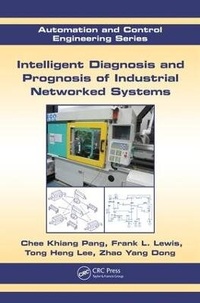
Intelligent Diagnosis and Prognosis of Industrial Networked Systems
Automation and Control Engineering Series
1st Edition
Published on 12. October 2020
Book
Paperback/Softback
332 pages
978-1-138-11450-0 (ISBN)
Description
In an era of intense competition where plant operating efficiencies must be maximized, downtime due to machinery failure has become more costly. To cut operating costs and increase revenues, industries have an urgent need to predict fault progression and remaining lifespan of industrial machines, processes, and systems. An engineer who mounts an acoustic sensor onto a spindle motor wants to know when the ball bearings will wear out without having to halt the ongoing milling processes. A scientist working on sensor networks wants to know which sensors are redundant and can be pruned off to save operational and computational overheads. These scenarios illustrate a need for new and unified perspectives in system analysis and design for engineering applications.
Intelligent Diagnosis and Prognosis of Industrial Networked Systems proposes linear mathematical tool sets that can be applied to realistic engineering systems. The book offers an overview of the fundamentals of vectors, matrices, and linear systems theory required for intelligent diagnosis and prognosis of industrial networked systems. Building on this theory, it then develops automated mathematical machineries and formal decision software tools for real-world applications.
The book includes portable tool sets for many industrial applications, including:
Forecasting machine tool wear in industrial cutting machines
Reduction of sensors and features for industrial fault detection and isolation (FDI)
Identification of critical resonant modes in mechatronic systems for system design of R&D
Probabilistic small-signal stability in large-scale interconnected power systems
Discrete event command and control for military applications
The book also proposes future directions for intelligent diagnosis and prognosis in energy-efficient manufacturing, life cycle assessment, and systems of systems architecture. Written in a concise and accessible style, it presents tools that are mathematically rigorous but not involved. Bridging academia, research, and industry, this reference supplies the know-how for engineers and managers making decisions about equipment maintenance, as well as researchers and students in the field.
Intelligent Diagnosis and Prognosis of Industrial Networked Systems proposes linear mathematical tool sets that can be applied to realistic engineering systems. The book offers an overview of the fundamentals of vectors, matrices, and linear systems theory required for intelligent diagnosis and prognosis of industrial networked systems. Building on this theory, it then develops automated mathematical machineries and formal decision software tools for real-world applications.
The book includes portable tool sets for many industrial applications, including:
Forecasting machine tool wear in industrial cutting machines
Reduction of sensors and features for industrial fault detection and isolation (FDI)
Identification of critical resonant modes in mechatronic systems for system design of R&D
Probabilistic small-signal stability in large-scale interconnected power systems
Discrete event command and control for military applications
The book also proposes future directions for intelligent diagnosis and prognosis in energy-efficient manufacturing, life cycle assessment, and systems of systems architecture. Written in a concise and accessible style, it presents tools that are mathematically rigorous but not involved. Bridging academia, research, and industry, this reference supplies the know-how for engineers and managers making decisions about equipment maintenance, as well as researchers and students in the field.
More details
Series
Language
English
Place of publication
London
United Kingdom
Publishing group
Taylor & Francis Ltd
Target group
College/higher education
Professional and scholarly
Illustrations
66 s/w Tabellen, 66 s/w Abbildungen
66 Tables, black and white; 66 Illustrations, black and white
Dimensions
Height: 234 mm
Width: 156 mm
ISBN-13
978-1-138-11450-0 (9781138114500)
Copyright in bibliographic data and cover images is held by Nielsen Book Services Limited or by the publishers or by their respective licensors: all rights reserved.
Schweitzer Classification
Other editions
Additional editions
Chee Khiang Pang | Frank L. Lewis | Tong Heng Lee
Intelligent Diagnosis and Prognosis of Industrial Networked Systems
E-Book
07/2017
CRC Press
€19.49
Available for download
Chee Khiang Pang | Frank L. Lewis | Tong Heng Lee
Intelligent Diagnosis and Prognosis of Industrial Networked Systems
E-Book
07/2017
CRC Press
€19.49
Available for download
Chee Khiang Pang | Frank L. Lewis | Tong Heng Lee
Intelligent Diagnosis and Prognosis of Industrial Networked Systems
Automation and Control Engineering Series
Book
03/2017
1st Edition
CRC Press
€25.50
Shipment within 10-20 days
Chee Khiang Pang | Frank L. Lewis | Tong Heng Lee
Intelligent Diagnosis and Prognosis of Industrial Networked Systems
Automation and Control Engineering Series
Book
06/2011
1st Edition
CRC Press
€49.50
Shipment within 15-20 days
Persons
Chee Khiang Pang is an Assistant Professor in the Department of Electrical and Computer Engineering at National University of Singapore.
Frank L. Lewis is a Professional Engineer and Head of Advanced Controls and Sensors Group at the Automation and Robotics Research Institute, The University of Texas at Arlington.
Tong Heng Lee is Professor and cluster Head for the Department of Electrical and Computer Engineering at National University of Singapore.
Zhao Yang Dong is Associate Professor for the Department of Electrical Engineering at The Hong Kong Polytechnic University.
Frank L. Lewis is a Professional Engineer and Head of Advanced Controls and Sensors Group at the Automation and Robotics Research Institute, The University of Texas at Arlington.
Tong Heng Lee is Professor and cluster Head for the Department of Electrical and Computer Engineering at National University of Singapore.
Zhao Yang Dong is Associate Professor for the Department of Electrical Engineering at The Hong Kong Polytechnic University.
Content
Introduction. Vectors, Matrices, and Linear Systems. Modal Parametric Identification (MPI). Dominant Feature Identification (DFI). Probabilistic Small Signal Stability Assessment. Discrete Event Command and Control. Future Challenges. References. Index.